
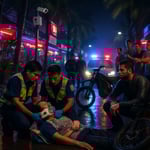
What began as a brief street confrontation in Ban Suan subdistrict, Mueang Chonburi, turned frighteningly real on the evening of January 4. At around 6:00pm a red motorcycle appears on CCTV, tails a teenager down a side lane and, within seconds, a verbal altercation escalates into gunfire. The victim, identified as Mr. Boonrit, was struck once in the left buttock; the bullet lodged inside his body and he was rushed to hospital after medics provided emergency aid at the scene.
The footage, replayed repeatedly by investigators, shows the suspect confronting the teen — shouting accusations and daring him to fight — before the victim attempts to run. The situation spiraled with astonishing speed: the assailant produced a handgun from his waistband, fired a single shot and sped away on his motorcycle. Neighbours and bystanders who later spoke to police described the clash as spontaneous rather than planned, a snap decision that had devastating consequences.
Local residents told officers that the injured teenager was known in the neighbourhood for sniffing glue, and suggested the incident may have been triggered by a perceived stare that neither party expected to become violent. Mr. Boonrit, speaking from his hospital bed while in pain, said he did not know the attacker and had no prior conflict with him. Doctors treating the teen report his condition as stable; they said the lodged bullet will be evaluated for removal once swelling decreases.
In a twist that brought the case full circle, the suspect surrendered the next morning. On January 5 he walked into Chonburi City Police Station and admitted to the shooting, according to Police Colonel Somchai Tiwongsa, the station superintendent. During questioning the man said he had been provoked and felt insulted by the teenager — his anger spiking into a reckless act. He confessed to carrying the firearm and to firing it during the confrontation.
Authorities have charged the suspect with attempted murder, illegal possession of a firearm and carrying a weapon in public without lawful reason. Police confirmed the gun was unlicensed. He remains in custody and will be taken to Chonburi Provincial Court after further questioning. Investigators are combing through CCTV footage and witness statements to complete their case file and build the prosecution’s evidence.
Chonburi police have used the incident as a blunt reminder about the dangers of firearms and impulsive violence in public spaces. “A minor spat can become a life-changing event when weapons are involved,” officers said, urging residents to report suspicious behaviour and to seek police help rather than settling disputes on the street. Patrols in the area will be increased in the coming days to reassure the community and prevent similar flashpoints.
For locals, the episode has been unsettling. What was once an ordinary side street is now the setting of a cautionary tale about anger, the accessibility of guns, and how quickly a moment of perceived disrespect can erupt into criminal violence. While the legal process moves forward, neighbours say they hope the case will spur conversations about de-escalation, youth outreach and community safety.
From an investigative perspective, the CCTV footage is central. The clip captured the rider on the red motorcycle, the shouted accusations, the attempted flight of the victim and the single fatal-sounding shot — a compact sequence that helped lead police to the suspect. Witness accounts and digital evidence will be cross-checked, giving prosecutors the best chance to present an accurate timeline of what happened that evening.
Meanwhile, Mr. Boonrit remains in hospital receiving care. Medical staff have stabilised his condition and are monitoring him until swelling subsides enough for surgeons to consider removing the lodged bullet. The physical recovery will extend beyond the scars; the psychological impact of being shot at close range is not easily measured and will likely be part of the wider recovery process.
As the case proceeds to court, it serves as a stark reminder for communities across Thailand: small incidents can spiral fast, and possessing a firearm — licensed or not — turns an argument into a potential criminal act. Police reiterated that carrying weapons without lawful reason will be met with serious charges, and they urged the public to prioritise de-escalation and to seek law enforcement assistance when conflicts arise.
Source: Bangkok Channel 7. Authorities continue to investigate the Jan. 4 shooting in Mueang Chonburi; the suspect is in custody and legal proceedings are pending.

















This whole thing is tragic but the kid was known for sniffing glue, so why did the shooter feel threatened enough to bring a gun to a street spat?
Because in some neighborhoods a stare or a remark is treated like a challenge; that doesn’t justify shooting, but context matters when you assess blame.
I get context, but carrying an unlicensed gun makes you the dangerous party, not the kid who may have been rude or high.
Yeah man weapons change the rules instantly — one snap decision and a life is ruined, even if someone was being annoying.
Seems like another example of easy access to guns creating needless harm; arrest and prosecution are the right steps but prevention matters more.
Prevention how though — more police, crackers on bikes? Or community programs for kids who sniff glue?
Both; tougher illegal-gun enforcement plus youth outreach and substance-help programs could stop the spiral before a gun appears.
From a public-health standpoint, addressing the root causes — poverty, addiction, lack of social services — is costlier but far more effective than short-term patrol increases.
Charging for attempted murder is correct if intent to kill can be shown, but the prosecution will struggle if they argue it was a heat-of-the-moment reaction.
Intent? He pulled a gun and fired at a fleeing teen — that screams intent to me, legal hair-splitting aside.
Legally speaking, intent can be proven by the act — drawing and firing a weapon at someone — though defense will claim panic or provocation.
Exactly, courts shouldn’t let provocation excuse lethal choices, especially when the kid was running away.
That CCTV is the smoking gun — video evidence makes the case cleaner, but I hope investigators preserve chain of custody.
Chain of custody and timestamp integrity are crucial; tampered footage could undermine a straightforward prosecution.
Totally — an edited clip or missing frames gives defense wiggle room, and the public loses trust in police work.
People always jump to moralizing about ‘kids these days’ when the real failure is systemic: why are youths sniffing glue and why are guns so accessible?
Because social safety nets are weak and there are markets for illegal weapons; simple as that, and blaming culture avoids fixing policy.
As a criminologist I see concurrence: supply-side measures to reduce illicit firearms plus demand-side interventions for youth substance abuse reduce such incidents long-term.
Glad someone with data said it. People need facts not moral panic.
I feel badly for the boy and his family; even a non-fatal wound can haunt a person forever and cost them jobs and schooling.
Why did the suspect surrender? Was it guilt, fear of a manhunt, or advice from someone telling him cops would find him anyway?
Likely practical reasons — with CCTV and witnesses he probably knew it was only a matter of time, and voluntarily surrendering can be tactically smart legally.
That makes sense; sometimes surrender gets you better treatment or shows remorse, which could affect bail or sentencing later.
This headline screams ‘sensational’, but the problem is everyday: tiny insults getting blown up because people carry weapons.
As a teacher I see kids escalate minor things without thinking; we need conflict-resolution training starting in schools so anger doesn’t lead to crime.
Exactly, teaching de-escalation could prevent a lot of these ‘snap decisions’ turning lethal.
Is there any accountability for the community that allowed a teenage glue user to slip through support services?
Health services are overstretched and stigmas prevent families from seeking help; the community does bear some responsibility but so does policy.
Then politicians should be shamed into funding local clinics and outreach instead of posturing about ‘tough on crime’ soundbites.
Police said they’ll increase patrols — that calms people short-term, but patrols don’t address why someone decided to carry an illegal firearm.
Increased patrols deter opportunistic crimes and reassure residents, but long-term reductions require intelligence-led crackdowns on arms channels.
So a two-pronged approach: immediate deterrence and strategic disruption. Hope they actually do both.
I think the shooter will get lighter sympathy because the victim ‘sniffed glue’; society still blames addicts more than the violent offender.
True, stigma distorts public empathy, but the law should stay impartial and punish violence regardless of the victim’s habits.
If only impartial law were reality; watch the comments next week and you’ll see victim-blaming ramp up.
What about CCTV privacy? Good that it caught the crime, but are we okay with cameras everywhere?
CCTV balances public safety and privacy; transparency, regulated retention, and strict access protocols minimize abuse risks while aiding prosecutions.
The police statement urging ‘report suspicious behaviour’ is hypocritical when budgets for proactive youth services are zero.
Yep, reactive policing is cheap politics; prevention costs money and yields benefits slowly, which isn’t sexy for officials seeking headlines.
I don’t like people getting shot, but I also worry about glorifying a kid who sniffed glue; both issues can be true without excusing the shooter.
You can recognize the kid’s problems and still say the shooter committed a violent, criminal act; nuance matters here.
Legally, this case will hinge on mens rea and the timeline in the footage; medically, the lodged bullet raises infection and nerve-risk concerns that could complicate recovery.
Thanks for the clinical perspective, that makes the human cost feel more real than just a news story.
The suspect turning himself in suggests some remorse, but remorse doesn’t erase the criminal act nor the trauma for the victim and community.
True, voluntary surrender can mitigate some sentencing factors but doesn’t eliminate culpability for attempted murder or illegal gun possession.
This is why people say ‘don’t carry a weapon’ — weapons turn every petty fight into tragedy and ruin lives.
But some argue carrying protects you; the data shows weapons more often escalate situations than protect, so the blanket ‘don’t carry’ advice is pragmatic.
Shot to the buttock can still damage muscle and nerves; hope the hospital follows up with physical therapy to prevent long-term disability.
Good point — medical aftercare is part of justice too, survivors need support beyond the courtroom.
Neighbors calling it ‘spontaneous’ doesn’t mean it wasn’t predictable; patterns of substance use and local tensions make these flashpoints inevitable without social work.
Exactly, calling it ‘random’ absolves systems that let young people fall through the cracks.
As an officer I appreciate residents sharing footage and tips; cooperation like that helps build airtight cases in crimes involving public CCTV.
Do you find people more willing to cooperate when the suspect surrenders, or does surrender sometimes reduce witness urgency?
Surrender can encourage cooperation because people see the suspect captured virtually, but we still need witnesses to testify about context and behavior.
When I was young we settled stuff with words, not guns; society has changed and not for the better.
Nostalgia ignores other problems of the past, but the point about fewer guns back then is fair — access has increased, with consequences.
Legal proceedings will be a public test of how seriously illegal firearms are prosecuted locally, and the outcome could set a precedent.
If prosecutors push for maximum penalties it might deter some, but without addressing supply channels offenders often replace one arrested actor with another.
The teen will probably get bullied more now; people already judge him for sniffing glue, and being a shooting victim might make things worse socially.
That victim-shaming is tragic; schools and social services must avoid excluding kids who need support after traumatic events.
CCTV solved it but at what cost to civil liberties; we need better oversight of surveillance deployment and data use.
Oversight and technical safeguards like encryption, limited retention, and audit logs can protect civil liberties while enabling crime solving.
I’m terrified to let my kids play outside after reading this; increased patrols help a little but community trust-building matters more.
Exactly, patrols are a band-aid; real safety comes from community programs, mentoring, and open lines to social services.
Someone pulled a gun over a stare — that’s insanity. Lock them up and make it expensive to own illegal weapons.
Harsh penalties can deter some, but without stopping illegal markets and fixing demand drivers, imprisonment alone won’t solve it.