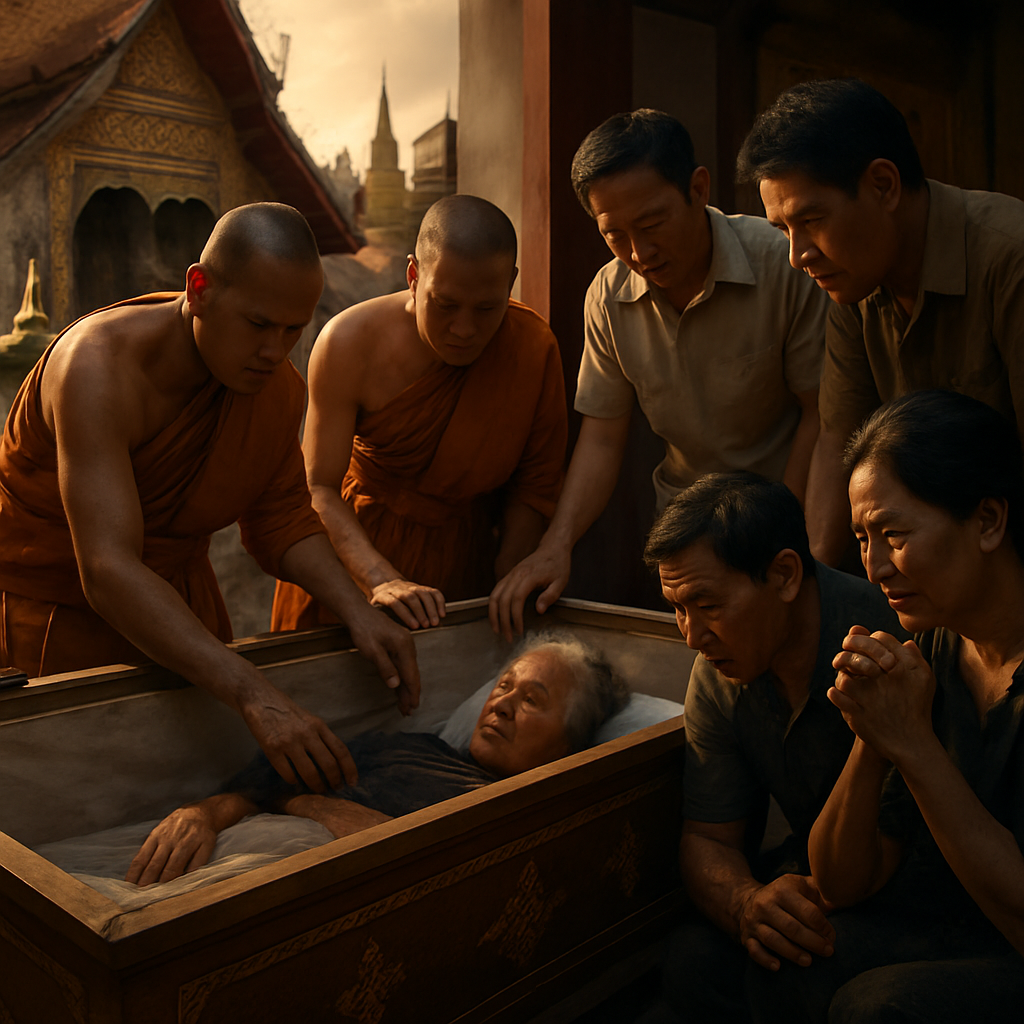
It reads like the sort of story that belongs in a supernatural thriller — a woman who stirred inside her coffin during funeral preparations, briefly breathing life into a stunned crowd — yet the real-life outcome was quieter and, sadly, more solemn. On December 14, 65-year-old Chonthirat Sakulku from Phitsanulok passed away peacefully at Bang Yai Hospital in Nonthaburi, officials confirmed. Wat Rat Prakhong Tham posted the news on Facebook on December 17, closing the extraordinary chapter that had captured national attention.
The sequence of events is as unusual as it is heartbreaking. Chonthirat, who had been stricken by a serious illness and presumed dead by her family, was brought to Wat Rat Prakhong Tham under the temple’s free funeral programme to await cremation. During last-minute preparations, temple staff heard and then saw unexpected movement from inside the coffin. A frantic check found Chonthirat still alive. She was rushed to nearby Bang Yai Hospital, where doctors determined that an episode of abnormally low blood sugar — hypoglycaemia — had caused her near-collapse and the misleading signs of death.
For a time, the story seemed poised to become a miraculous rescue tale: the woman who ‘woke up’ at her own funeral. But despite immediate treatment, Chonthirat’s condition deteriorated. Medical staff later recorded a urinary tract infection as the official cause on her death certificate. She died peacefully on December 14; the temple carried out funeral rites and the cremation under its free programme on December 16.
Wat Rat Prakhong Tham and Chonthirat’s relatives expressed deep gratitude to the temple’s abbot, staff and medical teams for their help during the ordeal. In its Facebook post, the temple also thanked members of the public for their sympathy and for the outpouring of concern that followed the initial, startling reports. For many who followed the story, the episode sparked emotions that ranged from relief to sadness, and plenty of reflection about how fragile and unpredictable life can be.
Photo via MGR Online
Stories of people presumed dead who later turn out to be alive — or at least were discovered to be alive — are rare, but not unheard of. Earlier this year, a grieving family in Phatthalung held what they believed to be a funeral for their teenage son after a motorcycle accident, only to learn later that he was alive and in medical care. In another case, rescuers in Chumphon helped a man who had been trapped in mud in a mangrove forest for seven days; initially a local fisherman mistook him for a lifeless body before realizing he was alive and urgently in need of help.
These incidents raise uncomfortable but important questions about how death is confirmed in emergency and community settings, especially where medical resources are stretched thin or where rapid assumptions are made. Hypoglycaemia, for example, can produce dramatic symptoms — fainting, shallow breathing, even unresponsiveness — that may be misread as signs of death by untrained observers. Similarly, trauma, severe dehydration, or prolonged exposure can mimic cadaveric features in a distressed person.
Beyond the medical and procedural issues, Chonthirat’s story is also a human one: a family navigating grief, hope and then grief again; temple staff acting swiftly amid chaos; doctors doing their best in a fraught situation. The gratitude expressed by relatives toward the temple’s abbot and staff underlines how communities often rally around families in times of crisis, providing both practical and emotional support.
For the public who followed the viral headlines — from the hair-raising moment at the coffin to the gentle closure of a cremation — the episode offered a sharp reminder that life is unpredictable, and that compassion and care matter whether a person is miraculously revived or passes away despite all efforts. In markets, temples and hospitals across Thailand, people will talk about Chonthirat’s story not merely as sensational news but as a prompt: to check, to double-check, and to treat each life with the dignity it deserves until the very end.
As officials and family members move forward from the incident, many will hope that lessons learned about rapid assessment and emergency response are captured and shared. Meanwhile, those who knew Chonthirat will remember her not for the moment that shocked a nation, but for the life she lived, the loved ones she left behind, and the community that gathered to help — even amid the most extraordinary circumstances.

















This story makes me angry and sad at the same time — how could no one check properly before the coffin was closed?
People make mistakes, but this seems like a serious procedural failure; hospitals and temples should coordinate better.
Medical confirmation can be tricky in low-resource settings; hypoglycaemia can mimic death, but basic checks like pulse and pupil reaction are easy and necessary.
Thanks for explaining, Dr. Park — I just want families to trust the system when they mourn.
Trust is earned, and after stories like this it’s understandably fragile.
Or are we being too quick to blame? The temple staff reacted when they heard movement and got her help.
True, the temple did right once they noticed, but prevention matters more than reaction.
This will be used by tabloids as ‘miracle wakes up at own funeral’, but the real issue is systemic gaps in emergency assessment.
Exactly — sensational headlines distract from learning what protocols failed and how to fix them.
Protocols won’t help if clinics are understaffed and families can’t afford transfers; we need funding for rural healthcare.
Agreed, public pressure after viral stories can sometimes push for budget changes, but it’s a slow process.
Also cultural practices affect how quickly families accept death — education on signs of life is essential.
I know people who live far from hospitals; community training for first responders could save lives and avoid funerals like this.
Community first aid is great, but someone still has to make the official death pronouncement; who trains them?
Local health volunteers can be trained to check vitals and call for help; it’s not rocket science.
What about religious beliefs? In some places families insist on quick rites and don’t wait for medical checks.
Medically, hypoglycaemia can be reversible if treated promptly, but if prolonged it causes organ damage and infections that complicate recovery.
So are you saying the initial revival moment was real but the body was too damaged later on?
Yes, transient recovery can occur; subsequent complications like infection or delayed organ failure can still lead to death.
Thanks for the clarity, Doctor. It helps stop the supernatural talk and focus on the clinical facts.
Terrible luck, but also a reminder to check blood sugar for elderly relatives with diabetes before making any assumptions.
Simple checks save lives, but we need public awareness campaigns so families know what to look for.
Why does it always take viral attention for authorities to explain what happened? People deserve transparency.
Because viral attention forces officials to respond quickly; otherwise many such cases go unreported.
Indeed, but that reactive model isn’t good enough; proactive reporting systems are needed.
This reads like folklore now — ‘the coffin who woke’ — but it’s really about poverty, healthcare gaps, and media frenzy.
Media often seeks clicks, not systemic solutions. Sensationalism helps nobody.
Exactly, and people forget the family who suffered twice: first with hope, then loss.
My heart goes out to the family; they were publicly exposed during raw grief and then had to endure the outcome.
Public sympathy can be invasive though; sometimes silence is what grieving families need.
True, but thoughtful support and privacy both matter — social media should throttle back sometimes.
Communities rally in public ways because temples are central to support systems here.
And the temple staff deserve credit for acting quickly and providing a dignified funeral service.
I worry about misinformation; some will say this proves reincarnation signs or miracles, which hurts rational policy debate.
Belief and policy are separate conversations; you can honor faith while fixing medical protocols.
What a strange final chapter; I keep thinking about the humiliation the family must have felt being viral overnight.
Humiliation or unwanted attention can compound grief; journalists should ask permission before amplifying families’ pain.
Temples offering free funeral programmes are lifesavers for poor families, but they also shoulder a lot of responsibility and tough decisions.
Yes, faith institutions fill gaps left by the state; we should support them with training and resources.
This case could be turned into a training module for both healthcare workers and temple staff about signs of life and infection control.
I volunteer for such training; interdisciplinary drills are effective and underused in many regions.
If we could get local NGOs involved, it might scale more quickly than waiting for government programs.
People forget how fragile life can be; one moment you’re gone in their eyes, the next you’re awake, and then gone again.
That emotional rollercoaster is cruel; we should make rituals that allow for uncertainty.
Are we sure about the cause on the death certificate? UTIs in elderly can be lethal but often complicate other conditions.
UTIs can trigger sepsis in older adults, especially after an episode of hypoglycaemia; both may be listed on a certificate if relevant.
The temple’s thanks on Facebook felt sincere, but social media statements should include facts to avoid rumor mills.
Factful updates would calm speculation, but they also risk exposing private medical details — a tough balance.
Right, privacy matters; summaries that keep dignity but correct false claims are ideal.
Sixth-grader answer: maybe the lady was sleeping and woke up, then got sick again. Adults complicate it too much.
That’s not wrong — sometimes the simplest explanation is best for kids to understand.
Insurance, hospital fees, and funeral costs drive rushed decisions; until that’s fixed, tragedies repeat.
Exactly — financial pressure is often the root cause of hasty rites and delayed care.
Can we stop calling it a miracle? It wasn’t magical, it was a window of life that medical care couldn’t ultimately save.
Language shapes perception; calling it a miracle erases the need for systems-level change.
Yes, we should honor the person not the sensational moment.
I fear this will lead to conspiracy theories too — that hospitals hide recovered patients or that temples stage things.
Conspiracies thrive on gaps in information; transparent, compassionate communication can limit that.
Public lessons: check vitals twice, keep a cooling period before burial, and train volunteers to spot reversible causes.
A recommended observation period and simple checklists could prevent misclassification of death in many cases.
Will any policy change happen because of this, or will we clap, comment, and forget in a week?
Change is possible if advocates push the story beyond social feeds into local health departments’ agendas.
Then someone needs to keep pushing — not just shock value, but sustained advocacy.
Also question the role of hospitals: did they discharge her as dead or was she pronounced at home? We need the timeline.
Timelines matter for accountability. Journalists should demand those details respectfully.
Final thought: let’s remember Chonthirat as a person, not as a headline stunt, and push for practical improvements in care.
Yes, dignity and concrete policy should be the legacy of this sad story.
Thanks — I hope the family finds peace and that communities learn from this.