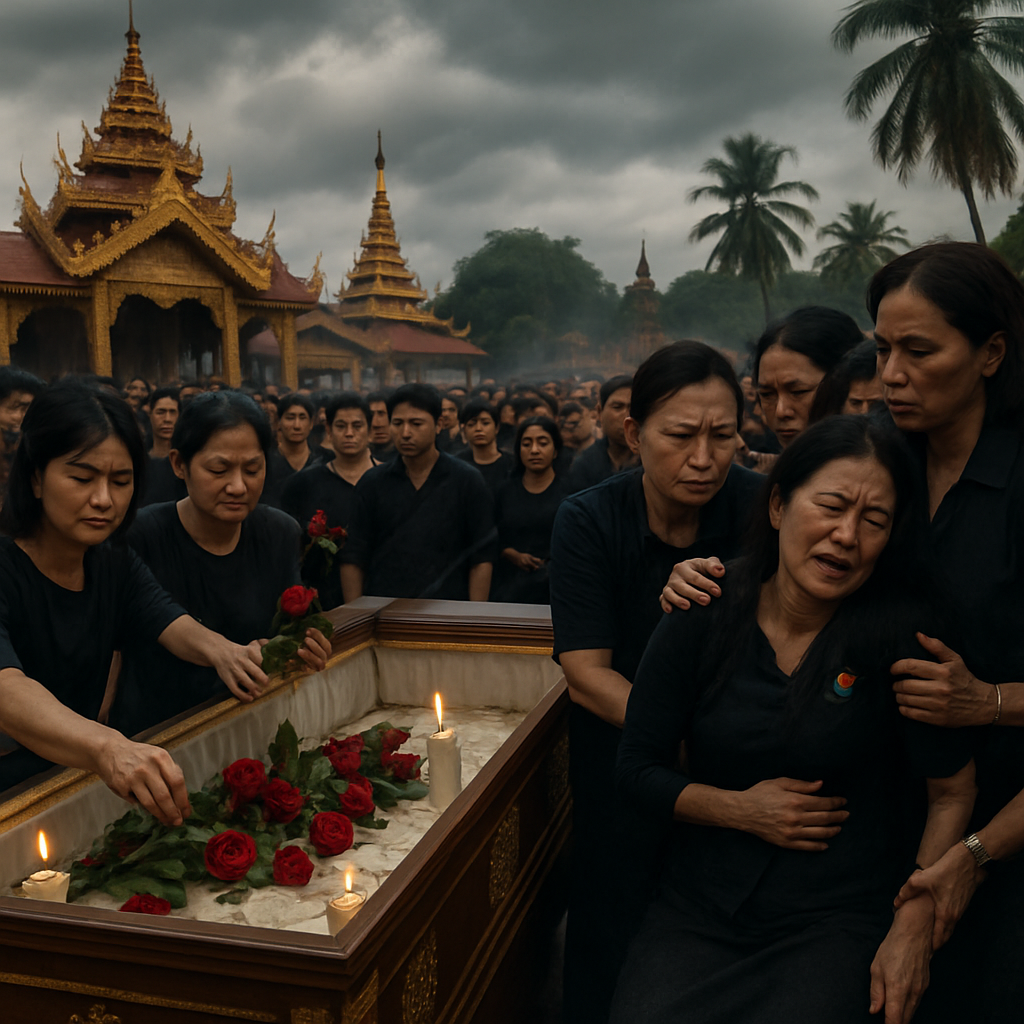
Under a gray Mae Sot sky and the heavy hush of mourning, thousands of fans gathered to say goodbye to Go Tin So Hwe — a 25-year-old TikTok personality from Myanmar whose life was cut short in a violent crime that has shaken both local communities and the wider LGBTQ family he belonged to.
The scene was at once mournful and vividly communal. Dressed in black and clutching red roses, friends, followers and fellow Myanmar residents formed a long, slow-moving procession as they carried Go Tin So Hwe’s body from Wat Luang to the Royal Cemetery in Mae Sot, Tak province. The open casket gave attendees one last chance to look upon a figure they had known mostly through a screen — a face that had brought joy, laughter and livelihood to more than a million TikTok followers.
Photos circulating from the service, courtesy of KhaoSod, capture the raw human moments: people laying red roses into the coffin, a sister overcome with grief, and the traditional rites performed by Myanmar residents guiding the departed’s spirit toward the afterlife. Go Tin So Hwe’s sister, Ye Ye Aye, 41, was so overwhelmed by grief that she fainted and had to be carried to a safe place amid the crowd. The cremation concluded in a somber ceremony as the body was placed into the crematorium.
The tragic discovery of Go Tin So Hwe’s body on January 24 has left many questions and a painful void. His body was found concealed near a large tree on the outskirts of Ban Phatong village in Mae Sot district, a location not far from the Thai-Myanmar border. According to investigators, the young creator had been lured from his home after receiving deceptive messages and disappeared for a day before locals stumbled upon his remains in dense grassland.
Mae Sot police say the inquiry has made strides but also faces challenges. Evidence indicates two suspects were seen with Go Tin So Hwe near a hotel close to the crime scene. Authorities believe the suspects may be hiding near the border or might have already crossed into neighbouring territory. Police are coordinating with counterpart agencies across the border and hope for an arrest soon, but as of now the suspects remain at large.
Beyond the investigation, the murder has rippled through the communities that loved and supported him. In Myanmar and within Thailand’s migrant circles, Go Tin So Hwe was more than a social media handle: he was an online merchant, a gifted content creator and a familiar presence to thousands who turned to his videos for entertainment, tips and a feeling of connection. For many in the LGBTQ community — which is still navigating safety, acceptance and visibility in the region — this brutal killing struck a particularly nerve-jarring chord.
Local reports suggest this case may not be isolated. KhaoSod has linked the murder to a pattern of crimes involving deception and robbery, where victims were lured by messages and then attacked. Whether a larger criminal ring is responsible or opportunistic predators are exploiting trust online, investigators are probing those possibilities while urging people to stay vigilant about meeting strangers from social media in secluded locations.
The public outpouring at the funeral reflected both grief and gratitude. Fans lined the route, many weeping silently, others offering prayers. The choice of red roses — symbols of love and remembrance — was deliberate and moving; mourners tucked blooms into the coffin as a final tribute, a quiet protest against a life ended too soon.
For those who followed Go Tin So Hwe’s journey on TikTok, the images of his content remain: expressive gestures, upbeat edits, and the entrepreneurial spirit of someone who turned an online following into a business that supported family and friends. His social media presence had become a kind of lifeline for many, especially fellow Myanmar residents living in Thailand, who found in his videos a rare taste of home and joy amid the trials of migrant life.
As police continue to pursue leads and collaborate with neighbouring nations, the community’s demand for justice grows louder. The case also highlights the darker side of social media interactions: the risk that a private message can lead to public tragedy. Safety experts and officials are reminding users to verify identities, avoid meeting alone in remote areas, and report suspicious contact to authorities.
In the memorial’s quiet aftermath, the image of a community united by sorrow lingers. Candles guttered, roses wilt, but the conversations sparked by Go Tin So Hwe’s death — about safety, borders, belonging and the vulnerabilities of public life — are only beginning. For now, thousands have said their farewells; what remains is a collective call for answers and for measures to prevent such tragedies in the future.
Authorities have appealed to anyone with information to come forward, particularly those who might have seen the two suspects near hotels around Mae Sot or along routes leading to the border. Until then, the memory of Go Tin So Hwe will live on in his videos, in the flowers placed in his coffin, and in the hearts of a grieving community demanding both justice and change.


















This breaks my heart — a young person with so many followers cut down like this. Social media brought him fame but also, apparently, danger. We need better cross-border police work and digital safety education.
Cross-border police coordination is a mess, true, but I also think influencers take risks for clicks. Not excusing the crime, but meeting strangers alone is a gamble.
Blaming victims for being online is unfair and harmful. People deserve to live and work without fearing robbery or murder just because they had an audience. Focus on catching the criminals, not shaming the victim.
I agree that we must avoid victim-blaming, yet we should still teach basic safety — like never meeting someone in a remote place. Education and enforcement must go together.
This is why I stopped sharing my location and meeting strangers from apps. Fame paints targets on people, especially migrants who can’t always rely on local protection.
As a migrant worker, I feel this deeply. We find comfort online but sometimes it’s also our biggest risk. More community shelters and safe meeting spaces would help.
The article hints at an organized ring using deceptive messages. If that’s true, it’s a terrifying new pattern exploiting social platforms. Law enforcement across borders must act fast.
Transnational organized crime often uses small-scale deception to test patterns before escalating. Tech companies should assist with IP tracing and message metadata to help identify suspects.
Tech firms will help only when pressured. Data privacy and jurisdictional limits are excuses to delay, sadly. Public outrage has to force action.
Exactly — pressure and legal frameworks are needed. But communities should also share safety tips and watch for suspicious accounts in real time.
The funeral photos were haunting — red roses in the coffin felt like a protest more than a ritual. It shows how communities reclaim dignity when institutions seem slow.
Public mourning can be powerful political expression. The LGBTQ aspect adds a layer: they mourn a life but also demand safety and recognition in societies that marginalize them.
Yes, and the fact he supported family through content complicates how we view safety nets for migrants. We must build economic protections too.
Economic vulnerability does increase risk exposure. Policy responses should include financial literacy, safer payment channels, and labor protections for migrant creators.
Don’t forget mental health resources. Creators handle pressure and threats often alone; accessible counseling could save lives.
I can’t stop thinking about how online identity and real-world vulnerability intersect here. He was a merchant, entertainer and a symbol to many — that visibility became a deadly liability.
There is a paradox: visibility offers livelihood but invites predation. Regulation of platforms and local safety networks must evolve together to protect creators.
Exactly, and we need culturally sensitive outreach for migrant communities, not one-size-fits-all programs that miss language and trust barriers.
It feels naive to expect tech platforms to be proactive without regulation. They profit from user connections and then wash hands when tragedy occurs. Legislative pressure is overdue.
Reading about his sister fainting made me cry. At funerals here we all feel like family even if we barely knew him online. This violence hits our safe places.
Community grief can be a catalyst. But are we using that sorrow to demand systematic change, or will it just fade with the flowers?
I hope it ignites change. People keep talking about safety tips but real policies are slow. We must push harder for protection and legal recourse.
Community pressure sometimes forces action — look at petitions and memorial rallies. But sustained advocacy is the hard part; emotions fade but policy needs persistence.
From a criminology perspective, the pattern described suggests opportunistic predators who network locally. Cross-border collaboration and digital forensics are key to dismantling such networks.
Your analysis is solid, but politics complicates prosecution. Border tensions, corruption, and red tape will slow arrests. People forget bureaucracy kills cases.
True, but transparency, international NGOs, and pressure from civil society can mitigate those obstacles. International legal instruments exist; they just need enforcement.
Media sometimes sensationalizes these cases. Yes, it’s tragic, but sensational headlines can inflame xenophobia against migrant communities. We must be careful in our coverage.
Responsible reporting matters, but downplaying crimes because of fear of xenophobia silences victims. Balance is needed: protect migrants and name the crime.
I followed him for recipes and humor; he felt like an older sibling. This violence shatters our feeling of small joys while living so far from home.
I also want to add that social platforms should let creators flag suspicious contacts and provide safer meeting locations. Small changes could help.
Why are predators targeting creators now? Is it just greed or is there a political angle against LGBTQ visibility in the region? We can’t ignore homophobic motives.
Both can be true: greed and bias. Sometimes crimes are economically motivated but fueled by social stigma that makes LGBTQ victims more isolated and vulnerable.
Investigators must consider motive, including hate components. Hate crimes can be masked as robbery; thorough probes are essential to uncover intent.