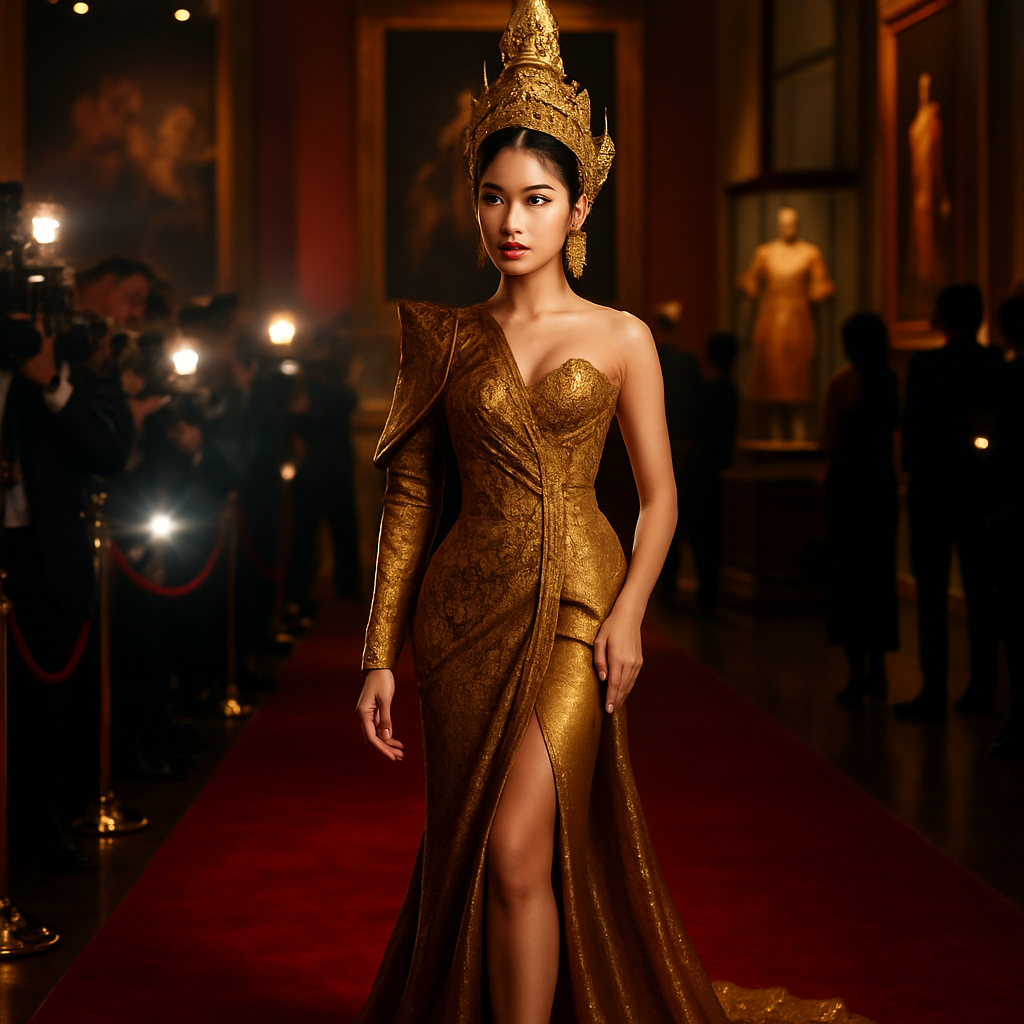
Move over, front-row flashbulbs—Lalisa Manoban is stepping behind the scenes. Thailand’s own global superstar Lisa (of BLACKPINK fame) has been officially named to the Host Committee for the Met Gala 2026, a meteoric nod that cements her as a true cross-cultural tastemaker in music, fashion and now high society’s most glamorous fundraiser. The announcement landed as the year closed, and it promises to make next May’s carpet even more electric.
Star-studded leadership: who’s steering the ship
This isn’t a cameo—Lisa will be joining a powerhouse roster shaping one of the world’s most watched fashion nights. Heading the gala as co-chairs are Oscar winner Nicole Kidman, tennis legend Venus Williams and none other than Beyoncé, whose return to the Met Gala after a decade away has already set tongues wagging. The creative and celebrity co-chairs roster rounds out with Saint Laurent creative director Anthony Vaccarello and actress-model Zoë Kravitz.
The full Host Committee is a hall of fame of contemporary culture: Lisa, Sabrina Carpenter, Doja Cat, Gwendoline Christie, Alex Consani, Misty Copeland, Elizabeth Debicki, Lena Dunham, Paloma Elsesser, Chloe Malle, Sam Smith, Teyana Taylor, Lauren Wasser, Anna Weyant, A’ja Wilson and Yseult. It’s a thrilling mix of musicians, actors, athletes, artists and models—an international mosaic that mirrors fashion’s boundary-pushing present. (Photo via Instagram: @voguemagazine)
“Costume Art”: Met Gala 2026’s ambitious theme
Circle the date: May 4, 2026. That’s when the Costume Institute’s annual gala will center on “Costume Art,” a theme that elevates fashion beyond runway spectacle into the realm of high art. Curated by Andrew Bolton, the exhibition will take visitors on a chronological sweep through Western art—from prehistoric silhouettes to contemporary couture—pairing garments with artworks to explore how clothing has shaped the perception of the human form through the centuries.
The exhibit will open in The Met’s newly unveiled Condé M. Nast Galleries, a sprawling nearly 12,000-square-foot canvas that gives the Costume Institute room to stage bold dialogues between textile and painting, armor and portraiture. For a show interrogating what costume means as art, the space itself feels like the perfect co-conspirator: grand, new and hungry for conversation.
Why Lisa’s invite matters
Lisa’s presence on the committee is more than celebrity optics. She represents a generation where pop culture is global by default—a K-pop superstar influencing Paris runways, couture houses courting Korean artists, and a Thai artist becoming an international ambassador for style. Lisa’s aesthetic—sharp, playful, and highly visual—resonates with the Costume Institute’s mission to show how clothes communicate identity, status and narrative.
Her appointment also signals fashion’s ongoing decentralization: influence is no longer confined to New York, London, Milan and Paris. It radiates outward from Seoul and Bangkok, from TikTok trends to haute couture salons. Having Lisa help shape the Met Gala lineup and tone acknowledges that shift in the most glamorous way possible.
More badges of honor: Thailand’s tourism ambassador
If the Met recognition wasn’t enough, Lisa has also been tapped as Thailand’s new tourism ambassador. It’s a perfect marriage of roles—celebrity and cultural emissary—tasked with amplifying Thailand’s heritage, food, and natural beauty to the world. Whether she’s posing in traditional garb or curating travel moments on social platforms, Lisa’s cross-cultural authority will likely nudge curious travelers toward Thailand’s shores. Fashion and tourism: two industries Lisa effortlessly bridges.
What to expect on the carpet
With “Costume Art” as the theme, anticipate a Met Gala that blends theatricality and scholarship—looks that dialogue with art history, garments that reference armor, sculpture, and devotional portraiture as readily as they riff on streetwear. Beyoncé’s return adds musical and fashion gravitas; Anthony Vaccarello’s presence hints at tailored, noir elegance; and Lisa’s role suggests inventive references to Asian sartorial traditions and pop-inflected couture. The carpet will be as much a curated exhibition as an awards-night runway.
In short: May 4 will be one of those cultural moments when music, museum and runway collide, with Lisa perched at the intersection.
Anticipation, elevated
The Met Gala lives on spectacle, but its true power comes when spectacle is married to concept. “Costume Art” promises to do just that—making the gala not only a global celebration of fashion but a thoughtful investigation into what clothing has always been: a moving, wearable reflection of who we are. Add Lisa to the committee, and you add global pop sensibility, social-media savvy and a fresh cultural lens.
So get your timelines ready. Between Beyoncé’s comeback, a slate of international stars shaping the guest list, and a thematic show in a dazzling new gallery, Met Gala 2026 looks poised to be a landmark night. And if Lisa has anything to say about it, it’s going to be unforgettable—stylish, interdisciplinary, and unapologetically global.

















This is huge for Lisa and Southeast Asian representation, but is the Met really ready to handle non-Western narratives properly?
Representation is great, but the Costume Institute’s framing has historically been Western-centric; having Lisa on the committee doesn’t magically rewrite curatorial priorities.
Totally — I’m glad she’s there but we need actual exhibition shifts, not just a famous face on the invite list.
Maybe Lisa can push for display contexts that include Thai textiles and their histories, not just as exotic motifs.
Or maybe Lisa’s presence will force the museum to think globally; celebrities open doors, curators do the heavy lifting.
I hope so — but calling it hope doesn’t fix institutional blind spots.
I love Lisa but the Met Gala is just rich people showing off. How does this help anyone?
It raises money for the Costume Institute and visibility for fashion as art, though I agree spectacle often overshadows substance.
This is wild. Thai tourism ambassador + Met Gala host? Sellout or savvy move?
Labeling it ‘sellout’ is reductive; it’s more productive to evaluate the cultural diplomacy benefits and economic impacts for Thailand’s creative industries.
Sure, but do those benefits trickle down or just fatten a few brands and agencies?
Tourism ambassadorship often has mixed outcomes; visibility can boost local economies but also commodify traditions.
As someone from Bangkok, I can say visibility matters for small artisans if handled respectfully.
The ‘Costume Art’ theme offers an academic opportunity to interrogate how dress operates as material culture, but the Met must avoid reifying colonial narratives when pairing Western art with garments.
Exactly — curators need to contextualize provenance and power dynamics rather than aestheticize non-Western dress as ‘exotic’.
Is the general public ready for a show that reads like scholarship? The Gala crowd usually wants spectacle over nuance.
Beyoncé coming back is the real headline for me; I wonder if the Met’s message will get swallowed by star power.
Celebrities draw attention, but they can also amplify the theme if they engage with it thoughtfully instead of just dressing up.
I’m curious: will Lisa’s influence push designers to incorporate Southeast Asian techniques and credit them properly?
Credit is the issue. Too often techniques are borrowed without acknowledgement or fair compensation.
Fashion’s decentralization is real, but saying influence now ‘radiates outward from Seoul and Bangkok’ erases the centuries-long global exchanges that preceded K-pop.
That’s a fair point; the article trends toward presentism, celebrating current stars while ignoring deeper histories.
Not trying to downplay K-pop’s novelty, just urging a fuller historical framing so we don’t confuse acceleration with origin.
Still, modern platforms like TikTok and streaming have accelerated cultural exchange in unprecedented ways; that matters too.
Will the ‘Costume Art’ show include non-Western garment traditions on equal footing, or will they be side notes to European portraiture?
Curatorial notes suggest a sweep through Western art specifically, which risks excluding global sartorial practices from the main narrative.
As a fashion student, I’m thrilled for Lisa. She could mentor young designers from Asia and help them access Western institutions.
That would be tangible change — mentorship programs and residencies matter more than one celebrity appearance.
The Met’s new Condé M. Nast Galleries sound impressive, but bigger spaces don’t guarantee better interpretation.
Agreed. Space is a tool; curatorial ethics and narratives determine whether it’s enlightening or just spectacular.
I’m hopeful they collaborate with scholars from diverse backgrounds to avoid a one-sided timeline.
I’m uneasy about celebrities as gatekeepers of cultural institutions. They bring clout, but do they have the expertise to guide an exhibition?
Committees are collective; stars like Lisa likely contribute perspective, not sole curatorial decisions. Still, transparency about roles would help.
Transparency is the word. People assume influence equals decision-making when it might not.
And even if they don’t make final calls, their platform shapes public reception — that’s influence too.
As someone who studies museum studies, I hope the exhibition addresses the ethics of display and repatriation conversations alongside stylistic narratives.
Yes, integrating provenance research and collaborative displays with source communities would set a new standard.