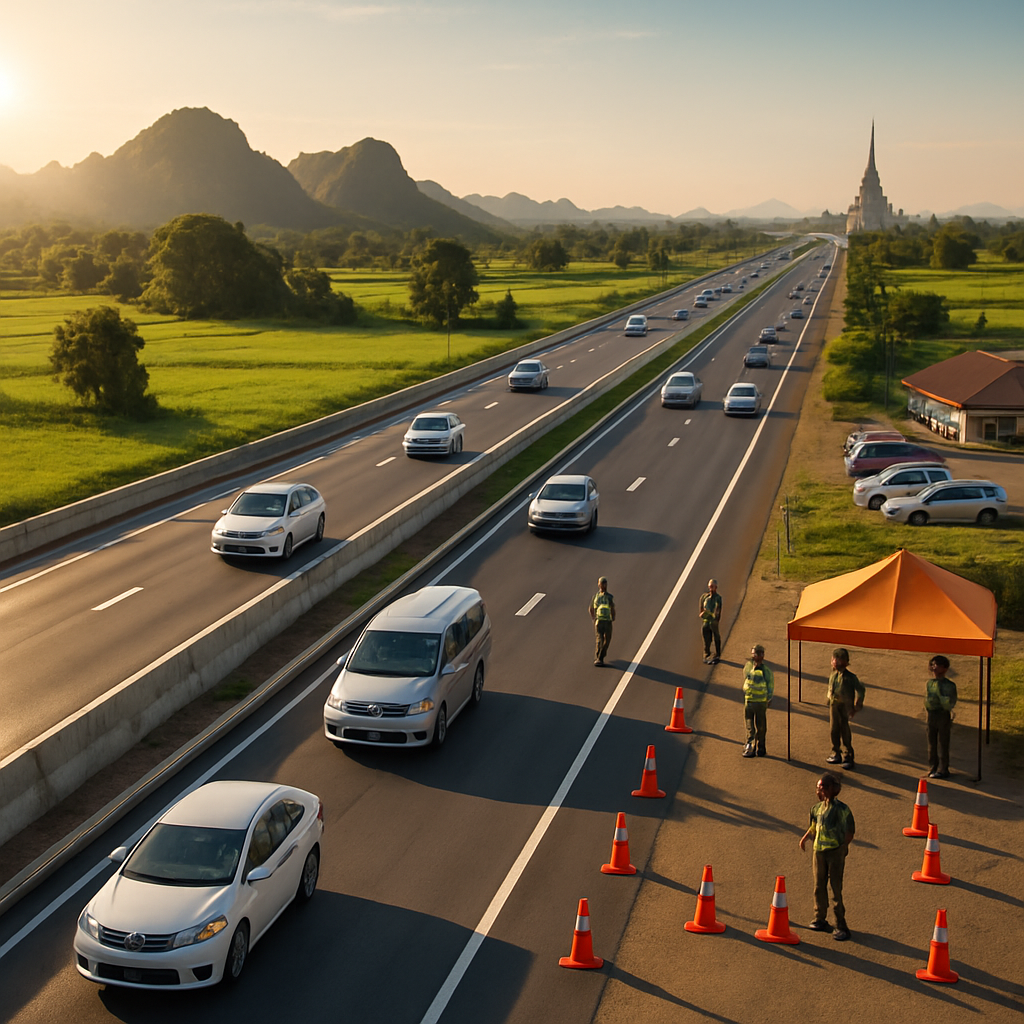
A Smooth, Toll-Free Ride: Thailand’s M6 Motorway Opens for the 2026 New Year Holiday
Good news for anyone planning a road escape over the 2026 New Year holiday: the Thai government has announced that the brand-new M6 motorway — the 196-kilometer stretch linking Bang Pa-in and Nakhon Ratchasima — will be open to motorists free of tolls for an 11-day trial period. The announcement came on December 19 from Siripong Angkasakulkiat, spokesperson for the Prime Minister’s Office, and it’s exactly the kind of holiday relief long-suffering drivers have been waiting for.
When and how it will be free
From December 26, 2025, at 00:01 through January 5, 2026, at midnight, the Department of Highways (under the Ministry of Transport) will allow full trial use of the M6 with no tolls collected. That means a clean 196 kilometers of modern motorway — toll-free — for folks heading north and east out of Bangkok toward the Northeast provinces and holiday hotspots.
Traffic flow: a one-way genius (for a while)
To make the most of the new route and shave hours off travel times, traffic management will get creative. The Bang Pa-in to Pak Chong segment will operate as a one-way outbound lane from Bangkok for the first seven days of the trial: December 26 at 00:01 until January 1 at 23:59. Then the direction switches — the motorway closes briefly for reconfiguration on January 2 from 00:01–06:00, and inbound traffic to Bangkok is allowed from January 2 at 06:00 until January 5 at 24:00.
Meanwhile, the Pak Chong to Nakhon Ratchasima section remains two-way throughout the holiday, helping balance the flow and serving travelers who have shorter hauls. Officials expect this staged approach to reduce congestion on parallel highways and make holiday journeys far more predictable.
Rules, limits and checkpoints — what every driver should know
There are a few important conditions to remember before you start your engines:
- Only four-wheel vehicles are permitted during the trial — so no motorcycles or large commercial vehicles.
- The speed limit is capped at 80 kilometers per hour. Authorities say this is necessary because parts of the motorway remain under observation during the trial phase.
- Entrances and exits will be controlled at seven checkpoints to manage access and ensure safety. Drivers can enter and exit at:
- Bang Pa-in
- Hin Kong
- Saraburi
- Kaeng Khoi
- Pak Chong
- Sikhiu
- Kham Thale So
Expect traffic officials and signage to be on high alert the whole time, and plan your entry or exit at one of these points — they’ll be your lifelines to and from the motorway.
Why the free trial matters
This isn’t just a goodwill gesture. The M6 is a strategic artery for travel to the Northeast (Isan) and is expected to play a major long-term role in regional connectivity. By offering a toll-free trial during one of Thailand’s busiest travel windows, authorities aim to:
- Reduce congestion on existing highways and secondary roads
- Shorten travel times for holidaymakers and commercial traffic
- Provide a safer, more controlled environment for mass travel
- Gather real-world data on traffic flows so engineers can fine-tune operations
In short: it’s part stress test, part public service, and part preview of a motorway that will become a backbone for many journeys in the years ahead.
Tips for a smoother, safer holiday drive
If you’re planning to use the M6 during the free period, here are a few practical tips to keep your trip pleasant and hassle-free:
- Check the timing: If you’re leaving Bangkok for holiday destinations, use the outbound window (Dec 26–Jan 1). Returning? Bookend your trip to match the inbound phase from Jan 2–5.
- Fuel and rest: Service areas may be limited during the trial. Top up your tank and take breaks at safe, designated stops.
- Follow the rules: Stick to the 80 km/h limit and the four-wheel restriction to avoid fines or being turned away at checkpoints.
- Watch for updates: Traffic authorities may tweak timings or access points, so monitor official channels for last-minute advisories.
Final thought
Whether you’re chasing cooler weather in the Northeast, heading home to family, or simply testing the new road for future trips, the M6’s toll-free trial is a rare holiday boon. Think of it as a preview ride — a chance to experience a smoother, faster route before the motorway becomes a regular part of Thailand’s transport landscape. Pack some snacks, map your entry and exit at one of the seven checkpoints, obey the rules, and enjoy what could be the most relaxed New Year road trip you’ve had in years.

















Free M6 for New Year is exactly what we needed after last year’s gridlock, nice move. Still, 11 days feels like a short PR stunt rather than a real test of capacity.
It sounds good but shutting out motorcycles is unfair to many people who rely on them, and an 80 km/h cap on a new motorway seems oddly low.
Motorcycles get killed on highways all the time, this ban probably reduces deaths; it’s not about being unfair, it’s about safety.
I hear both points — safety matters — but the government should explain the motorcycle policy publicly so people understand the rationale.
Why no motorcycles? That will push more two-wheel traffic onto dangerous secondary roads. This policy could make the situation worse for riders.
Exactly, I won’t risk the old road just because big vehicles are allowed to zoom on the M6.
Local vendors will benefit if travellers flow smoothly, but bikers are a large part of Isan culture and economy too.
We need safe motorcycle corridors, not outright bans that ignore livelihoods.
If they insisted on safety, they’d open motorcycle-friendly lanes instead of blanket bans.
From a transport-planning perspective, a toll-free trial during peak holiday traffic is a valuable quasi-experimental design to collect demand and queueing data. The one-way outbound then inbound operational strategy allows for high throughput but will need real-time monitoring to avoid spillover effects onto connecting roads.
Sounds like fancy words but isn’t this just a political show to curry favour before elections? Free things always smell like politics.
Political motives may exist, but the data gathered can still be scientifically useful; we should separate intent from outcome and analyze observed flows objectively.
An 80 km/h speed limit on a new motorway is ridiculous and will create dangerous speed differentials. Either finish the road properly or admit it’s not ready for full-speed traffic.
Maybe they left the limit low because some stretches aren’t fully protected yet, like missing barriers or incomplete shoulders.
Correct — temporary lower speeds are common during observation periods; it’s about minimizing consequences while checking system behavior.
Fair point, but authorities should communicate those construction-specific risks clearly so drivers understand why.
Checkpoint-controlled access at seven points will just move queues to those spots and create new bottlenecks. I expect long lines at Hin Kong and Pak Chong.
They’ll probably run managed entry with temporary marshals and pre-screening to keep flow steady, but yes, peak hours will be messy.
Managed entry only works if staffing is sufficient and staff don’t get stuck in the same traffic they should control.
Great tip about topping up fuel and resting — service areas might be thin. Families should pack snacks and plan exits carefully.
Also bring extra water and check your spare tire before the trip; help could be slow on a trial motorway.
Good reminders, Somchai — small preparations shave off stress during holidays.
This will be a tourism boon for Khorat and nearby districts if the motorway flows well. Faster journeys mean more weekend trips.
Economic benefit is real but uneven — roadside villages might get bypassed and lose passing trade unless local linkages are planned.
True, planners should ensure feeder roads and local exits help communities, not cut them off.
Closing the road to reconfigure direction on Jan 2 at 00:01–06:00 seems risky. Nighttime operations can cause confusion and errors.
Switchovers are complex but routine if done with rehearsed procedures, lane markings, and clear signage; the key is robust temporary traffic management plans.
I hope they rehearse and publish clear maps; I’ve seen nightwork reconfigurations go badly without public info.
I worry about how this affects truckers and goods transport since large commercial vehicles are barred. That could hurt supply chains temporarily.
They likely excluded large commercial vehicles to avoid heavy loads that complicate traffic modelling during the trial, but alternate routing will strain other highways.
Alternate routing is an inconvenience but understandable for a data-gathering exercise; still, they should coordinate with logistics firms.
Free road? I’m going straight to Khao Yai. This is the best New Year present!
We should also consider environmental impacts of faster, easier access — more cars could mean more emissions and pressure on local ecosystems.
That’s valid; induced demand is a real effect over time, so emission and land-use implications must be part of long-term assessments.
Then they must commit to monitoring air quality and traffic growth, not just revenue generation.
I smell electioneering — free roads during holidays are classic vote-hunting. Watch for sudden schedule ‘fixes’ later.
Whether political or not, the public gains short-term relief; cynicism shouldn’t stop us from using better infrastructure.
Using it once is fine, but I’m tracking whether tolls are reinstated at inflated rates later.
Speed limits are conservative during instrumentation and monitoring phases to reduce severity of incidents while sensors, ITS and barriers are validated. Data from this trial will inform operational design speeds.
Agreed, engineering judgments often require staged increases in allowed speeds as confidence in system performance grows.
Exactly — they should publicize the metrics that trigger any future speed adjustments.
Small businesses near the checkpoints could see more customers if authorities allow safe rest stops. Planning matters for locals to benefit.
Or it could bypass them entirely, routing people straight through with few stops; incentives needed to keep local spend.
Then local councils should work with the highway authority to create designated markets or pullouts.
Expect heavy enforcement at checkpoints — they will be checking vehicle types, speeds, and likely insurance documents. Compliance will determine flow.
Enforcement is good, but I’ve seen overzealous checkpoints cause corruption opportunities if not monitored.
Transparency and body-cam policies help; the department should publish checkpoint procedures and complaint hotlines.
Will they extend the toll-free trial if it works well? I can’t find official word about possible extensions.
I replied earlier but I’d add: if they’re serious about reducing congestion across Isan, they need staged pricing models, not just a free trial.
Staged pricing could smooth demand and fund maintenance, but it must be equitable; discounts for locals would help.
Make sure travellers understand the one-way schedule carefully — people could get stuck if they miss the inbound window and don’t plan exits.
They should push clear maps and SMS alerts; a lot of older drivers rely on clear printed instructions.
Exactly, and multilingual signage for tourists too.
If data shows congestion reduces on parallel highways, this will be a good case study for future managed free periods in other corridors.
It could indeed inform policy, but academic access to the raw traffic data will be important for independent evaluation.
Public datasets would build trust and allow better modeling for next steps.
I remain suspicious about who benefits financially once tolling starts. Privatization deals sometimes saddle the public with high fees.
Transparency in concession agreements is needed; otherwise we may see feeder tolls or bundled charges later.
Yes, demand-side protections like price caps should be in the contract.
Also watch for over-tourism in protected areas near exits. Easier roads mean more casual visitors and more stress on ecosystems.
Local eco-tourism groups should be consulted now so they can prepare capacity plans and fees.
Community-based management can mitigate impacts if empowered early.
One more thought: emergency response routes need to be rehearsed for the one-way configuration, otherwise accident response times might increase.
Emergency access plans should be integrated into the traffic management plan, with staged detours and pre-positioned rescue teams.
Good — we should ask authorities for a summary of emergency protocols before Dec 26.
I keep coming back to the timing — holiday freebies are a classic distraction. I’ll be checking whether maintenance budgets get cut afterwards.