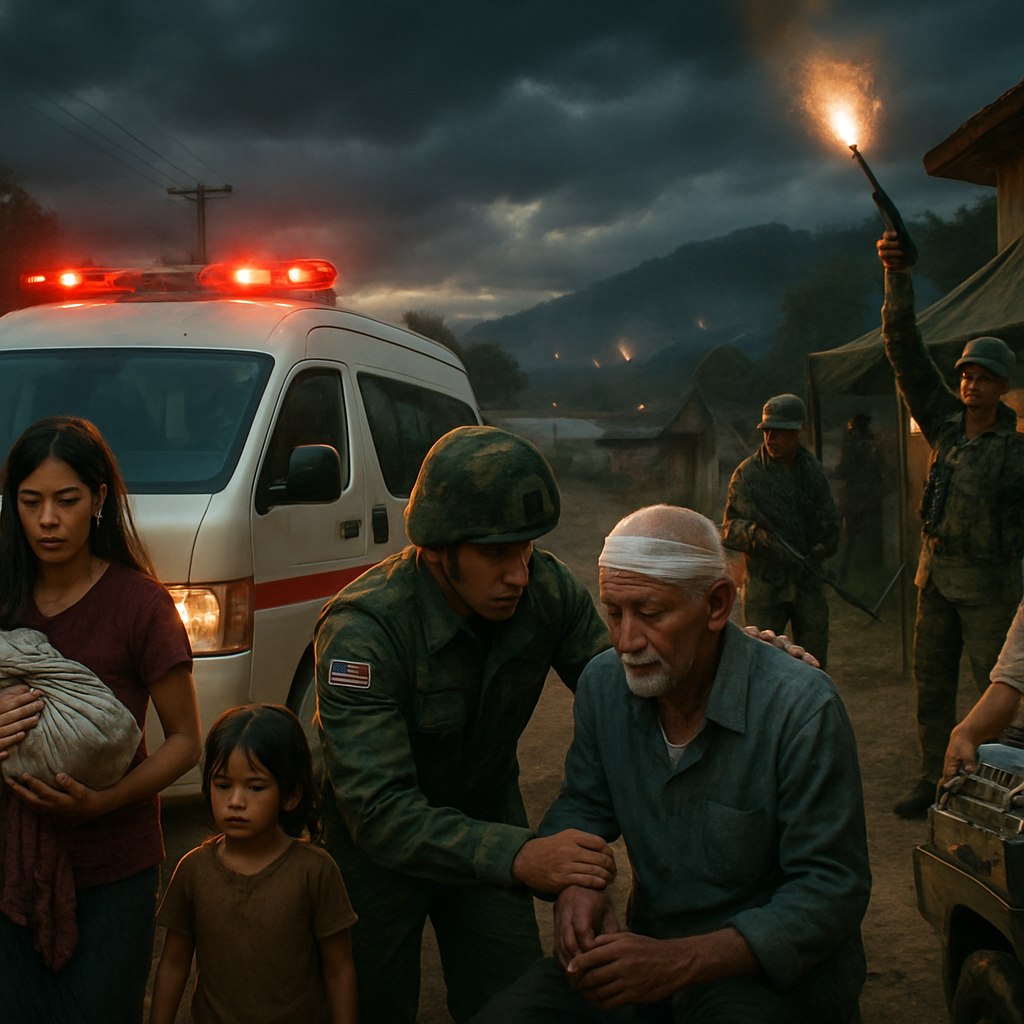
Border towns rarely make headlines unless something dramatic happens — and over the weekend Mae Sot in Tak province found itself at the centre of one such tense flashpoint. Artillery rounds from clashes across the Thai–Myanmar border landed on Thai soil, injuring civilians and forcing hurried evacuations, prompting a stern warning from Thailand’s Chief of Defence Forces, General Ukrit Boontanon.
General Ukrit said shells from the fighting spilling over from Myanmar struck parts of Mae Sot district after government troops and ethnic armed groups exchanged heavy gunfire and artillery. Some projectiles veered off course and landed in Thailand, where border communities are already used to the rumble of distant conflict. This time the sound came closer — and with real consequences.
Thai border units responded quickly. Soldiers fired warning shots and activated the Thai–Myanmar border coordination mechanism to communicate with counterparts across the line, trying to prevent further stray rounds from turning into a larger cross-border incident. Both Myanmar government representatives and ethnic minority leaders were formally warned by Thai officials, General Ukrit said, with a clear message: stop stray fire — or face stronger measures.
Evacuations, Injuries and a Community on Edge
Although no fatalities were reported, at least two villagers were wounded by stray rounds, including a 68-year-old man. The injured are receiving treatment at Mae Sot Hospital and are said to be in stable condition. The incident has revived memories — and fears — for families who had briefly returned home after earlier waves of fighting sent them fleeing to relatives or safer nearby areas.
Following renewed clashes in Min La Pan village, Myawaddy township, Myanmar — where explosions and gunfire erupted again on Friday morning — officials ordered immediate evacuations in border hamlets including Mae Kon Ken and Huai Mahawong in Mae Sot. Security forces are preparing contingency plans to move residents out of high-risk zones if the situation deteriorates.
Colonel Narongchai Charoenchai, deputy commander of the Naresuan Force, and Mae Sot local officials visited affected households, delivering relief supplies and checking on families who endured the sudden disruption. The swift humanitarian response offered a small measure of reassurance to nervous villagers who watch the border and count the hours between skirmishes.
Why This Matters: A Neighbourhood in the Crossfire
The latest flare-up is part of a broader, ongoing confrontation that has pitted the Myanmar military against the Karen National Union (KNU) since late last month. The fighting has been intense enough that constant gunfire and explosions can be heard from the Thai side of the border, unsettling residents and raising diplomatic tensions.
Padoh Saw Taw Nee, a spokesman for the Karen National Union, urged the Myanmar military to halt its offensive immediately, arguing that indiscriminate shelling endangers local communities and foreign nationals alike. Bangkok Post reports added that four Chinese nationals were wounded by shrapnel from explosions in Min La Pan, underscoring the international ripple effects when conflict spills across into civilian areas.
Thailand’s Red Line
General Ukrit’s message was firm but measured: Thai authorities have formally warned both parties and are prepared to escalate their response should cross-border incidents recur. The Thai military’s current posture appears to be focused on deterrence — warning shots, diplomatic communications, and the potential for tougher action if community safety is threatened again.
For now, the response plan balances caution with care: monitor the border, prepare evacuation routes, continue communication through existing coordination mechanisms, and offer immediate relief to affected families. Local commanders, like Colonel Narongchai, are on the ground to manage both the security and humanitarian sides of this tense episode.
Lives Interrupted, Resilience Tested
Residents of Mae Sot and nearby hamlets live daily with the risk of spillover violence. What might seem remote to many Thais or international readers becomes immediate for those in border villages: a cracked wall from a near-miss, a trip to Mae Sot Hospital, or the decision to leave one’s house at dawn with nothing packed but hope. The recent incidents are a reminder that conflicts do not always respect lines on a map, and that local communities often bear the first cost.
As authorities continue to monitor the situation, the hope is simple: calm, clear communication, and a return to safer days for Mae Sot’s families. But General Ukrit’s warning makes it clear that Thailand’s patience has limits. If shells keep landing on Thai soil, the next steps may be no less forceful than the last.

















This is exactly why border security should be a top priority — civilians are getting hurt by stray shells and that cannot be brushed off. Thailand warned both sides, but warnings are useless if shots keep landing here. We need clearer rules about returning fire and protecting villages.
Why would Thai soldiers fire back into Myanmar? That could start a real war and scare everyone away from their homes.
International law allows self-defence, but any proportional response must be carefully calibrated to avoid escalation. Diplomatic channels and the coordination mechanism should be used more actively alongside humanitarian protections.
Coordination mechanism? That just sounds like window-dressing while people get hurt. If shells keep falling we should close the border and demand reparations.
Closing the border hurts traders and refugees; it’s not a simple fix. Pressure and clear legal consequences for the party responsible would be smarter than an economic shutdown.
I agree with Larry D, but there must be consequences. Thailand can’t let its citizens be collateral damage while trade continues as normal.
From the KNU perspective, we have repeatedly tried to avoid civilian harm and have called on the Myanmar military to stop its offensive. Indiscriminate shelling undermines any political solution and threatens cross-border civilians.
If that’s true, PadohSpokesman, then please coordinate better and ensure fighting doesn’t endanger Thai soil; people here want peace, not excuses.
Four Chinese nationals wounded? Now this conflict has clear international implications, and Beijing won’t ignore that lightly. Thailand will have to balance deterrence with diplomacy to avoid a bigger regional crisis.
China’s involvement complicates ASEAN dynamics; Beijing could press for a halt or leverage Myanmar, but it may also shield the junta. Thailand’s measured approach seems aimed at avoiding direct confrontation with either neighbor or an external power.
Measured is one word, but residents need action not just balance. Humanitarian corridors and compensation should be immediate priorities.
I’ve woken up to explosions before, but when shells land in our fields it’s different — it’s terrifying. The hospital is overwhelmed with anxious people even if injuries are not fatal.
My nephew used to farm near Huai Mahawong; he said people are packing again. How long can families live like this and keep their livelihoods?
They should either fully evacuate the really risky hamlets or get permanent shelters. Half measures just keep everyone stressed and poor.
Evacuation isn’t simple — some have old parents or livestock they can’t just abandon. We need state help, not just advice.
If shells keep landing, Thailand must make a strong military statement. Warnings haven’t worked in the past with this junta.
A strong military response risks drawing Thailand into a war that has nothing to do with us. There are economic and safety costs to consider.
If the choice is risk or continued shells on my village, that’s not a hard decision for me. Diplomacy only works when backed by credible force.
This has the smell of a slow-motion disaster caused by state failure in Myanmar, but Thailand’s threat of ‘stronger measures’ could be interpreted in many ways. Will they retaliate, close the border or take legal action at the UN?
A legal approach is slow; people need immediate protection. Local commanders doing relief is a good stopgap but not a long-term answer.
International legal action may be symbolic, but coordinated ASEAN pressure could be more effective if member states unite — which they rarely do in openly criticizing Myanmar.
I don’t trust ASEAN to act decisively. Thailand might have to lead a regional diplomatic push or risk being seen as weak by its own people.
This reads like the same script we’ve seen for years: civilians pay the price, officials promise action, and then silence. When will someone prioritize human lives over geopolitics?
Prioritizing humanitarian concerns requires funding, safe corridors, and neutral monitoring — things that are politically sensitive but necessary. Civilian protection should be non-negotiable.
Is there any easy way for Thailand to prevent stray artillery beyond diplomacy? I mean, shells don’t care about borders.
Hard choices: targeted counter-fire, reinforced shelters, or pressure for cessation. None are easy, but doing nothing is worse.
This incident illustrates how internal conflicts have transboundary externalities, complicating sovereignty and non-intervention norms. Thailand’s calibrated deterrence is rational but fragile if incidents persist.
Nice theory, Professor, but residents want food, shelter and guarantees they won’t be shelled again. Academic framing helps little in a crisis.
People calling for big military responses might not realize that an escalation could trap Thailand in a prolonged conflict. Sometimes the safest path is de-escalation and heavy diplomacy.
Diplomacy hasn’t stopped shells from hitting my neighbor’s home. How long do we wait for talks to work while kids get hurt?
I hear you, Aunty May. My point is that any response must weigh likely outcomes, not just immediate anger.
China will likely urge calm and behind-the-scenes talks with Naypyidaw. Publicly, they prefer stability along their border interests and might push for containment rather than punishment.
Containment from China sounds like letting the problem fester. That benefits the junta, not civilians.
Possibly, but China also has economic ties to the region; outright chaos would hurt Beijing too, so they have incentive to mediate quietly.
We’re trying to help with relief but supplies run out fast and volunteers are tired. More coordinated aid from Bangkok would make a real difference.
Local NGOs need funding and safety guarantees; international aid could help but needs logistics and clear protection to operate near the border.
Exactly — and the government should prioritize those routes instead of only issuing statements.
If shells cross the border intentionally or negligently, Thailand could present a case at the ICJ, but that is slow. Immediate protection measures are legally easier to enforce domestically.
ICJ proceedings require state consent and may be impractical here; however, documenting incidents now preserves options later for justice or reparations.
My harvest is at risk every time fighting flares up. Compensation talk is nice, but who pays and how fast would matter to keep families fed?
Those farmers need immediate cash help and seeds for next season if fields are damaged. Long-term promises won’t help this month’s bills.
People returning home after earlier waves of fighting are now traumatized again; psychosocial support and child protection must be part of the response. Repeated displacement has long-term social costs.
Why is mental health always an afterthought? It’s central to recovery and community resilience.
Funding cycles and short attention spans make it hard, but local groups can provide low-cost interventions if supported.
It’s frustrating to see empty platitudes. If General Ukrit really means it, show action not only warnings.
Action must be measured or we risk making things worse, but visible protection for civilians would rebuild trust.