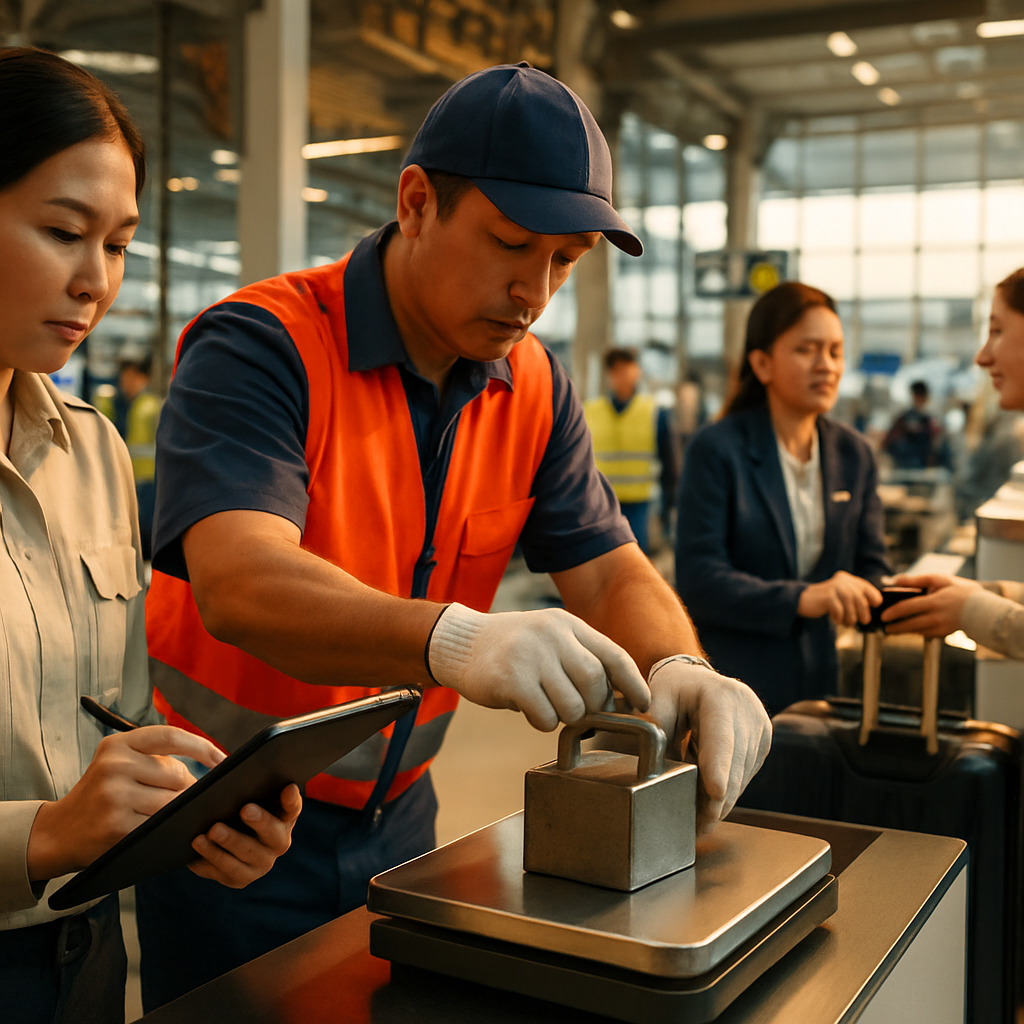
If you’re heading to the airport this New Year season, here’s one less thing to worry about: the scales. Deputy Minister of Transport Mallika Chiraphanwanit has ordered the Department of Airports (DOA) to team up with local trade and weighing authorities to inspect and verify luggage scales across DOA-run airports — a practical move designed to keep baggage disputes, surprise fees and check-in chaos to a minimum.
The directive, issued on December 6, asks airports to work closely with provincial internal trade offices and regional weighing centres to make sure passenger luggage scales meet official accuracy standards. It’s a straightforward fix with big benefits: travellers get fair measurements, airlines can better calculate total aircraft weight, and check-in counters run more smoothly during one of the busiest travel periods of the year — the 2026 New Year rush.
Why accurate scales matter (beyond the obvious)
We often think of a luggage scale as a tiny convenience — until it isn’t. An inaccurate scale can add up to unexpected excess baggage fees for passengers, create arguments at check-in, and slow down lines when staff must reweigh and recheck many bags. From the airline’s perspective, precise baggage weights feed into aircraft weight and balance calculations, an essential safety step before every flight. In short: accurate scales protect wallets, time and safety.
Deputy Minister Mallika’s initiative is both passenger-friendly and safety-minded. By standardising and validating the scales now, the DOA aims to give travellers peace of mind — and avoid last-minute headaches at crowded counters.
Where inspections are already happening
Danai Rueangsorn, Director General of the Department of Airports, reported that several regional airports have already completed scale inspections. Among those checked are Nan Nakhon, Roi Et, Khon Kaen, Nakhon Si Thammarat and Udon Thani. Each site worked with the appropriate regional weighing authority to ensure precision and compliance.
- Khon Kaen Airport partnered with the Northeastern Weighing Centre.
- Nakhon Si Thammarat Airport worked with the Southern Weighing Centre in Surat Thani.
- Udon Thani Airport coordinated with the Branch Office of Weighing and Measuring Area 2-2 Udon Thani.
- Roi Et Airport collaborated with the Internal Trade Department of Roi Et province to inspect conveyor belt scales at check-in counters.
Inspections at these airports concluded that the scales are operating correctly and meeting required accuracy standards — reassuring news for anyone planning to travel through these hubs.
Fast check-in, fair fees, safer flights
This effort is more than a public-relations tidy-up. Accurate weighing equipment speeds up the check-in process because fewer bags need to be retested, and gate agents aren’t forced into awkward reweigh-and-repack situations. For passengers, it means fewer arguments over a few dozen grams and a lower chance of being slapped with an unexpected surcharge at the desk.
For airlines and airport operators, the upside is operational: predictable baggage weights aid load planning and contribute to aviation safety. With heavier travel flows expected around the 2026 New Year, a proactive push to confirm scale accuracy now is a pragmatic step.
What travellers should know
Even with verified scales, it’s wise for passengers to weigh bags at home before heading to the airport — think of it as a courtesy to yourself and fellow travellers. If you notice a discrepancy at check-in, ask staff whether the scales have been recently verified. Airports carrying out formal inspections will have done so in coordination with provincial authorities, but a friendly question can help you spot errors early.
The DOA has promised to speed up inspections across its managed airports to ensure maximum convenience and consumer confidence. As the travel rush approaches, these checks are intended to make lines shorter, fees fairer and flights safer for everyone.
Reported by KhaoSod, the initiative demonstrates a simple truth: small technical details — like the accuracy of a luggage scale — can have an outsized impact on travel experiences. With Mallika Chiraphanwanit’s instruction in place and Danai Rueangsorn overseeing implementation, Thailand’s regional airports are taking a practical step to keep holiday travel humming along.
Image credit: iStock

















Good move by Mallika to get scales checked before the holidays; simple fixes save so much hassle at the counter and probably a few tempers too.
Totally—last New Year I got charged extra for 200 grams and it turned into a huge argument, so accurate scales would have saved time and money.
As someone who works near gates, I can confirm: aligned scales reduce delays and make load planning easier, but only if inspections are frequent and records are transparent.
Thanks for the insider view—so what would be a sensible inspection interval for airport scales during peak season?
Ideally weekly during peak season with documented certificates; monthly could suffice off-peak but airlines need current data for safety calculations.
Weekly is conservative but reasonable; weight sensors can drift and environmental factors at some regional airports mean calibrations must be frequent to maintain safety margins.
Agree with Dr. Ananya—calibration protocols and traceability to national standards must be published so independent auditors can verify compliance.
Sounds good on paper, but I’ve seen paperwork that looks great while reality lags; who enforces the auditors and what penalties exist for falsified checks?
Penalties? That depends on who you know. I’m not saying it’s corrupt everywhere, but boots-on-the-ground enforcement rarely bites the big players.
That’s a cynical take. Many officials actually want fair service; we shouldn’t assume corruption is the default explanation.
Maybe, but calling out the risks keeps them honest. If inspections are public and repeatable, then fine—otherwise I remain skeptical.
From my small airport, the team really does work hard and the weighing centre helped us fix an old conveyor scale—not everything is scandalous.
I appreciate the local effort, but who pays for these inspections if they ramp up frequency? Travelers already pay high fees and taxes.
Costs are modest relative to operational risks; investing in regular calibration is cheaper than mishandled weight info leading to delays or worse.
Could those costs be passed to airlines, taxpayers, or bundled into airport service fees? People should know where the money comes from.
Airlines and airports usually share responsibility; transparency in cost allocation should be part of the public announcement to avoid surprise fee hikes.
Appreciate all these perspectives—sounds like the main ask is transparency and regular, documented checks so passengers can trust the process.
Transparency is fine, but open databases and third-party audits are the real test; otherwise it’s just PR.
Implementing an open register of calibration certificates with timestamps would be straightforward and increase public trust immediately.
My mom says weigh your bag at home with a bathroom scale and don’t argue with the people at the desk, but this inspection idea still sounds good.
Simple home checks help, but bathroom scales vary too. Using a verified luggage scale or checking calibration certificates at the airport is safer.
Sounds like a PR move to me—inspect today, forget tomorrow. We’ve all seen band-aid policies designed for photos, not lasting change.
Not every government action is cynical. This one has immediate benefits for ordinary people and doesn’t cost much compared to big infrastructure projects.
I hope you’re right. I’ll believe it when inspection logs are online and not just a press release.
If they actually publish results, I’d be impressed. Otherwise it’s just a headline before the holiday.
From an aviation safety standpoint, accurate baggage weights influence payload calculations and fuel burn projections; small errors can compound across multiple flights.
Exactly. Even a few hundred kilograms misreported across a full flight schedule can alter load planning and crew decisions.
Which is why standards and measurement traceability are not optional; regulators should publish acceptable tolerances and audit results.
Can someone explain what an acceptable tolerance is in plain language? I’m not an expert but I fly a lot and want to know how precise ‘precise’ is.
A typical tolerance might be +/- 0.1 kg for passenger baggage scales but it depends on scale class; the key is documentation linking the instrument to national measurement standards.
I keep coming back to accountability—who checks the checkers? Without public oversight, this could easily be theatre.
Public oversight and penalties for non-compliance would help. Maybe allow independent NGOs to spot-check on behalf of passengers.
Independent checks are good but they cost money and need legal authority. You can’t just let volunteers recalibrate airport equipment.
I didn’t mean recalibrate—just verify the paperwork and sample-check the scales at random times to keep things honest.
Practical tip: still weigh bags at home and pack a little lighter. Even verified scales won’t stop every dispute if you leave things to chance.
Also, pack clothes in your carry-on. My teacher says layers are good and you can avoid fees that way.
Back in my day airlines were simpler. Maybe this is progress but I miss predictable rules rather than constant policy tweaks.
A note on conveyor belt scales: they must be level and regularly calibrated. A misaligned conveyor scale can give wildly inconsistent readings.
Is that why sometimes my bag is heavier at the first counter than at the reweigh? I figured it was human error, not the machine.
Often both: human handling and uncalibrated conveyors. That’s why it’s important to have calibrated stationary luggage scales for verification, not just belts.
So airports should have clear signage showing the last calibration date, like gas pumps do with inspection stickers.
I’m uneasy about the cost and bureaucracy. Will this mean another committee with glossy reports and little follow-up?
Council meetings are annoying, but the inconvenience at check-in is worse. I’d prefer effective checks even if it means more admin.
Fair point. I just want assurance the checks are meaningful and not just boxes ticked for PR.
Proud to see regional airports like Khon Kaen and Udon Thani already completing inspections. Local action matters.
Agreed, regional hubs get overlooked often. Good that the DOA included them in the rollout.
Good that results were positive, but I’d like independent verification beyond official announcements.
Technical suggestion: publish a machine-readable registry of calibrated equipment, make sampling results accessible, and include instrument serial numbers.
Yes — that enables researchers and regulators to spot trends in drift and helps prioritize high-risk locations for more frequent checks.
If they do that, I will be pleasantly surprised. Until then, I’ll keep a healthy dose of scepticism.
One last thought: if this becomes routine, airlines that tried to squeeze money out of small differences will adapt, so the net effect could be positive.
Optimistic end to a heated thread—I’m glad someone sees the systemic upside.