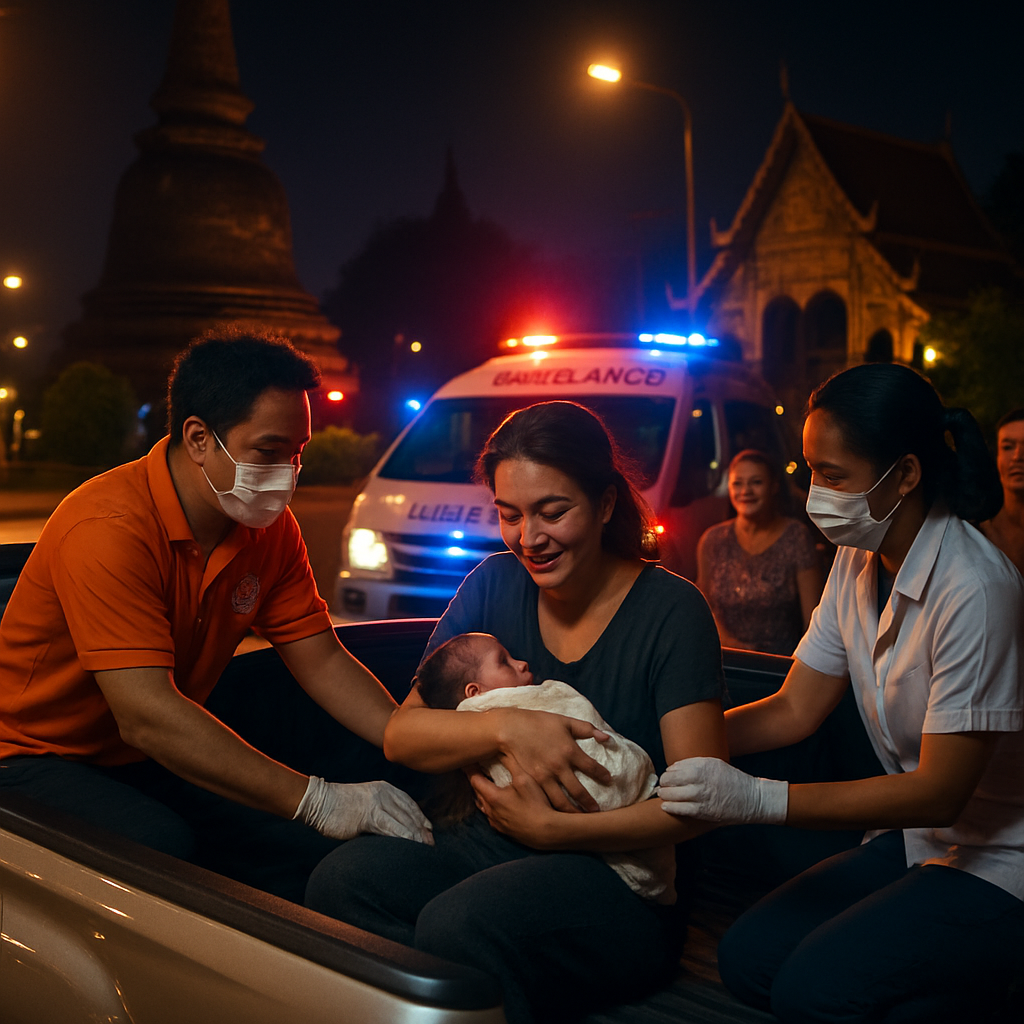
In a scene equal parts tense and triumphant, a 34-year-old woman named Mayuree gave birth in the back of a silver pickup truck at the Wat Sam Pluem roundabout — locally known as Chedi Nakleng — on Rojana Road in Phai Ling, Phra Nakhon Si Ayutthaya province. What started as a midnight dash to the hospital turned into an impromptu roadside delivery that ended with cheers, quick-thinking rescuers and a healthy baby boy.
According to rescue officers from the Ayutthaya Ruamjai Association, the dramatic moment unfolded when a pickup truck carrying Mayuree stopped at the Wat Sam Pluem roundabout asking for immediate medical help. Rescue personnel arrived to find the new mother cradling her newborn in the vehicle. First aid was administered on the spot before both mother and baby were transported by ambulance to Rajthanee Hospital, where staff later confirmed that the infant is a healthy boy and both are in stable condition.
The driver of the pickup, 28-year-old Krisana — Mayuree’s partner — told officers that the couple lives near Rojana in the Sam Ruean area of Bang Pa-in district. He said the labour pains began around midnight, and he set out for Phra Nakhon Si Ayutthaya Hospital. But fate had other plans: the baby arrived while they were passing through Rojana Gate B, and the couple happened upon rescue personnel who were already stationed near the roundabout.
“One minute we were on our way to the hospital, the next minute our son decided to make his grand entrance,” Krisana recounted to officers, according to local reports. The couple — now parents for the fourth time — were fortunate that help was immediately at hand. The quick response from the Ayutthaya Ruamjai team turned what could have been a frantic ordeal into a safe transfer to the hospital.
Local residents gathered at the roundabout after the news spread, offering congratulations and curiosity in equal measure. Some even noted the house number, half in jest and half in tradition, hoping the newborn’s arrival might carry a bit of luck to the neighborhood. A photograph shared in local media, credited to Khaosod, captured the relieved smiles and the tiny bundle that changed the night’s course for the family.
This spontaneous roadside birth in Ayutthaya isn’t an isolated tale. Earlier this year, in June, a woman in Phuket gave birth to a healthy boy at home before rescue services arrived; both mother and child were later transferred to a hospital for checks and care. In another recent incident in Bangkok, a 31-year-old coffee shop employee unexpectedly delivered in a petrol station toilet in the Ram Inthra subdistrict of Khan Na Yao district — another reminder that babies sometimes have their own timetable.
Stories like these underscore how unpredictable childbirth can be, and why timely first aid and capable emergency responders matter so much. In Ayutthaya, rescuers stationed near busy junctions like the Wat Sam Pluem roundabout are often the difference between panic and a safe outcome. In this case, their presence helped ensure that Mayuree and her newborn arrived at Rajthanee Hospital in good condition.
For the couple, this fourth child brings the familiar mix of sleepless nights and boundless joy that comes with expanding a family. For passersby and neighbors, it provided a dramatic episode to remember — and a reason to stop and celebrate a new life in the middle of a roundabout. For local emergency teams, it was a textbook example of quick thinking and calm action under pressure.
As the city returns to normal routines, the little boy’s first headline will likely be one of many family stories shared over the years: “Born at Wat Sam Pluem roundabout, on Rojana Road, Ayutthaya.” For now, mother and child are safe in the care of hospital staff, and the community can relish another happy ending — a reminder that when life takes unexpected turns, a steady crew of rescuers is never far away.
Latest updates from Rajthanee Hospital confirmed both mother and son remain in stable condition, receiving routine postnatal care. Residents and well-wishers are already sending congratulations, and the surprise roadside birth has become a feel-good story in Ayutthaya’s busy news cycle.
















What a night — rescuers at Wat Sam Pluem turned a potential emergency into a safe delivery. Thanks to the quick response both mother and baby are stable at Rajthanee Hospital.
Quick response is great, but why are so many births happening outside hospitals lately? This points to gaps in prenatal monitoring and transport.
Not every unexpected labour can be predicted, but improved prenatal education and emergency transit plans can lower out-of-hospital births. Investing in community first-aid and trained responders saves lives.
Agreed, Dr. Ananya — local teams mentioned in the piece are part of a deliberate plan to station volunteers at busy junctions precisely for these moments.
Why can’t ambulances be everywhere? I mean, babies shouldn’t pick random roundabouts to be born at.
Ambulances cost money and time; people need better access and maybe more local clinics. Also, what about the cost of having one more child?
As someone who lives nearby, the rescuer team is amazing. They calm everyone down and know exactly what to do.
Amazing or intrusive? Locals always swarm and take photos, it’s like privacy evaporates when something dramatic happens.
Photos were taken by media with permission. The family seemed okay with it, but yes, it can feel invasive sometimes.
Congratulate the family, but let’s not pretend this isn’t a systemic issue. Midnight labour should not rely on luck and a friendly roundabout.
Systemic indeed — urban planning, health infrastructure, and community outreach all intersect here. A robust emergency network includes prepositioned responders like Ayutthaya’s Ruamjai teams.
That’s theory. In reality traffic, roundabouts and delays are the problems. Rescuers can’t be at every junction all the time.
Right, which is why policy needs to focus on predictable coverage and subsidized transport for expectant mothers.
Wow, a baby in a truck! That’s so cool. I hope the baby grows up telling the story.
Cool now, medical emergency then. But yeah, a great anecdote for family dinners.
This incident highlights the importance of first-response training for non-medical rescuers. Simple interventions can prevent hypothermia and infection in newborns before hospital transfer.
Fancy words. Can you tell me plain advice for what neighbours should do if this happened where I live?
Sure: keep the mother warm, clear the airway, clamp the cord if trained and sanitary instruments are available, and call emergency services immediately.
Folks here already joking about the house number bringing luck. Superstition never sleeps.
Sometimes these small joys are important for community morale. Not everything has to be medicalized.
Cultural practices like noting house numbers are part of social cohesion, but they shouldn’t distract from improving maternal care systems.
I was there the next morning; neighbors were smiling and the mood was festive, like a mini-parade. It felt good for the area.
Festive until someone slips and there’s a lawsuit. Jokes aside, communal support matters a lot after birth.
True. But people also donated meals and baby clothes right away, so practical help followed the celebration.
Donations are great, but long-term support for the family would be wiser, given this is their fourth child.
Public roundabout births are trending headlines, but are we glorifying emergency scenes? It feels voyeuristic.
As the partner, I appreciated the attention because it recognized the rescuers who helped. We didn’t want pity, just gratitude.
Fair enough. I just worry about privacy for the mother and child in the social media era.
We aim to balance public interest with respect; photos were credited and the family gave verbal consent for the coverage.
Thank you to everyone who helped us that night. I was scared but the rescuers were calm and kind, and my baby is healthy.
Welcome to the world, little one. Wishing you and your family all the best.
Congratulations, Mayuree. Hope hospital staff give you rest and good care.
They are taking good care of us, and our older children are excited to meet their brother.
I drove as fast as I could, but the baby had other plans. Grateful to the team who helped us stay calm and get to the hospital.
You’re a hero for keeping calm. My dad would have panicked and made it worse.
I was very nervous, but thinking of the baby helped me focus.
Policy takeaway: place trained responders at high-traffic points and invest in maternal emergency outreach. These low-cost measures can reduce morbidity.
Policy takes time. Who will lobby for it now that the headline has passed? We need sustained civic pressure.
Agreed. Academics, NGOs and local governments must collaborate to maintain momentum after a feel-good story fades.
Is this just another viral feel-good story that lets authorities off the hook? I like the happy ending, but systemic problems remain.
Good point — we plan follow-up coverage on how these stationed teams are funded and whether the program is scalable.
I’ll be watching that follow-up. Media should hold systems accountable, not just celebrate rescues.
Congratulations to the family. Stories like this remind us how fragile and beautiful life is.
All beautiful until someone gets hurt in the chaos. Blessings but also caution.
As a midwife, I say bravo to the crew. Many births are normal and safe outside hospitals with the right knowledge and calm people.
Midwives are critical, especially in remote or out-of-hospital situations. Integrating them with emergency services is key.
Yes, integration and training benefit everyone — mothers, babies and responders.
Would the outcome have been different if the rescuers weren’t nearby? It makes you realize how much luck plays into safety.
I believe so. If we had been alone on that road I don’t know what would have happened. We feel lucky beyond words.
Glad you and the baby are safe. That’s what matters.
One more point: after the news cycle ends, will the family get follow-up support? Media attention is fleeting but needs to trigger lasting help.
We’re checking with local charities and the hospital about any support programs, and we’ll report on any assistance the family receives.
Good to hear. Please do — these stories should come with accountability.
As a teacher, I told my students this morning and they were thrilled. It sparked a great conversation about community helpers.
That’s adorable. Kids ask the best questions.
I work nights near Rojana Road and can confirm rescuers are usually there. Their presence feels reassuring and, apparently, lifesaving.
Reassuring until funding cuts reduce their shifts. Keep an eye on the budget, folks.
Will do. I’ll write to the local council to express support for continued funding.
Cultural aside: the house number talk is sweet and very Thai. Small rituals like that help communities bond after a shock.
I agree, traditions can comfort people. Still, we need to pair them with practical support.