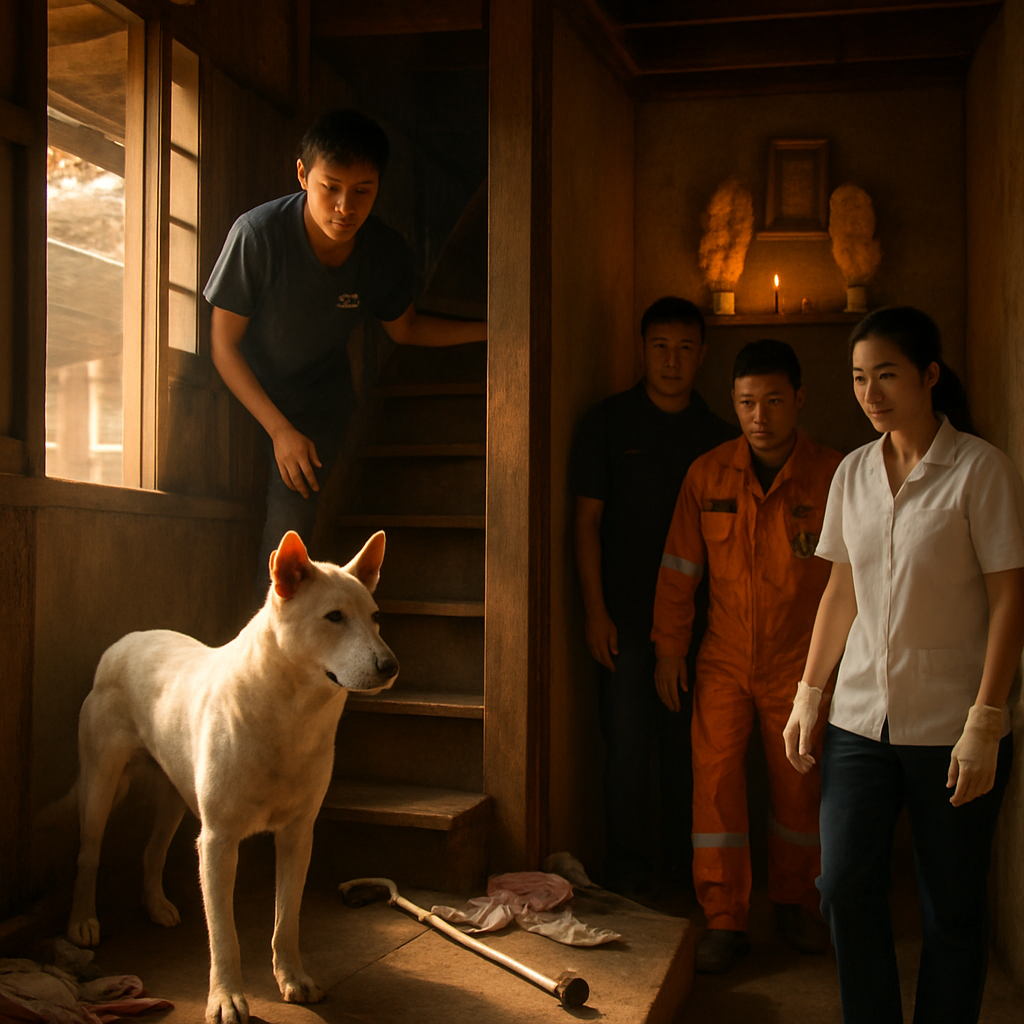
In a scene that was equal parts heartbreaking and quietly heroic, rescue workers in Nonthaburi faced an unusual obstacle while responding to a welfare check on January 12: a stubborn, fiercely loyal dog named Hippo who would not let anyone near his owner’s body.
The call came into Mueang Nonthaburi Police Station reporting an unresponsive elderly woman at a two‑storey wooden and concrete house on Soi Ngamwongwan 8. Volunteers from the Ruamkatanyu Foundation and an officer from the Institute of Forensic Medicine arrived to find the 77‑year‑old woman lying face up on the ground‑floor near a bathroom. Her belongings were close by and a stainless‑steel, four‑pronged walking cane lay knocked over — quiet clues that pointed to a sudden collapse rather than a struggle.
Standing guard over the scene was Hippo, a white Thai dog with the kind of devotion that scenes in movies are made of. According to relatives, Hippo had been a stray the woman adopted more than a decade ago. He had never been much for sharing her attention, and on this sad morning his protectiveness turned into a practical barrier: Hippo barked and lunged at anyone who approached, refusing to let rescuers enter the room where his owner lay.
Family members told rescuers that although the woman technically was the caller’s great‑aunt, the family always referred to her as “grandmother.” She lived alone with Hippo and, despite repeated invitations to move into a nearby house with relatives, she had preferred the quiet independence of her own home — and the company of her dog. When routine checks that the family performed went unanswered, they called for help.
Rescue worker Weerayut Phetkaemthong and the team faced a delicate situation: forceful entry could have escalated into a dangerous confrontation with a frightened animal, but any delay risked important time for the medical examiners. So the team improvised a kinder, cleverer solution. One volunteer quietly went upstairs to the second floor. As expected, curiosity — or perhaps simply the desire to check on his human — drew Hippo away from the doorway. The volunteers then blocked the stairs, keeping the dog occupied long enough for medical staff to enter without direct confrontation.
The approach worked. The medical examiner examined the woman and reported no visible signs of injury or a struggle. Given her medical history, the initial finding suggested she likely died of natural causes related to an existing condition. After the formalities, the body was released to relatives so they could carry out religious rites, as reported by Dailynews.
For those on the scene, Hippo’s behavior was a poignant reminder of the bond between humans and animals. He had fulfilled his duty to the end, refusing to leave his owner’s side even in the face of strangers and emergency lights. Passersby and rescuers alike remarked on the dog’s steadfastness — an awkward obstacle in an operational sense, but a stirring display of loyalty in every other way.
Such incidents also underline the practical challenges that emergency teams sometimes encounter when animals are involved. The Ruamkatanyu Foundation volunteers handled the situation with patience and ingenuity, opting to distract and redirect rather than escalate. Their tactful decision minimized stress for Hippo and avoided potentially injuring a frightened pet — an outcome that would have made a sad story even sadder.
The case in Nonthaburi was not the only recent report of a lonely death that surfaced in local news. Authorities in Prachin Buri also discovered a motorcycle taxi driver deceased in the bathroom of a police outpost; police estimated he had been dead for more than 24 hours before being found. Together, these stories highlight the vulnerability of people who live alone and the essential role of family check‑ins and community vigilance.
In the days following the discovery, relatives and neighbors reflected on the woman’s independence and her choice to live with Hippo. While grief was the dominant emotion, there was also gratitude — for the rescue workers who handled a tricky situation with compassion, for the dog who kept his vigil, and for the community that stepped in when routine contact failed.
At the heart of the incident is a simple, human truth: relationships matter, even — or especially — the ones we form with the animals who share our lives. Hippo’s watchful presence at the threshold of life and death served as a quiet testament to that truth, leaving those who heard the story both moved and mindful of the ways we look after one another.


















This story hit me hard — a dog refusing to leave his owner at the end feels like something out of a movie. It raises real questions about how communities check on elderly people who live alone. We should talk about practical, humane ways to prevent lonely deaths without stripping independence.
So heartbreaking and beautiful at the same time. Dogs are angels, seriously. Why don’t more people move in with family when they’re that old?
Maya, not everyone has family who can take them in or wants to lose their independence; plus cultural values and past family conflicts matter. The solution is community-based check-ins and better social services, not shaming the elderly. We can respect autonomy while improving safety.
Honestly, the volunteer trick was brilliant — distraction instead of force. But is this a sign of systemic failure when relatives only discover someone after they die? That’s worrying. Taxpayer-funded welfare checks should be routine for vulnerable people.
Routine welfare checks sound good until privacy and resource limits clash. Who decides who gets checked and how often? The slippery slope is real when government starts scheduling people’s lives.
Larry D, privacy matters but life is at stake. A mix of voluntary enrollment and community programs would reduce government overreach while saving lives. Neighbors and local groups can do a lot if they’re incentivized or supported.
As someone in my 60s, I get the urge to stay alone. But you have to accept some help. Adopt a neighbor watch, or at least give a key to someone trustworthy. It’s sad, but pride can be deadly.
From a public health perspective, this story underscores gaps in elder surveillance and social determinants of health. Living alone with limited social ties increases mortality risk, and policy should incentivize integrated care models. Also, the responders showed good animal-handling judgment that minimized harm.
Dr. Elena Morales, totally — integrated care and pet-friendly services are essential. Pets complicate interventions but often provide emotional support that reduces other risks. Any policy should account for human-animal bonds.
This is sentimental but also ethically complex: do we prioritize human intervention over animal attachment? The volunteers struck a fair balance, but the legal framework for accessing private residences in welfare checks is fuzzy in many countries. We need clearer protocols.
I just feel angry that people can be forgotten until it’s too late. Social media makes us connected yet isolated in person. Maybe mandatory family check-ins once a week should be a thing.
Mandatory check-ins by family are unrealistic and cruel for people with no family. Invest in community outreach and affordable assisted living. The state and NGOs should step up.
Also, why is there a stigma about moving in with relatives? Many older adults prefer dignity over dependency, and we should respect that while offering safer alternatives.
Can we please stop romanticizing deaths like this? Yes the dog was loyal, but the sad truth is neglect and broken social nets. Loyalty doesn’t solve systemic neglect.
Anika makes a valid point: it’s easy to fixate on an emotional image and ignore structural problems. However, emotional narratives can mobilize support. The challenge is converting sympathy into sustainable policy changes.
Exactly — crying about the dog on the internet doesn’t make day centers affordable. Advocacy needs follow-through or it’s just performative grief.
I’m more curious about the forensic side: how often do dogs actually obstruct investigations and how do teams train for that? Seems like they handled it perfectly here. Maybe more cross-training needed.
Carlos R, true. Training for animal behavior should be standard for first responders, especially in rural or older communities. Forceful entry is a last resort and can traumatize animals.
There are legal risks too. Entering a private home can lead to liability if mishandled. The volunteers’ improvisation was effective, but we need codified safe practices to protect both responders and animals.
This also ties into mental health resources — elder isolation often coexists with depression and chronic illness. If neighbors had better awareness and systems to report concerns earlier, outcomes might improve. Education campaigns could help.
I still think the dog is a hero. Why can’t more people be loyal like that? We need more animals in care homes.
Companion animals can have measurable benefits for mental health and longevity, but they also add complexity to medical emergencies. Policy must consider both benefits and operational challenges.
To build on earlier points: pilot programs that combine home visits, pet welfare checks, and telehealth could be low-cost and effective. Community volunteers paired with professionals might respect privacy while preventing tragedies.
Sam Lee, a pilot sounds good but will it actually reach the stubborn ones who refuse help? My neighbor refuses even simple visits. You can only do so much.
Auntie May, outreach should be gentle and culturally sensitive — start with services that respect autonomy, like meal drops and social calls from trusted volunteers. Compulsion rarely works; relationship-building does.
Also measure outcomes — pilots must be evaluated for reduction in delayed discovery and improved wellbeing. If data shows impact, scaling becomes easier to justify politically and financially.
Still, what happens to Hippo? The story didn’t say if relatives kept him or if animal services stepped in. The dog deserves care after that trauma. People forget animals suffer too.
grower134, good point. Post-incident plans for companion animals are often ad hoc. Standard procedures to reunite pets with family or place them humanely are needed.
I worry about unintended consequences: if responders always have to distract animals, will that embolden people to keep aggressive pets in risky situations? Regulations on pet ownership for seniors might be controversial but necessary.
That’s a slippery slope to blaming victims for their pets. Many elderly rely on animals for company — taking that away could worsen loneliness and mental health.
The middle path is better: support responsible pet ownership with resources like pet care assistance, temporary foster programs during emergencies, and community education. Punitive approaches don’t help.
We should also examine media framing. These stories can either push for systemic change or just be heartwarming clickbait. Journalists have a role in turning emotion into policy discussion.