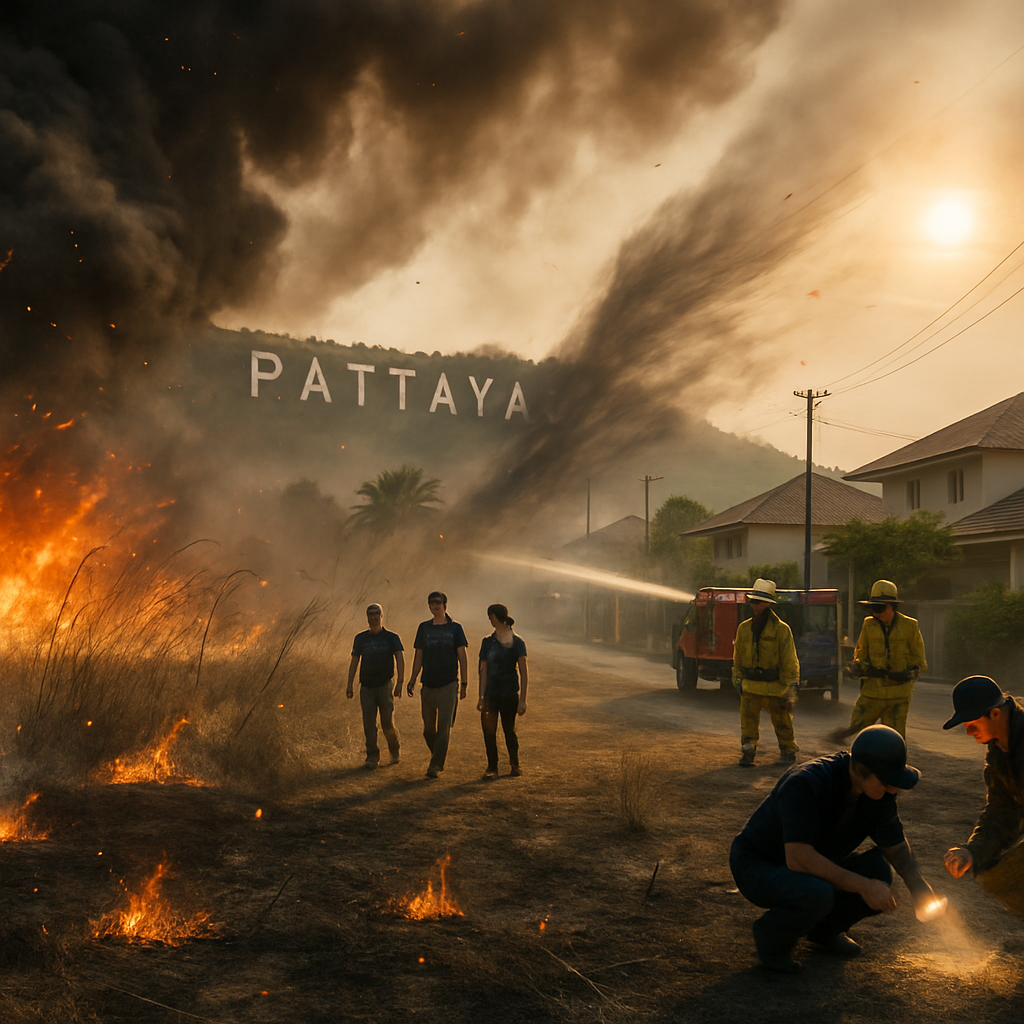
On the afternoon of January 8, Pattaya’s usually sun-drenched skyline was briefly cloaked in thick, ominous smoke as a fast-moving grassland blaze erupted in Bang Lamung district. What began near the community office on Moo 11 in Khao Talo at about 1:30 PM quickly ballooned into a serious incident, prompting a rapid response from firefighters and leaving locals and visitors staring up at a sky full of smoke and questions.
The day the wind turned against Pattaya
Fire crews from Nong Prue Municipality and Pattaya City answered the call with several engines on scene. Their speedy arrival matters, but the real adversary that afternoon was the weather: strong winds fanned the flames and pushed thick smoke across neighbourhoods, creating a surreal, hazy tableau that settled over parts of the city. By the time crews had the situation under control — roughly an hour after ignition — the blaze had consumed more than 10 rai of dry grassland (about four acres).
Miraculously, no homes were damaged and no injuries were reported, according to local outlets including The Pattaya News. Still, the heavy smoke and the speed with which the fire spread left many residents rattled and asking how something like this could happen so quickly.
Two fires, one worrying pattern
Adding to the concern was testimony from a 58-year-old community caretaker, Jom. She told local reporters that a smaller fire had broken out earlier in the day, shortly before midday. That blaze appeared to be extinguished by crews, but within hours a second fire erupted about 100 metres away. The proximity in both time and space led Jom, and later investigators, to question whether the incidents were connected.
Officials are treating the January 8 blaze as suspicious and are investigating the possibility of deliberate ignition. As of the latest reports, no suspects have been identified. The dual ignition points and timing understandably have authorities and residents on alert, especially during the dry season when vegetation fires can spread with frightening speed.
A reminder of how quickly everyday activities can spark disaster
The Pattaya blaze also brings into sharp focus how ordinary activities and small sparks can have disproportionate consequences. The report reminded readers of a September incident in which a townhouse fire in Pattaya began when welding sparks ignited insulation. In that case, swift action contained the damage to the kitchen area, but the incident forced residents to flee and underlined a universal truth: sparks don’t need much help to become infernos when the conditions are ripe.
Whether arson or accident, these events highlight vulnerabilities in urban and peri-urban areas where dry grasslands sit next to homes, offices and community buildings. The city’s patchwork of development, seasonal winds and dry vegetation create a recipe where a small ignition source can rapidly escalate.
What residents can do — simple steps that really help
- Report smoke immediately: Call local emergency services as soon as you spot smoke or flames. Early reports save time.
- Keep safe distance: Smoke inhalation is dangerous. If you’re near the area, move upwind and avoid breathing in the plume.
- Clear defensible space: Homeowners near grasslands should keep vegetation trimmed and store flammable materials away from structures.
- Be vigilant with hot work: If you hire welding or cutting services, ensure sparks are contained and that crews have proper fire watches and extinguishers.
Looking ahead
Investigations into the Khao Talo fires are ongoing. For now, the community breathes a little easier that no one was hurt and no houses were lost. But the questions remain: were the ignitions deliberate, and if so, why? Authorities will be probing those angles while residents and officials alike take another look at how to bolster fire prevention and readiness.
Pattaya’s close call on January 8 is a stark reminder that fires don’t announce themselves politely. They arrive fast, fed by wind and dry brush, and they demand local vigilance, clear-headed responders and, frankly, a little neighborhood cooperation. Whether you live in Bang Lamung, visit the beaches, or simply travel through, it’s a good time to tune up your own fire-safety habits — because when the wind changes, every precaution counts.

















This reeks of arson to me, two fires close together is not a coincidence. Someone wanted that land cleared fast and easy. Authorities need to stop being polite and show CCTV or arrest someone already.
Not every grass fire is a conspiracy, sometimes dry season and careless smokers do the trick. But yeah, two ignitions is odd and worth probing deeper.
I agree it’s not proof, but patterns matter. If developers or shady owners benefit, follow the money and you’ll find motives.
I got scared when I saw the smoke, it looked like a movie. Are people really burning land on purpose? That makes me mad and sad.
From an investigative standpoint, dual ignition points raise red flags but don’t confirm arson alone. Forensics and witness statements are key, and those are underway.
Planning failures are obvious here — leaving dry grasslands next to communities is a recipe for disaster. Municipalities should create buffer zones and enforce trimming rules every dry season.
We keep telling the council to clear the verge, but it always takes a tragedy to get movement. The patchwork development around Pattaya is out of control.
Buffer zones help but need funding and enforcement. Community volunteer brigades could be a cost-effective supplement if organized properly.
Exactly — community brigades plus municipal oversight could cut risk dramatically. Prevention beats a thousand emergency responses.
In some villages people burn old grass to make way for new crops, maybe someone was being careless. But doing it near houses is stupid and dangerous.
Traditional burning is not the same as random ignitions near communities, Sawang. There’s a world of difference between controlled agricultural burns and apparent deliberate fires.
Controlled burns require permits, wind checks, and fire watches. In windy urban fringes those checks are often ignored, and the climate is only making conditions worse.
I knew people who did it safely, but those folks were careful with wind and had helpers. This case sounds sloppy at best, criminal at worst.
Farmers sometimes slash and burn to prepare soil, but now with tourism and developers nearby it’s a liability. Blame can’t always land on small farmers though, big projects encourage risky shortcuts.
So we blame both the poor farmer and the rich developer then? Sounds fair, but who’s going to fix it? The council won’t move without heat from voters.
Training and subsidized equipment for safe burns would help. Or better, provide alternatives so farmers don’t need to burn at all.
Exactly — give people options and incentives. Criminalizing smallholders without support just pushes practices underground and makes fires worse.
Investigators will look at who benefits and who had access that day. Motive and opportunity often point to the culprit, but we need physical evidence.
My mom told me not to go near the windows when the smoke came, it was so loud with fire trucks. I don’t understand why someone would start fires on purpose, it seems mean.
Sometimes people do stupid things for profits or out of anger. Or because they think nobody will catch them, which is wrong.
Children seeing smoke is traumatic and underlines the human cost beyond property. We must teach and build systems that prevent these hazards.
Thanks for saying that, Dr. Emily. I hope the city helps families who were scared and teaches kids about fire safety at school.
Climate change increases frequency of dry, windy windows where fires spread fast. Urban planning needs to integrate fire risk models into zoning and development approvals.
Not everyone accepts climate arguments, but local planning is low-hanging fruit regardless. Make building codes better and stop allowing random developments near flammable lots.
Sometimes I think officials use climate as an excuse to avoid responsibility for bad planning. Both are important and neither should be a dodge.
They’re complementary issues, Somchai. Attribution doesn’t absolve local governance failures; it underscores urgency to adapt and prevent.
I smell developers every time a suspicious fire appears near land being eyed for projects. Old trick: burn first, claim it’s abandoned, then buy cheap.
Exactly my point earlier. Follow the developers’ ledgers and you’ll find suspicious acquisitions. It’s often about profit, not farming.
Accusations are easy online but investigators must rely on evidence. If there are suspicious land transfers, prosecutors can subpoena records quickly.
I know a few cases locally where land changed hands after a ‘mysterious’ fire. Correlation isn’t proof, but it’s a pattern worth watching.
People have watched those plots for years, waiting for a chance. When fires happen, you can see real estate agents suddenly appear like vultures.
Hats off to the firefighters for getting it under control in an hour. Quick response saved homes and lives, even if we still need answers about cause.
If it keeps happening, tourists might avoid Pattaya in high season and that hurts everyone. Prevention is part of protecting the economy too.
True — safety and perception affect tourism. Municipalities should publicize prevention steps and emergency readiness to reassure visitors.
Air quality was terrible for a couple hours, people with asthma were coughing. I want a hotline for smoke complaints that actually gets action, not a recording.
Hotlines exist but response times and accountability are weak. Maybe a transparent dashboard with real-time incidents would push officials to act faster.
People should be more proactive — report, film, and share locations. Social pressure can sometimes force quicker action than bureaucracy.
I tried that and the post got taken down as ‘unverified’ by the page admin. We need official channels that don’t dismiss citizens’ evidence.
We’re treating it as suspicious and collecting samples from both ignition sites. Forensic markers and witness timelines will be central to determining cause.
Chain of custody on samples and rapid lab turnaround are essential. If the labs are overwhelmed, evidence can degrade and cases fall apart.
How transparent will the probe be? Locals deserve updates, not radio silence that breeds rumors and finger-pointing.
We will release findings when substantiated. Premature statements can compromise the case, but I hear you — timely summaries are possible without revealing sensitive details.
Maybe the wind wanted a haircut. Jokes aside, wind is the real villain sometimes, not just people. Still, humans can manage risks better than they do.
Haha Kai but wind can’t set a match, people can. We need to teach everyone to be careful and not play with fire.
Lighten up, Kai, but your point stands — environmental factors amplify human error. Good planning accounts for both.
Exactly, a little planning and common sense goes a long way. Also more bins for cigarettes and fewer loose sparks around dry fields.