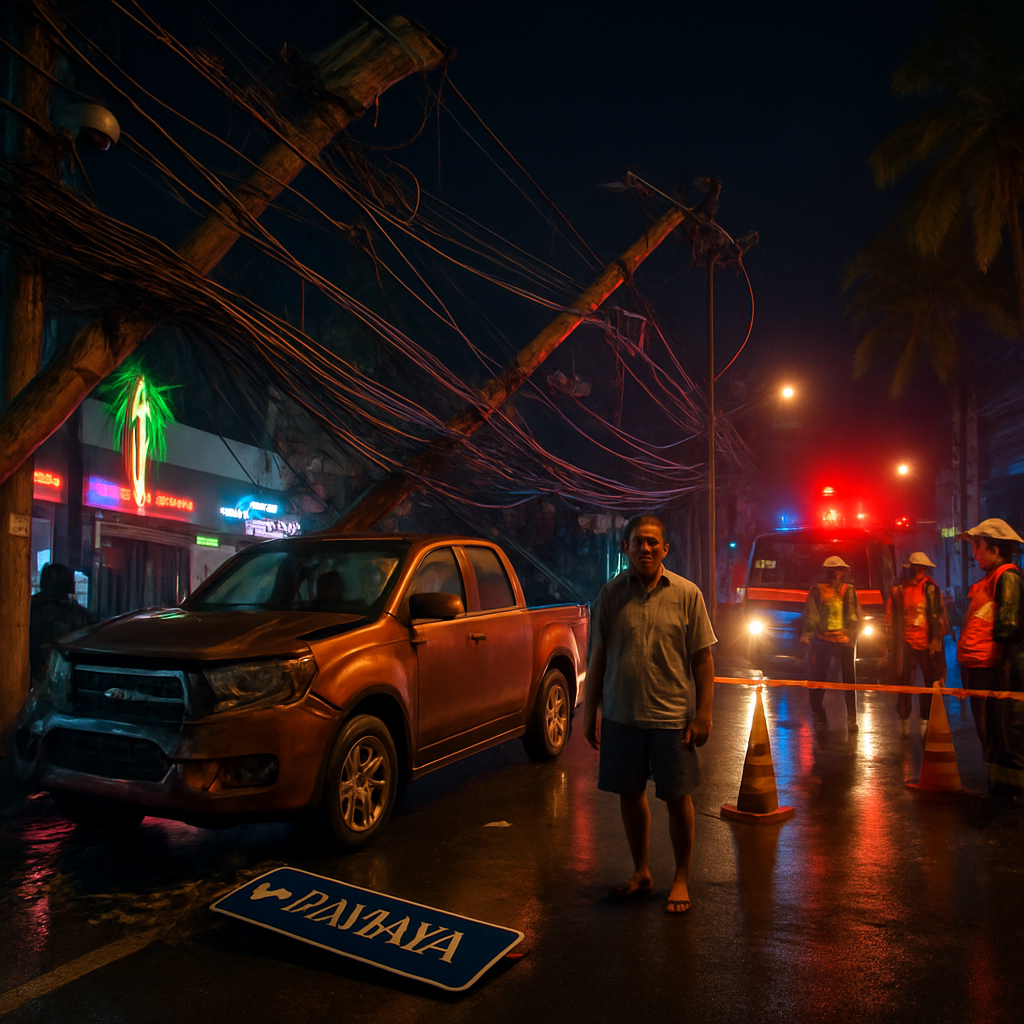
What started as a routine late-night run through Pattaya turned into a dramatic roadside spectacle on the evening of January 11, when a bronze Toyota pickup truck collided with and toppled three high-voltage power poles along Soi Paniad Chang. The crash — which occurred at precisely 10:36 p.m. in Bang Lamung district, Chon Buri — left live wires swinging across the road, forced an immediate police shutdown, and sent rescue teams scrambling to make the scene safe.
Chaos on Soi Paniad Chang
Onlookers described a scene that felt equal parts dangerous and surreal. The collapse of three electricity poles didn’t just block the street; it left a tangle of live power lines and communication cables dangling dangerously low, and even knocked over a directional sign. Emergency responders from the Sawang Boriboon Rescue Foundation and the Pattaya Electricity Authority moved fast, cordoning off the area to protect residents and motorists from the risk of electric shock.
The Driver and the Story He Told
Beneath the wreckage sat the bronze pickup, its front end battered but not engulfed in flames. The driver — a 57-year-old Thai man — wandered about the scene, visibly disoriented but not showing obvious physical injuries. He told rescue workers that he had swerved to avoid an oncoming vehicle, lost control around a curve, and struck the pole. Whether that maneuver was a reflex to avoid a genuine hazard or a split-second error remains part of the on-site investigation.
Eyewitness Accounts and Investigations
A 21-year-old delivery rider who witnessed the crash told police the pickup was returning at high speed before it lost control. That testimony, coupled with the driver’s account, has prompted authorities to look more closely at traffic speed and the behavior of nearby vehicles leading up to the incident.
Officials have taken sensible precautions: the driver was subject to a breathalyser test, and investigators are reviewing nearby CCTV footage to piece together what really happened. For now, the official story is still being written.
Traffic Disruption and Safety Work
Traffic on Soi Paniad Chang was blocked late into the night while Pattaya Electricity Authority crews and emergency teams cleared debris and secured the live wires. With three high-voltage poles down, the priority was obvious — make the area safe and restore power lines without exposing workers or the public to further danger.
Given the presence of high-voltage lines on the tarmac, the quick cordon and controlled response likely prevented what could have been a far worse outcome.
Not an Isolated Incident
This isn’t the first time a flashy collision has taken out utility infrastructure in the region. Just last December, a Lamborghini slammed into a roadside power pole near the Bang Rak Noi Tha It MRT station in Nonthaburi, severely damaging its front end and toppling a pole. That crash — like the Pattaya incident — served as a stark reminder that even a brief lapse at speed can have disproportionate consequences for public safety and local infrastructure.
Lessons and Local Reactions
Residents and regular commuters on Soi Paniad Chang will likely remember this night for a while. Beyond the immediate disruption (and the viral photos and chatter that followed), the incident raises a few hard questions: Are speed limits being observed on curvy stretches? Was lighting sufficient at the curve? What role did the other vehicle — the one the driver said he swerved to avoid — play?
Authorities’ use of CCTV footage to answer those questions is standard procedure, but it’s also reassuring. In an age when cameras are as common on streets and intersections as traffic signs, footage often provides the decisive details that witness accounts alone cannot.
Finally
For now, there were no reported injuries beyond the shaken driver, and crews worked through the night to get power lines fixed and traffic moving again. The exact cause of the crash will emerge from breathalyser results, CCTV review, and the ongoing police inquiry — but the takeaway is clear: a split-second driving decision can topple more than just a vehicle. It can bring down vital infrastructure, threaten the safety of passersby, and leave a neighborhood dark and disrupted until the mess is cleaned up.
As Pattaya tidies up the aftermath, locals will be watching to see what the investigation reveals — and hoping that the next late-night trip home ends with nothing more dramatic than a comfortable pillow and a good night’s sleep.


















This is ridiculous — the driver should be held accountable for toppling three poles. Even if he swerved, you slow down instead of ending up like a wrecking ball on the street.
Slow down? Easier said than done when another car suddenly appears in your lane at night. We need better lighting and clearer road markings on that curve.
I hear you about lighting, but responsibility still matters. The driver said he swerved; that implies choices were made — we can demand safer roads and safer driving at once.
Both points are valid. Poorly lit curves + reckless drivers = disaster. Fix infrastructure and enforce speed limits already.
This story highlights a systemic problem: poles so close to the road are a public hazard. Urban planners and the electricity authority should be embarrassed that one accident can pull down critical infrastructure.
Pole placement is a trade-off of cost versus safety. Burying lines costs millions and routine maintenance is cheaper, but repeated incidents suggest long-term thinking is needed.
Exactly — short-term savings are false economy. The cost of emergency responses and power restoration probably outweighs the price of safer design in the long run.
Burying cables isn’t always practical in flood-prone areas and can be expensive, but shielding poles and adding crash barriers near curves could help right now.
People keep celebrating CCTV like it’s magic, but footage can be edited or misread. I want transparency: release the clips and timestamps so we can see what truly happened.
CCTV helps, but we have protocols to protect privacy and ongoing investigations. Footage can be released after initial inquiries unless it compromises a case.
Fair, but too often ‘ongoing investigations’ is used to delay accountability. If the footage clears the driver or shows another vehicle at fault, the public deserves to know asap.
Flashy cars and speed culture are the problem. Whether Toyota or Lamborghini, people who treat streets like racetracks will keep destroying public things and hurting others.
Not everyone who speeds owns a flashy car. This pickup could have been a regular guy making a late-night mistake, so let’s not moralize too quickly.
Sure, mistakes happen, but culture matters. When society glamorizes speed you get more of this; change the culture and you reduce crashes.
I think enforcement and education beat moralizing. More speed cameras, regular checkpoints, and driver education would actually change behaviour.
From an engineering standpoint, three poles toppling suggests either sequential failure from impact or an unusual load transfer. Investigators should check pole foundation condition and anchoring.
That sounds technical but important. Could old poles be more dangerous than new ones when hit?
Yes, degraded materials, rusted bolts, and rot in wooden bases significantly reduce impact resilience. Maintenance records will be telling.
Wow that sounds scary. Live wires in the road? I bet people were really scared and lucky no one got hurt.
Very lucky indeed. People should keep far away and wait for the rescue teams to deal with live wires; touching anything could be deadly.
I will tell my friends to always stay behind barriers and not go near downed lines. Simple rules can save lives.
Breathalyser tests and CCTV are standard. But I doubt the law will be strict enough — fines, maybe, but no real punishment unless someone dies.
Thailand has been increasing traffic penalties, but enforcement is the issue. If fines aren’t costly relative to income, they don’t deter.
Exactly. Without meaningful deterrents like license suspension or mandatory training, speeders won’t change until they lose something important.
Saw the crew work that night; quick cordon and trained protocols kept everyone safe. Kudos to rescue and electricity authority teams for efficient coordination.
Thanks for the update — it’s reassuring to hear responders were on top of it. Public praise helps morale for those teams.
Appreciate that. We also ask locals to avoid the area and report any damaged poles or exposed wires promptly to prevent secondary incidents.
Why are poles so close to the road in the first place? Urban planning seems reactive, not proactive, and residents pay the price when something bad happens.
Agreed. Planning reacts until a tragedy forces an upgrade. Regular audits of risky stretches should be mandatory, not optional.
Exactly. If audits were routine, maybe they’d add barriers or move poles before someone hits them.
This incident is a reminder that modern life’s small moments — a split-second swerve — can cascade into communal disruption. Infrastructure binds society in fragile ways.
It always seems like electricity crews work through the night while other services delay until morning. Why can’t restoration be faster without risking workers?
Night work is dangerous but sometimes necessary. Safety protocols slow things down for a reason, though better-prepared rapid response teams could shorten outage times.
I get safety, but we should invest in better rapid-response infrastructure teams so neighborhoods aren’t left in the dark for long.
If the driver was disoriented but uninjured, could medical issues have played a role? Strange behavior at the scene sometimes hides medical emergencies.
Possible. Toxicology and medical checks are routine if there’s reason to suspect a health event. Breathalyser only addresses alcohol, not other conditions.
The comparison to the Lamborghini crash last December just shows this isn’t isolated. Speed kills, period. People don’t learn unless consequences are immediate and real.
Immediate consequences do help, but societal change also needs empathy and public education, not only punishment.
Local businesses must have been affected by the outage. Small vendors can lose a night of income because of one driver’s mistake, and that’s often forgotten.
Good point — ripple effects matter. Insurance and municipal compensation policies should cover businesses hurt by infrastructure damage from crashes.
The driver’s story about swerving for another vehicle raises red flags. If proven, the other party needs accountability too; leaving the scene of an accident is common and cowardly.
Investigators will check for hit-and-run evidence on CCTV and witness statements. If another vehicle caused the swerve and fled, there will be follow-up.
I live near Soi Paniad Chang and heard everything. It sounded like brakes and a big crash. Very traumatic for residents — we worry about safety at night now.
As a commuter I’d worry too. Maybe neighborhood associations should petition for traffic calming measures at that curve.
Public infrastructure is underpriced in budgets until disaster hits. We should redirect some tourism taxes into safer streets — Pattaya gets many visitors who rely on safe roads.
Media always focuses on dramatic photos, but we never hear about the long-term fixes. Will the poles be upgraded or just patched? Accountability ends at the news cycle for many agencies.
Patching first is normal to restore service quickly; planning for upgrades follows. The public should demand a timeline for permanent fixes.
I drove by the next morning; crews had neat organized work. Still, it’s scary that such chaos can happen so fast. Drivers need to respect curves and speed limits.
Yes! I told my parents to go slowly on curves now. It’s not worth risking a whole neighborhood.
Maybe the authorities should install guardrails in front of utility poles on dangerous stretches so a single vehicle doesn’t take them down.
Guardrails help, but they need proper design or they can cause vehicles to ricochet into other hazards. Still worth studying for that curve.
If CCTV was prevalent, why are we still guessing? It sounds like selective release of footage. Transparency would reduce speculation and calm the internet mobs.
Evidence must be handled carefully; premature release can taint witness statements and legal outcomes. But we agree transparency post-preliminary inquiry is appropriate.
I appreciate the praise for crews, but residents deserve a clear plan presented publicly: audits, fixes, timelines. Otherwise these conversations vanish next week.
The human element is neglected: drivers who are older may have slower reactions. The driver’s age (57) could matter if vision or reflexes played a role.
That’s sensitive but true. Mandatory health checks for older drivers would be controversial but might reduce such incidents.
Can we organize community first-aid and emergency awareness sessions? If people know to keep distance from live wires, collateral harm drops dramatically.
Great idea — we run community workshops and would welcome volunteers. Public training makes a big difference in emergencies.
I’m skeptical that the driver’s breathalyser will tell the whole story. There are other substances and medical issues that standard roadside tests miss.
True; full toxicology panels are different from breathalysers. The police often follow up with more comprehensive tests if circumstances warrant.
Social media will run wild with photos and blame before facts come out. Be careful what you accept as truth until the investigation is complete.