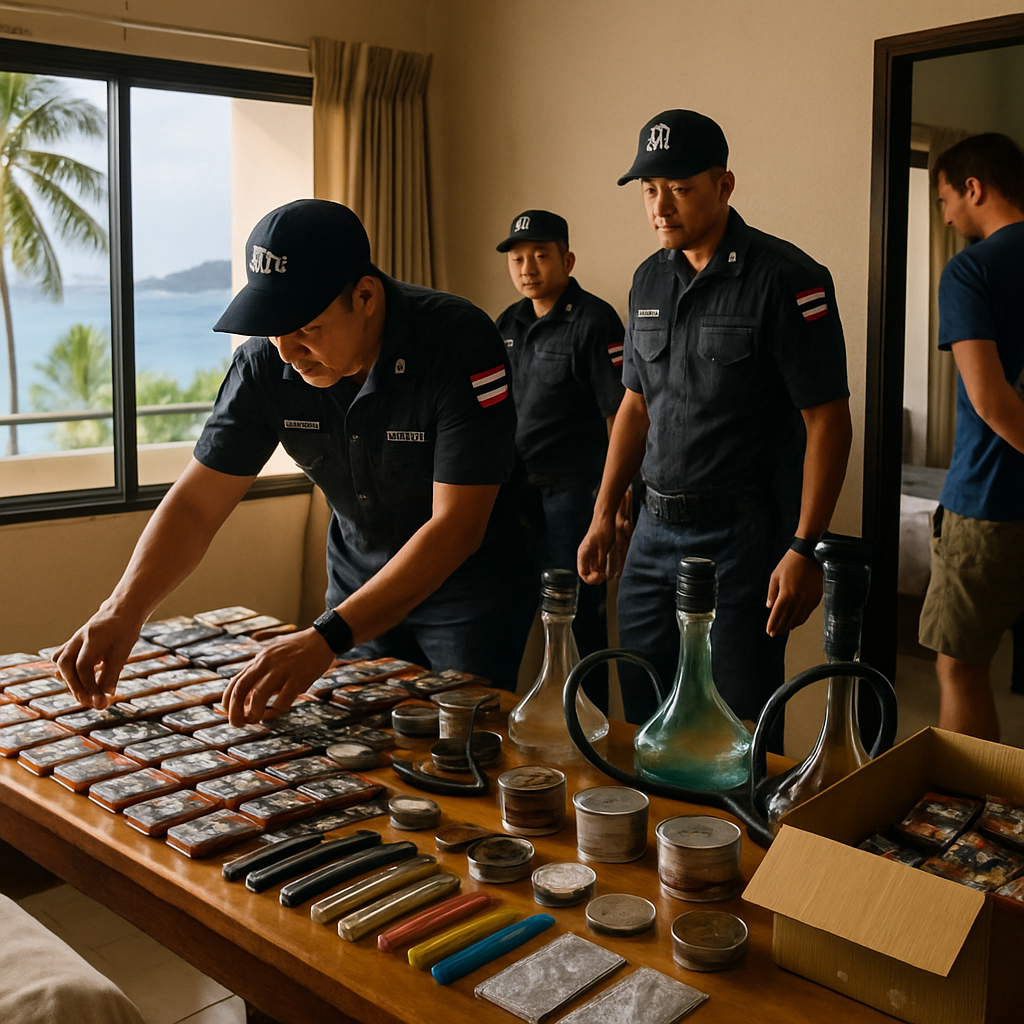
Phuket police have once again cracked down on the island’s underground hookah trade. On December 9, officers from the Region 8 Special Operations Unit raided a rented room in Soi Hua Tiew, Cherng Talay, and arrested a 41‑year‑old Russian national identified as Maksim Shalygin after discovering a substantial cache of hookah products — locally known as baraku.
The search uncovered a total of 361 items of evidence: 296 packets of hookah tobacco and 65 pieces of hookah equipment. The quantity and packaging suggested the goods were being stored for resale rather than personal use. Shalygin was found inside the residence during the raid and was taken to Cherng Talay Police Station for questioning and legal processing.
Authorities have charged Shalygin under several provisions of Thai law. The alleged offences include:
- Section 24 of the Tobacco Act — sale or possession of smuggled tobacco products without excise tax stamps. Offenders face fines equal to 15 times the unpaid tax value.
- Section 246 of the Customs Act — concealing, selling, transporting, or possessing smuggled goods. Penalties can include up to five years in prison, a fine worth four times the value of the goods including tax, or both.
- Sections 29/9 and 56/4 of the Consumer Protection Act — covering the sale of baraku products, electric baraku, e‑cigarettes, hookah substances, and refilling liquids. Violators may face up to three years’ imprisonment, a fine of up to 600,000 baht, or both.
Photos of the seizure were shared on Facebook by Newshawk Phuket (เหยี่ยวข่าว ภูเก็ต), underlining the growing public scrutiny of illegal hookah sales across the province.
This bust is far from an isolated incident. Phuket and other provinces have seen a string of operations targeting contraband hookah products, illegal vapes and smuggled tobacco over the past year. Just three weeks prior, officers from the Phuket Provincial Defence Office raided a food and drink outlet in Kathu and arrested a man for selling hookah equipment and alcohol to students. That raid turned up a dozen hookah sets, 327 grams of hookah tobacco, used pipes, nozzles, charcoal, foil and a small stove.
In September, customs officials in Songkhla announced one of the largest crackdowns of the year when they seized more than 4 million baht worth of smuggled cigarettes, vapes and hookah equipment. And earlier in 2024, police raided an entertainment venue on Bangla Road where seven people — including a foreign store manager — were detained for selling vapes and offering hookah services to tourists.
Why the heat on baraku? Authorities cite several concerns: tax evasion, the health risks of unregulated tobacco and vape products, and the involvement of criminal distribution networks. Hookah and related paraphernalia, when smuggled or sold without safety checks and taxation, not only undermine legitimate businesses but can also expose users — often tourists and young locals — to dangerous products and harmful marketing practices.
For visitors and residents, the message is clear: buy from licensed vendors and be aware that possession of unregulated hookah tobacco and equipment can carry serious legal consequences. For operators in Phuket’s nightlife and food scenes, enforcement appears to be stepping up, with multi‑agency raids becoming more common as authorities try to stamp out an illicit market that has proved both lucrative and persistent.
The Cherng Talay arrest adds to a pattern of intensified enforcement across southern Thailand, and it’s likely investigators will continue tracing supply chains to disrupt those who move smuggled tobacco and vape items into the market. As the case against Shalygin proceeds, police will be careful to build evidence that proves intent to sell, not merely personal possession — a key distinction in Thai law.
Keep an eye on local updates as the legal process unfolds in Cherng Talay. For now, the seized hookah tobacco and equipment serve as a reminder that even in paradise, the rules still apply — and that Phuket’s enforcement agencies are keeping watch on anything that puffs up outside the law.


















Thanks for the thorough write-up — this raid shows how enforcement is getting serious in Phuket. The legal distinctions between possession and intent to sell will be pivotal in court. I’ll follow the case and post updates if prosecutors file charges.
As a Russian living here, I worry this reads like targeting foreigners more than a neutral law enforcement action. Maybe he was just storing for friends? The punishment described seems excessive for what many call a cultural pastime.
Elena, cultural pastime or not, if he was selling unregulated tobacco and avoiding taxes that’s illegal. Smuggling undermines local businesses and puts people at risk.
From a public health lens, unregulated hookah tobacco can contain contaminants and unknown additives. Tourists and teens exposed to these products face real health harms, regardless of cultural context.
I get the health point, Dr. Chen, but enforcement should be consistent and not scapegoat expats. There are licensed vendors nearby who sell similar products.
Finally. These underground sellers have been ruining the island’s reputation and cheating the system. If tourists get sick from dodgy stuff, it’s our healthcare that suffers too.
Enforcement helps, but the law requires proving intent to sell. Simply finding many packets isn’t automatic proof — investigators need corroborating evidence like invoices or ads.
Agreed, Helen. But 361 items is a lot. The scale seems to indicate resale. I’d rather see targeted crackdowns than random arrests, though.
The public health implications are understated in many reports. Hookah smoking can deliver nicotine and toxins comparable to cigarettes, and unregulated liquids may include heavy metals. Preventing unregulated sales is a legitimate government interest.
This is dumb. People should be able to smoke their hookah. It’s their choice. The police are wasting time on small business owners instead of catching real criminals.
But if it’s illegal and dangerous, why should we support it? I don’t like smoking though.
Choice doesn’t include breaking laws or exposing minors. We need regulations for safety, not anarchy in the bars.
I’m not for minors getting hooked, but legal adult use and small vendors are different from mafia operations. The article lumps everything together.
This opens a bigger question: are penalties proportionate? Fines equal to 15 times unpaid tax value sound punitive and could bankrupt people. There’s a balance between deterrence and justice.
When taxes are evaded, legitimate businesses lose out. Harsh fines are sometimes the only way to deter organized sellers who treat illicit trade as normal business.
But enforcement must distinguish between small-time sellers and organized smugglers. Blanket heavy penalties risk injustice.
As a tourist, this scares me. Could I get in trouble for buying a hookah at some beach bar? The rules are confusing and locals sometimes ignore them. Tourists need clearer warnings.
The law should be taught to hospitality workers. Selling to students, as noted in previous raids, is especially troubling. Bars must take responsibility for who they serve.
As a parent, I hate hearing about students being sold alcohol and hookah. Enforcement needs to protect kids first.
Many venues cut corners to make quick money. If they’re targeting minors, they deserve shutdowns.
There’s an ugly undertone here: foreigners, especially Russians, often get more scrutiny in tourist towns. We should be careful not to let xenophobia drive policing. Equal treatment matters.
I disagree. The law is the law. If foreigners break it, they should be treated the same as locals. The issue isn’t nationality but actions.
Vladimir, I just want fair process. Too many cases end up judged in public first, then in court.
Legally, prosecutors will need to show intent to distribute. Quantity, packaging, communications, and customer records matter. Without that, convictions could be overturned on appeal.
As a student, I find the overlap of customs and consumer protection law fascinating. Proving ‘intent’ often relies on circumstantial evidence like scales or multiple packages.
Helen, could thorough cross-agency cooperation (customs, consumer, police) make convictions more likely? The article hints they work together increasingly.
This is the classic show-raid: flashy photos, public shaming, and vague charges. How many of these cases end in meaningful convictions? I want to see court records, not just Facebook posts.
We publish proofs once cases progress. Public interest is valid, but patience is needed for legal processing and evidence collection.
Exactly — media loves the drama. Until we see charges proven, it’s just clickbait and reputational damage.
This crackdown will ripple through tourism. Guides and small bars may lose income if enforcement is unpredictable. Authorities should provide clear licensing paths for vendors.
We encourage legal compliance and training for operators. Illicit markets hurt Thailand’s brand. Assistance programs are being discussed.
Tom, that’s a good point. If authorities coupled enforcement with accessible licensing, it might reduce illicit trade and protect livelihoods.
People keep romanticizing ‘small vendors.’ But when big seizures hit, it shows organized supply lines. Tracing smugglers upstream matters more than fining a shopkeeper.
I don’t understand the legalese but I support shutting down places that sell to kids. My teenager should not be exposed to hookah or vapes.
If the defence argues personal use, prosecutors must counter with distribution indicators. Social media ads or bulk packaging could be decisive in court.
This is scary. I used to see hookah at parties. If it’s illegal, why do stores still sell it? Rules are confusing for kids.
Proactive patrols and inspections are ongoing. We urge residents to report illegal sales to ensure swift action and evidence gathering.
Balance is key: protect public health while supporting legitimate tourism businesses. We will work with law enforcement to minimize collateral damage.
As a local vendor, licensing processes can be opaque and costly. It’s hard to compete with cheaper black-market goods. Authorities need to simplify compliance.
Lots of talk about law, but little about corruption. Who’s profiting from the smuggling rings? Arresting a street-level seller won’t stop the supply chain.
I tell clients to avoid unlicensed venues. But they’re sometimes the most tempting for cheap nights out. Education for tourists is lacking.
Consumer protection laws exist for a reason: unregulated products can be dangerous. Sellers who circumvent those rules jeopardize public safety and fair markets.
Why aren’t outlets taxed equally? If taxes are too high, people will always look for cheaper illegal options. Fiscal policy drives behavior here.
This story highlights larger policy failures: demand, enforcement gaps, and lack of safe legal alternatives. Fixing one corner won’t solve the market.
I’ll believe justice is served when courts publish outcomes, not when photos appear on Facebook. Public trials, not public virtue-signaling.
Transparency in prosecution and careful evidence presentation will strengthen convictions and public trust. Knee-jerk public shaming risks miscarriages of justice.
We need both accountability and fairness. Stamp out criminal networks but avoid blanket stereotyping of communities and tourist groups.