RID: 15bn cu m dry-season water in reserve
Thailand's irrigation chief says 15 billion cubic metres of water is held in reserve, with 28 billion allocated for dry-season use as Chao Phraya dams sit near 77 percent.
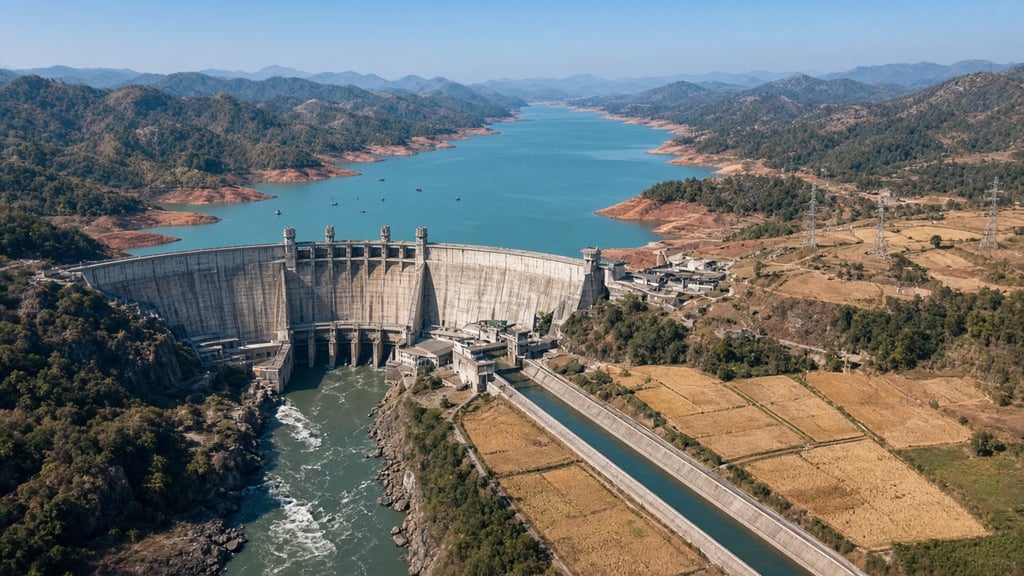
Thailand's Royal Irrigation Department opened its 2026/27 dry-season water plan with a blunt assurance: irrigated land should not run short. Director-general Wittaya Kaewmee said the department is holding about 15 billion cubic metres in reserve against a possible May to August dry spell, while scheduling 28 billion cubic metres for delivery. The volume stored for dry-season delivery is 43,479 million cubic metres, a stock RID called relatively complete, especially in the North. Areas inside irrigation schemes are expected to be covered. Land beyond those canals is being left to the Department of Royal Rainmaking and Agricultural Aviation.
What the reservoirs actually hold
RID's mid-November water watch recorded 63,889 million cubic metres in large and medium reservoirs, or 83 percent of combined capacity, of which 39,913 million cubic metres was usable. That is 5,633 million cubic metres below the same week in 2025, yet operators still have 12,836 million cubic metres of unused room.
The four Chao Phraya spine dams that feed the Central Plains remain the strategic core. On 15 November, Bhumibol Dam on the Ping River in Tak held 9,691 million cubic metres (72 percent, 5,891 million usable). Sirikit Dam on the Nan River in Uttaradit held 7,497 million cubic metres (79 percent, 4,647 million usable). Khwae Noi Bamrung Daen stood at 868 million cubic metres (92 percent) and Pa Sak Jolasid at 911 million, slightly above its normal retention level. The four-dam total was 18,967 million cubic metres, or 77 percent, with 12,259 million cubic metres usable. Bhumibol, completed in 1964, is Thailand's tallest dam at 154 metres, with a 13.46 billion cubic metre reservoir. Sirikit stores up to 9.51 billion cubic metres. UNESCO basin studies note that the pair control about 22 percent of annual Chao Phraya runoff.
Households first, then ecology, then farms, then factories
RID's allocation order has not changed. Drinking water and other household use come first. Ecosystem flows, including the freshwater pulse used to push Gulf salt water back down the Chao Phraya, Tha Chin, Mae Klong and Bang Pakong, come second. Agriculture is third. Industry, including Eastern Economic Corridor plants, is fourth. The national dispatch plan is 28,009 million cubic metres. By 23 November the department had already released about 2,955 million cubic metres, or 11 percent of that schedule.
Chao Phraya agriculture is budgeted 9,000 million cubic metres from 12,239 million cubic metres of basin source water, covering a planned 7.69 million rai, with more than 4,000 million cubic metres held back inside the basin for a late dry spell. Nationwide, RID expects about 15 million rai of dry-season farming. Off-season rice planting since 1 November has already reached about 1.52 million rai, of which 1.19 million rai sits in the Chao Phraya basin. At the Chao Phraya Dam in Chai Nat, operators had cut discharge to 700 cubic metres a second by early November, a shift from flood-control releases after a rainy season that hit 62 provinces.
The watch list: Isan, leftover floods, and EEC demand
The national 83 percent figure hides a regional split. Mid-November storage was 76 percent in the North (23 percent below 2025), 69 percent in the Northeast (24 percent below last year), 97 percent in the Central and Western regions, 98 percent in the East, and 72 percent in the South. The Northeast is the drought-watch zone. Rain-fed farms and smaller Isan reservoirs have a thinner cushion even when the Chao Phraya dams look healthy.
That gap was already flagged in September, when RID reported rainfall about 10 percent below normal and Eastern Economic Corridor reservoirs stood at about 460 million cubic metres, or 61 percent. The later fill to 83 percent nationally and 98 percent in the East shows the late-season catch-up. RID still says EEC demand and supply are in balance, but it is rewriting industrial water plans after Board of Investment data implied data-centre loads of about 60 million cubic metres a year, a figure the Office of the National Water Resources is also reviewing. Not every farm is dry. The Pho Phraya lowland in Suphan Buri is still pumping leftover floodwater from the Tha Chin, with RID targeting 15 January 2027 before a new off-season rice round. Eleven provinces remained flood-affected in early November, while the South is still under heavy-rain warnings.
What This Means for Expats and Travelers in Thailand
Bangkok tap water and most Central Plains municipal supplies sit at the top of RID's queue, ahead of off-season rice and EEC factories. Condo residents in the capital should not see irrigation-driven rationing if the 15 billion cubic metre reserve is actually held. The weaker link is outside the big canals. Island systems such as Koh Samui are not fed by Bhumibol or Sirikit. Samui already rotated tap water in July after production fell to about 40 percent of normal. Travelers heading to the Gulf islands, and anyone on a well in rain-fed Isan, should treat the national 83 percent figure as a Chao Phraya statistic, not a local guarantee. Saltwater intrusion remains the silent Bangkok risk: part of the ecology allocation is spent pushing Gulf water downstream so Metropolitan Waterworks intakes stay fresh. If RID has to defend that pulse, off-season rice at the edges of Ayutthaya and Pathum Thani is the usual first cut. EEC data-centre loads of about 60 million cubic metres a year are small beside the national allocation, yet they concentrate on the East Coast. Residents in Chonburi, Rayong and Pattaya should watch local reservoir notices more than the Chao Phraya dashboard.


No comments yet. Be the first to join the conversation.