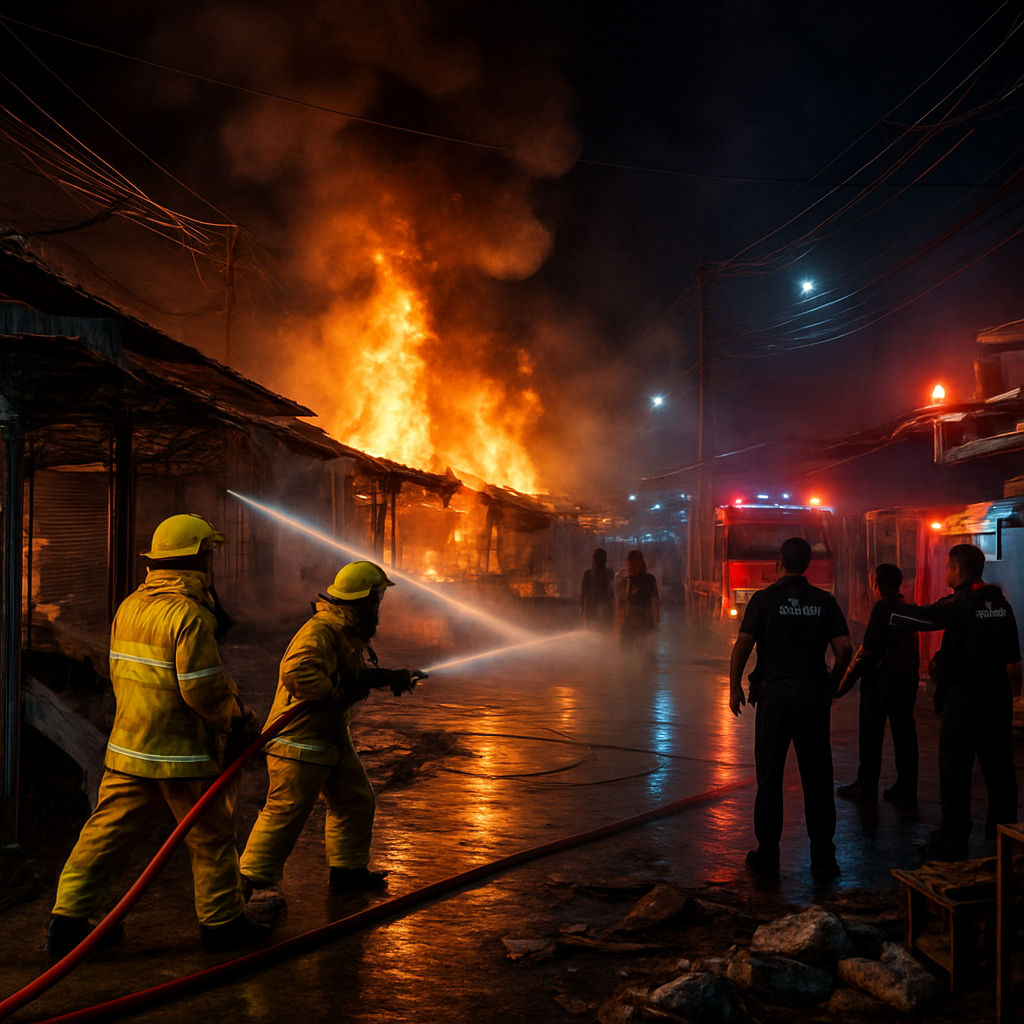
Just after 1:20 a.m. on December 20, a fierce blaze ripped through Building B5 of Rong Kluea Market in Pa Rai sub-district, Aranyaprathet — a bustling trading hub that hums day and night along the Thai-Cambodian border. In the small hours, flames lit the sky above one of Thailand’s busiest cross-border marketplaces, reducing a cluster of shops to smoldering shells while sending firefighters and police into an all-out scramble to protect the tightly packed market.
Rapid response in the dead of night
The radio communications center at Khlong Luek Police Station received the initial alarm and wasted no time. Officers and fire engines from multiple local agencies converged on the scene, where crews fought the inferno for more than an hour before bringing it under control. Authorities emphasized that, despite the market’s dense layout and the ever-present danger of a domino effect, the flames were contained and did not leap to nearby buildings — a small but significant victory for first responders on the scene.
Extent of the damage
Preliminary assessments indicate roughly 10 to 15 rental units were completely destroyed. Those units, owned by the Sa Kaeo Provincial Administrative Organization, were primarily occupied by Cambodian vendors selling clothing, household goods and a variety of imported products that shoppers from both sides of the border rely on. Thankfully, there were no reported injuries or fatalities — a relief for residents and vendors who feared the worst when the call came in the stillness of night.
Possible cause and ongoing investigation
Investigators suspect an electrical short circuit may have triggered the blaze. Early findings point to temporary wiring and overloaded power connections — a familiar risk in older market structures where informal stalls and makeshift extensions often rely on improvised electricity setups. Forensic teams from Sa Kaeo have been called in for a full examination to confirm the exact cause, and Pol. Col. Chuchart Kongmuang, superintendent of Khlong Luek Police Station, has ordered an expedited probe. Officials are documenting losses and coordinating with local agencies to ensure safety measures are enforced before any rebuilding begins.
Border context — calm amid concern
Given Rong Kluea Market’s location a stone’s throw from the Thai-Cambodian border, authorities were quick to dispel any rumours linking the fire to broader border tensions or security incidents. While many Cambodian vendors did cross back into Cambodia temporarily, officials said this movement was precautionary and unrelated to the blaze itself. The swift containment and clear messaging aimed to reassure shoppers and traders that the incident was an isolated accident rather than part of a larger incident affecting the border region.
Economic ripple effects
Rong Kluea Market acts as a vital economic artery for cross-border trade, drawing thousands of shoppers daily and supporting dozens of families on both sides of the border. Friday’s fire — first reported by Khaosod — is likely to disrupt commerce in the affected zone for weeks. Vendors are already tallying losses, and local authorities are working to catalog destroyed inventory and damaged infrastructure. In markets like Rong Kluea, a single night of disaster can ripple into a season of lost income, tight cash flow and anxious vendors waiting for assistance or the green light to rebuild.
What’s next
In the immediate term, investigators will complete their forensic work to determine the fire’s cause, while local officials finalize damage assessments and begin planning safety upgrades. Longer term, the incident raises familiar questions about market infrastructure, electrical safety and the need for more resilient systems in high-traffic trading zones. For the vendors who lost their shops, the path back will likely depend on coordination between the Sa Kaeo Provincial Administrative Organization, local authorities and cross-border communities.
For now, the market’s familiar chorus of haggling and commerce is quieter in the B5 sector. But if past experience is any guide, the drive to rebuild — and the human stories behind each stall — will be a powerful engine for recovery. As officials work through assessments and investigators pursue answers, shoppers and traders alike will be watching closely, hoping the market soon returns to the noisy, colorful crossroads it has long been.
Source: Initial reporting by Khaosod; details confirmed by Khlong Luek Police and Sa Kaeo officials.

















Terrible news — hope everyone’s okay. Markets like this need proper wiring, you can’t keep patching things up forever.
Blaming wiring is lazy. Who was inspecting the market? This is a failure of local governance and enforcement, not just a short circuit.
Sometimes vendors rig stuff to save money. It’s their stalls, their decision. Can’t punish the whole system for individual shortcuts.
Larry, sure inspections matter, but informal stalls use cheap extensions and overload systems every day. Both issues need fixing.
So relieved there were no injuries, but 10–15 stalls gone is huge for those families. Where’s the emergency fund for vendors?
The Sa Kaeo Provincial Office should step up immediately. These are livelihoods, not just inventory on a spreadsheet.
Exactly. Aid should be fast and transparent; otherwise people will lose trust and never come back.
This is a structural problem: informal economies repeatedly face catastrophic risk due to regulatory gaps. A resilience plan is needed, not temporary handouts.
Resilience is a nice word, but who pays for it? Vendors barely break even month-to-month.
Maybe microinsurance or community funds could help, but you need government facilitation and cheap access.
I buy there all the time. It’s messy but cheap. If they raise standards prices will jump and tourists will go elsewhere.
Cheap today, disaster tomorrow. Public safety trumps low prices when people could die in a fire.
No one died though; calm down. I just want affordable goods.
Why does it always take a blaze for authorities to act? Proactive maintenance would prevent this kind of loss.
Because proactive measures cost money and require political will. Easier to fix things after headlines.
Sure, but preventing repeated losses pays off economically in the long run; it’s short-sighted not to invest.
Border markets are political too — someone will try to spin this into a security threat and blame Cambodia to score points.
Police already said it wasn’t related to border tensions. Still, misinformation spreads faster than facts at night.
People love a dramatic story. A fire is more compelling than the boring truth of overloaded sockets.
Then why do officials rush to dismiss tensions? They know how rumors can affect trade and want calm quickly.
I work near the border — traders are nervous and that nervousness hurts business more than the actual damage sometimes.
Simple question: were the vendors insured? Without insurance, rebooting a stall is impossible for many.
Most informal vendors can’t afford formal insurance products. They rely on family support or local lenders instead.
Then local authorities should subsidize basic cover or offer emergency credit so recovery isn’t a season-long disaster.
From an urban planning perspective, this incident highlights how informal peripheries lack integration into municipal utilities and safety schemes.
Agreed. Emergency protocols, certified wiring, and enforced spacing can reduce domino effects, but they clash with informal economies.
You talk like policy is enough. People will resist regulation that threatens incomes; you need incentives, not just mandates.
True — policy design must be participatory and include subsidy pathways to make safety economically feasible for vendors.
It’s scary to think a frayed wire can ruin lives. Why are temporary wires allowed anywhere near flammable goods?
Because the market evolved organically, with no central planning. Quick solutions are cheap, slow ones cost money and time.
But money should be spent on safety first; everything else can wait. People’s lives come before profit.
I hope cross-border trade bounces back — many families depend on weekend shoppers and border traffic.
I’ve seen this before: temporary fixes, no enforcement, and then a disaster. Officials must inspect monthly, not once after a fire.
Monthly inspections are good in theory but who pays auditors? And are auditors independent or just rubber-stampers?
Make audits public and involve vendor committees. Transparency forces better behavior and builds trust.
Don’t ignore the role of informal finance in all this; vendors borrow to rebuild and get trapped in debt cycles after disasters.
That’s why microcredit programs tied to safety upgrades are useful — link loans with mandatory wiring improvements.
Exactly. Otherwise rebuilding just recreates the same hazards and the market is gambling with survival.
Would stricter building codes mean closing parts of the market? That seems like punishing the poor for being poor.
Not if codes are phased with financial support. Codes without support are cruel; codes with grants are protective.
Phased support sounds fair, but we need clear timelines and accountability or it becomes empty promises.
Seeing familiar stalls gone hurts. But are we sure investigators won’t just blame vendors and close stalls instead of fixing infrastructure?
That’s the fear. Punishing vendors will push commerce to even less-regulated places, increasing risk overall.
So what’s the alternative? Help them upgrade and keep the market functioning. It shouldn’t be a binary choice.
I want hard answers: who signed off on the wiring and who profited from short-term fixes? Follow the money.
Follow the money and you’ll find complex layers of permits, contractors, and informal middlemen — not a single villain.
Maybe, but that complexity is used to hide negligence. Public records should be easy to audit.
A fire in a market this busy will have ripple effects: suppliers, transporters, and customers all lose income. Recovery needs multi-party support.
Don’t forget cross-border workers who lose daytime wages when shoppers avoid the area for a while.
Right, it’s not just stalls — the whole ecosystem suffers and timely aid is crucial to prevent long-term decline.
I keep thinking about forensic teams. Will their findings lead to prosecutions or just a report filed away?
Often it’s the latter. Unless there’s clear criminal intent, these reports push for policy changes rather than court cases.
Policy changes are good, but victims deserve restitution too, not just recommendations.
This incident is a case study waiting to happen: integrate lessons into national small-scale market regulations and emergency preparedness curricula.
Universities can help with low-cost retrofits and community training programs. Knowledge transfer can be practical and fast.
Partnerships between academia and local government could be a friction-free way to pilot safer market models.
I worry vendors will be scapegoated. They’re victims too, often without a voice in how markets are run.
True — vendors deserve a seat at the table. Policies written without them often fail in practice.
Then let’s push for vendor representation in recovery planning committees from day one.
Rumors about border tensions started fast online; authorities handled it well by calming people. But will that stop the conspiracy posts?
No, conspiracy posts feed off uncertainty. Rapid transparent info helps, but some folks will always prefer drama.
Transparency plus visible action — like on-site inspections — reduces the space for rumors to grow.
If the cause is confirmed as temporary wiring, it’s an indictment of informal electrification practices across markets everywhere.
Then regulators must prioritize safe, affordable electrical access plans for markets before more disasters occur.
Yes, prevention is cheaper and more humane than repeated emergency responses.
I feel the loss for traders from Cambodia too. Cross-border commerce is fragile and such events strain trust between communities.
Cross-border frameworks for market safety could be a smart idea, with shared funding for infrastructure upgrades.
Shared funding is complicated but necessary; these markets benefit both sides and should be co-managed.
People will rebuild because they have to. I just hope they get fair help and not political theatre.
One last note: media follow-ups matter. If the press forgets this in a week, vendors will be forgotten too.
Community journalism and local watchdogs should keep the issue alive until reforms are in place.
I’ll keep sharing updates. Public attention is pressure that sometimes forces action.