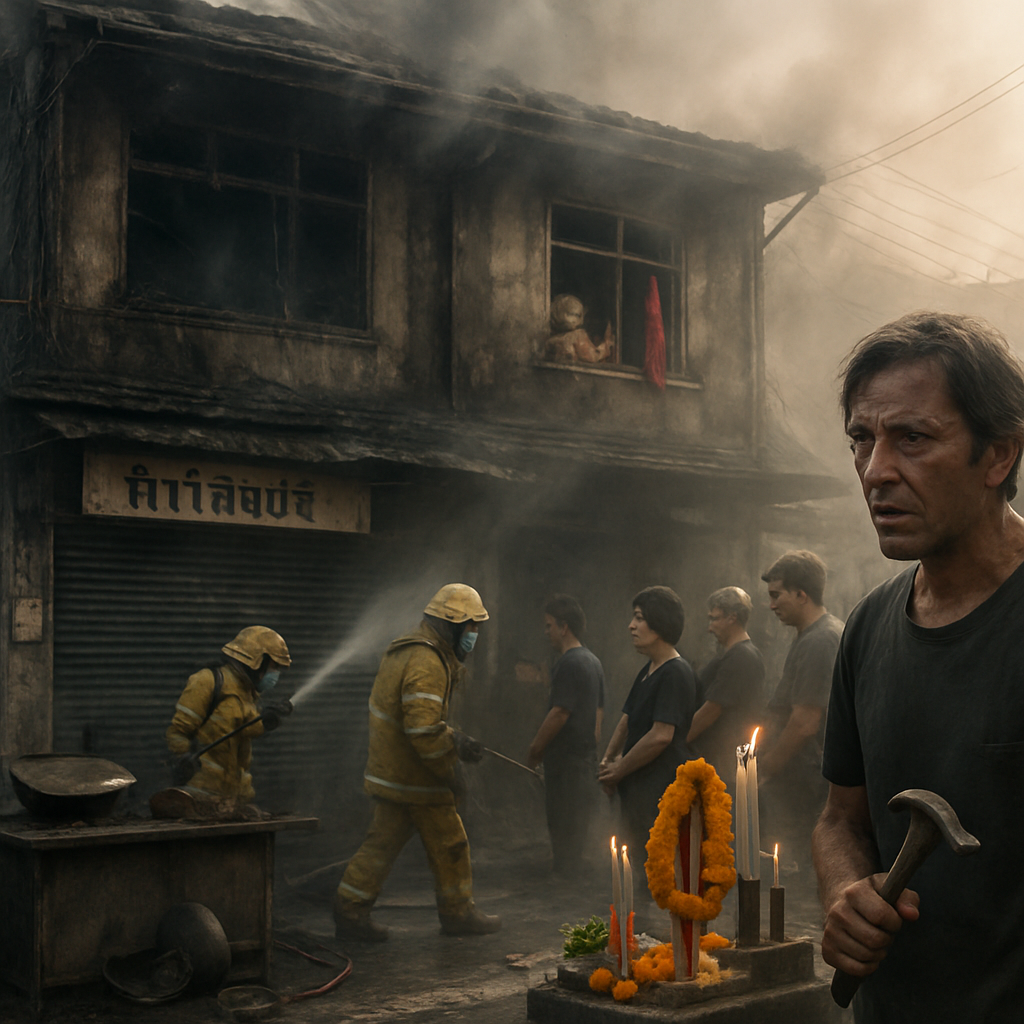
Tragedy struck a four-storey building in Samut Sakhon on the afternoon of November 30 when a fast-moving fire reduced a family’s life to ash and heartbreak. What began as routine midday quiet for a family who worked nights ended in the worst of outcomes: 33-year-old Thanya Hankla and her two young children—seven-year-old Thawatchai Sarathongpim and four-year-old Nyathida Sarathongpim—were found dead, embracing one another in a bedroom on the building’s second floor.
Krathum Baen Police Station received the first frantic report at 12:50pm. Firefighters were mobilised immediately, with more than ten fire engines arriving from Om Noi City Municipality, Suan Luang Subdistrict Municipality, Tha Mai Subdistrict Administrative Organisation and nearby areas. When crews reached the scene, flames were already erupting from the ground floor and licking up the exterior, racing toward the upper levels with alarming speed.
The building housed eight people at the time of the blaze. Five occupants managed to escape but not unscathed: three of them were injured—one seriously and two with minor injuries—and were rushed to Vichaivej Om Noi Hospital and Mahachai Hospital for treatment. Despite neighbours’ desperate attempts and firefighters’ rapid response, three people remained trapped inside. Later, investigators recovered the bodies of Thanya and her children in a bedroom on the second floor. Relatives say the family rented the unit to run a noodle stall, a business that opened in the evening and stayed busy until late at night. Their nocturnal work schedule meant the family slept during daylight hours—when the fire broke out.
Eyewitnesses described a neighbour’s harrowing attempt to save them. He noticed smoke seeping under a closed door and smashed at it with a hammer for several minutes in a bid to wake the family and pull them to safety. Neighbours also fought the flames with portable extinguishers, but the fire intensified and surged upward through the building’s stairways and shafts so quickly that their efforts could not stop it.
Krathum Baen investigators combed the wreckage, collecting evidence to determine the blaze’s cause. The three victims’ remains were transported to the Forensic Medicine Institute at Siriraj Hospital in Bangkok for autopsy and identification before being released to family for funeral rites. Police have vowed to follow investigative leads and announce findings when available.
When the Night Owls Sleep
The family’s business—an evening noodle shop—paints a vivid picture of the life they led. Night-market eateries are a familiar part of Thai evenings, where the warmth of broth and the chatter of late customers thread into the city’s nocturnal rhythm. For owners like Thanya, the work is long but rewarding: late nights, early sleeps, and a tightrope of safety and routine that many in congregated urban housing rely on. That very schedule tragically became a vulnerability in this case; sleeping through the day left them unaware of danger until it was too late.
Neighbours, Firefighters and the Race Against Time
Multiple agencies converged at the scene, and their coordination was crucial to rescuing the occupants who did escape. Fire chiefs say vertical fires in older mixed-use buildings spread frighteningly fast, especially when ground-floor businesses house cooking equipment, fuel sources, or clutter that can accelerate flames. In this incident, the blaze’s rapid ascent blocked escape routes and trapped residents before help could pry the doors or break windows to reach them.
The neighbour who tried to force the door open is being remembered in local accounts for his bravery. His frantic hammer blows and urgent attempts to wake the family highlight how ordinary people often become first responders in urban fires, confronting impossible choices while waiting for professional crews to arrive.
What Happens Next
Authorities continue to examine structural remains and interview witnesses to establish the fire’s origin and whether any safety violations contributed. The findings will be critical for both criminal inquiries and future safety improvements in Samut Sakhon’s dense commercial-residential neighbourhoods. For the grieving relatives and the wider community, questions remain: could different construction, better alarms, or stricter regulations have prevented this loss?
As the community mourns, support networks are expected to rally around the family. Local officials often help with immediate funeral arrangements and liaise with social services to assist those left behind. The forensic results from Siriraj Hospital will guide the official conclusion and the legal route, if any determined cause points to negligence or foul play.
A Sobering Reminder
This devastating fire is a grim reminder of how fragile safety can be when lives are lived in mixed-use buildings and around-the-clock businesses. It underlines the need for working smoke alarms, clear escape routes, fire-resistant doors, and community awareness—especially for families who sleep during daytime hours. While investigators dig for facts, the heart of this story is human: a mother and her children who ran a small noodle business and became the victims of a sudden, devastating blaze.
As Samut Sakhon prepares to say goodbye to Thanya, Thawatchai and Nyathida, neighbours and strangers alike are calling for lessons to be learned. Their embrace in death—a heartbreaking image shared by authorities—will linger as a poignant call to improve fire safety in homes and businesses across Thailand.


















This is horrifying. How can buildings like this still have such bad safety? Tenants and owners both share blame, but someone needs to be held accountable.
Blame the government for lax enforcement, not the poor families trying to survive. Regulations mean nothing when inspections are paid off or ignored.
That’s too simplistic. Corruption exists, but so does ignorance and poverty. We need targeted education, funded retrofits, and real enforcement, not just finger-pointing.
I didn’t mean to blame victims. My point is the system failed them. If alarms, clear stairways and a working fire door had been present the outcome might differ.
I live near those markets and many shops sleep in daytime. Smoke alarms would help but who pays for them? Tenants often can’t afford improvements.
This story shows the human cost of mixed-use buildings without proper safety adaptations. Vertical fires spread fast through stairwells and shafts; regulators must rethink codes for night-shift households.
Correct. Older Thai mixed-use buildings often lack compartmentation and have open service shafts that act like chimneys. Retrofitting with fire-stopping and self-closing doors would slow flame spread and save lives.
But retrofits cost money and landlords avoid upgrades. How do we force retrofitting without displacing tenants?
Subsidies and phased compliance could work. Offer tax breaks or low-interest loans to small owners, plus community grants for alarms and sprinklers in high-risk rows.
Where were the firefighters? People call and it still took too long. Emergency response needs better funding and faster access.
They arrived quickly according to the piece, more than ten engines came from several jurisdictions. The problem was the fire’s vertical speed and blocked egress, not response time.
Maybe, but if we had more stations and better training for urban fires, neighbors could be saved. I want officials to explain equipment and timeline publicly.
Transparency is key. A public timeline, CCTV where available, and release of incident command logs would help build trust and identify procedural gaps.
I can’t stop thinking some details feel off. Why did three people stay? Were doors locked from the inside? I smell negligence or worse.
Conspiracy theories are careless here. It’s much likelier they were asleep and overcome by smoke. Investigators will determine cause; let facts lead, not speculation.
I just want thorough answers. Families deserve closure and accountability if negligence is proven.
That is so sad. They were hugging. I feel like crying.
It’s okay to be sad, kiddo. Stories like this remind us to check smoke alarms and help neighbors.
From the description, this is a classic rapid vertical spread case. Cooking fuel, clutter, and open shafts create a fire plume that travels floors in minutes. Building inspections should prioritize these hazards in mixed-use blocks.
How realistic is it to retrofit old buildings with fire-stops and alarms without displacing businesses? What’s the cost estimate for a block?
Phased retrofits can be cost-effective; basic smoke alarms and self-closing doors are low-cost. Full compartmentation and sprinklers are pricier but targeted grants and group bargaining for neighbors can reduce per-unit cost.
The image of the mother clutching her kids breaks something inside me. It feels like the poorest pay the heaviest price.
Nice sentiment, but emotive portrayals can obscure root causes. We need to avoid turning tragedy into a sentimental headline and focus on technical fixes.
Both matters. People grieving need dignity and action. Technical fixes are urgent, but not at the expense of human empathy.
Police saying they’ll follow leads is predictable. I want to see results — arrests or fines for code violations if found. Accountability matters.
Rushing to criminalize landlords isn’t always fair. Sometimes tragic accidents happen even with compliance. Investigators need time before punishment.
Sure, but patterns of negligence often repeat. A transparent investigation distinguishes accident from systemic failure.
I saw smoke under a door once and pounded until the family woke. Most people don’t realize how fast smoke knocks you out. Please, get CO and smoke alarms.
Amen. Community first responders can only do so much. Education campaigns about daytime sleeping and alarms should be prioritized.
Besides physical retrofits, urban planners must re-evaluate mixed-use zoning in dense corridors. Place daytime sleeping occupants away from high-heat cooking establishments or mandate separated access.
But night markets are core to culture and economy. You can’t just ban mixed uses; you must integrate safety into cultural life.
Agreed. Integration not prohibition. Safe design standards that respect livelihoods are the path forward.
Why do articles always include those heartbreaking images? It feeds public grief but also voyeurism. Respect the family’s privacy.
Journalism needs to balance public interest and dignity. Describing the embrace is factual but editors must avoid sensational photos if family objects.
The neighbour with the hammer is a hero, but we can’t keep relying on neighbours risking their lives. Systemic prevention is the only humane solution.
Exactly. Heroes shouldn’t be a substitute for safety nets. We need regulations, funding, and community training.
I worry about displaced families after enforcement. If authorities clamp down, landlords might evict tenants to avoid upgrades. Solutions must protect renters.
Tenant protection clauses during retrofit programs are essential. Otherwise enforcement can worsen vulnerability by causing homelessness.
If investigators find code violations, civil suits are likely. But proving negligence requires clear evidence of foreseeability and failure to act. These cases can be complicated and slow.
Then make laws clearer and inspections frequent. Don’t let courts be the only remedy after lives are lost.
Why weren’t there smoke detectors? Even cheap battery alarms save lives. Small investments prevent tragedies.
Many people distrust alarms or disconnect them because of false triggers from cooking. We need better tech and community training to use them effectively.
People forget how dangerous cooking setups can be. Portable gas and fryer oil ignite quickly. Regulate food stalls’ equipment and storage more strictly.
Stall regulation can help, but enforcement must be fair. Many small vendors would be crushed by overbearing rules without support.
I suspect an electrical fault. Night-workers sleep during the day and might have chargers or illegal wiring running. Electricity inspectors should be part of the probe.
The embrace detail is haunting and will galvanize action if used rightly. It could be a turning point for stricter fire safety in mixed-use zones.
We need data: how many similar incidents per year, causes, solutions applied elsewhere. Policy must be evidence-based, not just emotional reaction.
I can share studies showing retrofit kits reduce deaths by a significant margin. Evidence supports targeted interventions at scale.
Three injured people survived; hospitals can tell us about smoke inhalation patterns and timings. Medical data helps reconstruct what happened and guide prevention.
Community-level drills for daytime sleepers could work. Who organizes them? Local municipalities in partnership with vendors and NGOs.
We run free safety workshops and install alarms for low-income families. Funding is scarce but grassroots programs can scale with modest government support.
Some comments are preaching charity but forget structural fixes. Charity is temporary; legal frameworks and budgetary commitments endure.
I hope the community rallies for the funerals and that children won’t be forgotten. Rituals matter in healing after such violence of loss.
They will be remembered. Local councils usually help with funerals and support, but long-term welfare must be ensured.
Will the forensic report be public? Transparency about cause and whether foul play is suspected is vital for public trust.
Often families or ongoing probes limit public release, but summaries of findings can and should be published to inform safety policy.
Good point. Even anonymized summaries help prevent speculation and conspiracy.
We must remember the victims beyond policy talk. Thanya and her children were people, not statistics. Respect their memory by acting, not exploiting their story.
I keep coming back to this thread because anger won’t let me shrug it off. If we don’t demand better, nothing changes and similar tragedies will repeat.