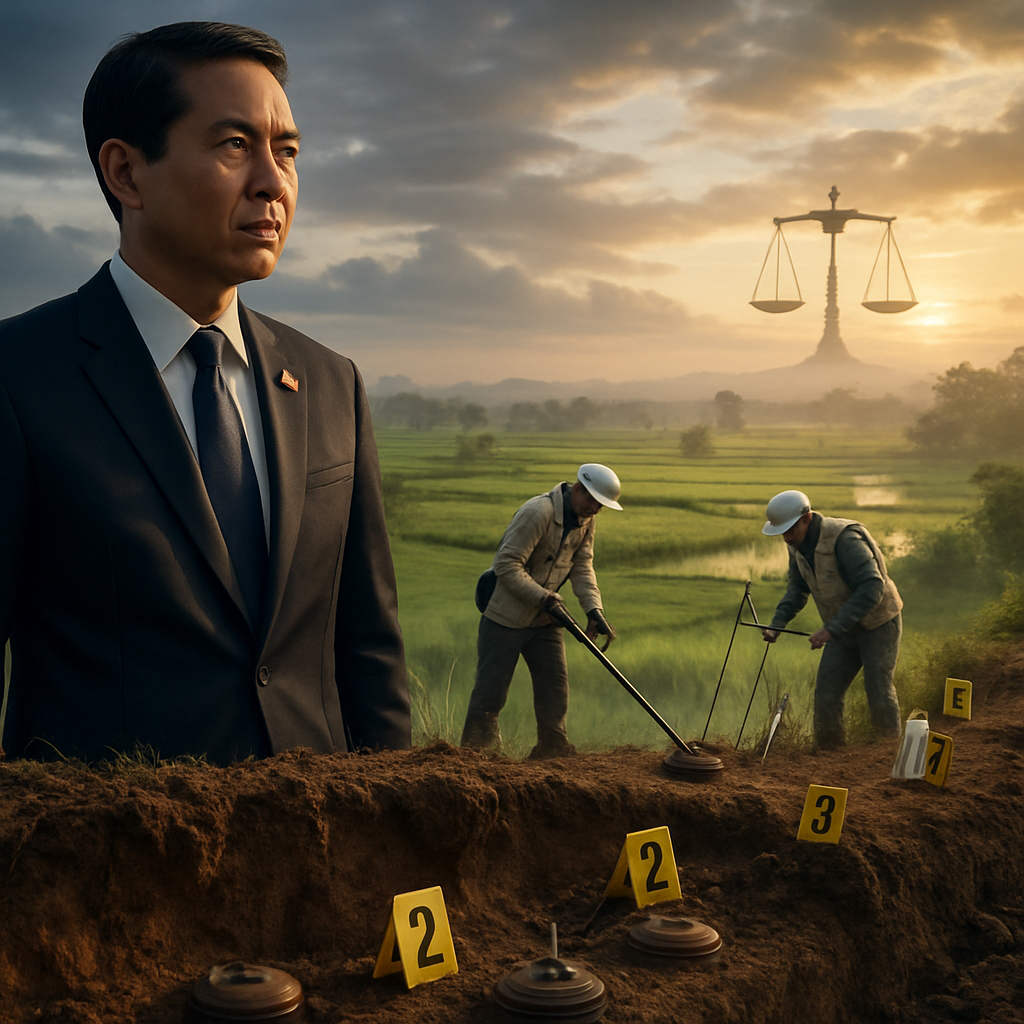
Thailand has put the United Nations Office for Disarmament Affairs (UNODA) squarely in the spotlight, urging the body to confront a worrying uptick in landmine incidents along the Thai–Cambodian border — a situation Bangkok says threatens not only soldiers’ lives but the very credibility of the international landmine ban.
Foreign Minister Sihasak Phuangketkeow raised the alarm during talks with Carolyne‑Melanie Regimbal, head of UNODA in Geneva, on Thursday, December 4. “The Thai side hopes that UNODA will help in highlighting the seriousness of this landmine situation, as resolving this issue is essential to the credibility of the work of UNODA and the Convention,” the Ministry of Foreign Affairs posted on social media.
The Geneva stage: Ottawa Convention and Article 8
Sihasak was in Geneva for the 22nd Meeting of the States Parties to the Anti‑Personnel Mine Ban Convention — commonly known as the Ottawa Convention — where he delivered a formal statement under Article 8. He used the platform to underscore Thailand’s view that the landmine incidents amount to a breach of Article 1 of the Convention, which prohibits the use and emplacement of anti‑personnel mines.
Bangkok’s case is blunt: since mid‑July, 18 Thai soldiers have been injured by mines found along the border, and seven of those injured have suffered permanent disabilities, including amputations. Thailand says it possesses solid, professional evidence indicating that these mines were newly planted on Thai soil and did not stem from old or forgotten conflict residue.
What Thailand is asking for — and why
Rather than escalate rhetoric, Sihasak proposed a procedural, depoliticized path: ask the UN Secretary‑General to facilitate an independent fact‑finding mission. In Thailand’s view, an impartial mission would rely on mechanisms already built into the Convention and restore trust in the system by producing a transparent, third‑party assessment.
“How can the Convention remain credible if a State Party can plant new mines and deny it without consequence?” Sihasak asked, laying out Bangkok’s central worry: impunity undermines international norms and the painstaking work that treaties like the Ottawa Convention embody.
Back‑and‑forth and parallel diplomacy
Thailand has not kept its findings to itself. The foreign minister met Japan’s Ambassador Ichikawa Tomiko, who presides over the 22nd Meeting of States Parties, and informed her that a letter plus additional evidence had been submitted to the UN Secretary‑General documenting what Thailand calls Cambodia’s repeated violations. Thai agencies and an ASEAN Observer Team, according to Bangkok, professionally reviewed the evidence and confirmed that the mines appeared newly and deliberately planted inside Thai territory.
At the same time, Sihasak met UN High Commissioner for Human Rights Volker Türk to stress Thailand’s preference for peaceful, rules‑based solutions, while noting what Bangkok described as Cambodia’s lack of sincerity in addressing the issue. He also reassured officials that 18 Cambodian prisoners of war held in Thailand are being treated according to international humanitarian law and have been visited by the ICRC.
Cambodia rejects the allegations
Cambodia has flatly denied the accusations. Cambodian ambassador Dara In questioned Thailand’s evidence and said that neutral parties were not allowed access to the sites where mines were found, according to Fresh News. The refusal to permit full and independent access is precisely why Thailand and other observers are pushing for an impartial, UN‑led inquiry.
Yet Bangkok points to ASEAN military observers who have reportedly confirmed that the mines discovered along the border were newly planted — a detail that, if upheld by independent investigators, could have serious implications for Cambodia’s standing under the Convention.
Why this matters beyond the border
At stake is more than a bilateral spat: the effectiveness of the Ottawa Convention and UNODA’s reputation hinge on the ability of the international community to investigate and hold parties accountable. If allegations of new mine emplacement go unexamined, critics argue, the norm against landmine use could be weakened, with dangerous consequences for civilians and soldiers alike.
For now, Bangkok is leaning on diplomacy and institutional mechanisms — letters to the UN Secretary‑General, meetings with UN and regional figures, and a public appeal to UNODA — while urging a neutral, independent fact‑finding mission to resolve what it calls an urgent and credibility‑testing matter.
As Geneva considers the request, the world will be watching whether the Ottawa Convention’s built‑in safeguards can produce clarity — and whether the UN can deliver the impartial probe Thailand seeks. Meanwhile, Thailand is also continuing other international engagements, including preparations for its International Conference on the Global Partnership against Online Scams in Bangkok on December 17–18, 2025, even as the landmine dispute remains squarely on the diplomatic agenda.

















Thailand is justified to demand an independent probe; if new mines were planted that’s a clear violation and the Convention’s credibility is at stake. The international community can’t just shrug and say ‘old mines’. We need transparency and a neutral fact‑finding mission now.
But how do we know Thailand isn’t framing this for political leverage? Borders there are messy and evidence can be selective. Asking the UN is sensible, but expect diplomatic theatre.
Framing for leverage is a cynical take but plausible, yes; however Thailand claims professional forensic evidence and ASEAN observers backed it. That’s why a UN mission is critical — to cut through competing narratives.
As a Cambodian I can say the government denies it and foreign media loves headlines. Still, withholding site access looks bad and feeds suspicion.
Seems like the classic game: blame your neighbor so international donors notice you. I smell opportunism more than humanitarian concern. Who benefits from keeping this headline alive?
That’s dismissive and undermines the injured soldiers’ suffering. Even if politics are involved, people lost limbs — that deserves investigation regardless of motives.
I don’t dismiss the victims, but motives matter. International probes cost reputations and might be used to score political points rather than fix safety.
Accountability shouldn’t be skipped because investigations are inconvenient. If the evidence is strong, let the UN verify it and move on.
From an international law perspective this hinges on proving intent and contemporaneity — Article 1 prohibits use and emplacement, but the burden of proof is high. Forensic dating of mine components and metadata from deployment sites will be decisive. A UNODA-facilitated mission could provide the evidentiary rigor the Convention demands.
Can forensic teams really tell if a mine was planted last month versus years ago? That sounds technical and slow, which is why politics fill the vacuum.
Yes, compositional analysis, corrosion patterns, and device provenance can often narrow timing windows, especially when combined with satellite imagery and witness statements. It’s not perfect but far better than claims and counterclaims.
This should be about methods and chain of custody. If samples aren’t handled properly the whole inquiry collapses into accusations.
Soldiers getting hurt is bad. UN should check quickly. Why are leaders not fixing the border?
The diplomatic choreography here is fascinating: letters, meetings, ASEAN observers — Bangkok is building a paper trail before public accusations escalate. That suggests seriousness rather than mere theatrics.
Or it’s bureaucracy buying time while the real politics play out behind closed doors. Governments often use procedures to signal rather than solve.
Signaling is part of diplomacy, true, but relying on Convention mechanisms is a restraint that benefits both sides if followed properly. The alternative is messy unilateral reprisals.
Procedural restraint is noble on paper, but when one party blocks access it becomes a tactic to stall and avoid accountability.
If Cambodia planted mines, there should be consequences under the Convention. No immunity for violations. The UN must act or the norm weakens.
Consequences are tricky: sanctions or suspensions are politically fraught and could worsen bilateral ties. Still, investigation is non‑negotiable.
I agree sanctions are messy, but at minimum there should be international condemnation and reparations for victims if culpability is proven.
This incident tests multilateral institutions’ capacity to adjudicate disputes impartially, not just to mediate them. The Ottawa Convention’s verification mechanisms need to be operationalized swiftly to avoid precedent of impunity. An independent UN mission would also protect the Convention’s technical credibility.
As someone who patrolled those borders years ago, I know about leftover ordnance. But fresh emplacement with modern fusing is different and terrifying for troops.
Exactly — distinguishing legacy UXO from deliberate emplacement has huge policy consequences for regional security and humanitarian remediation funding.
I fear geopolitical alignments will distort even neutral reports. The UN must be beyond reproach in methods and access to preserve legitimacy.
Isn’t ASEAN supposed to handle these disputes quietly? Dragging the UN in raises the stakes and could internationalize a regional spat. That might be Bangkok’s intent.
ASEAN’s consensus model often fails in crises. When a neutral, credible external mechanism exists, states will and should use it to break deadlocks.
Maybe, but once you involve the UN, media pressure spikes and reconciliation becomes harder. ASEAN has its tradeoffs but also flexibility.
Flexibility shouldn’t trump victims’ rights. If mines endanger civilians and soldiers, transparency through UN investigations is preferable to closed-door diplomacy.
I’m torn: I want the UN to be impartial, but we’ve seen politicized UN missions before. How do we ensure this isn’t another show trial?
Neutral fact‑finding is the only fair path, but access denial by Cambodia undermines trust. If access isn’t granted, the UN must consider alternative evidence like satellite and forensics.
Satellite imagery can be manipulated interpretations; without boots on the ground, conclusions may remain disputed. Still, it’s a useful tool complement.
True, but combined methods reduce false positives. A triangulated approach (satellite, forensics, testimony) is the best practical option when access is contested.
This will probably fizzle into diplomatic notes and vague statements. Big powers rarely want escalation in Southeast Asia, and that dampens bold action.