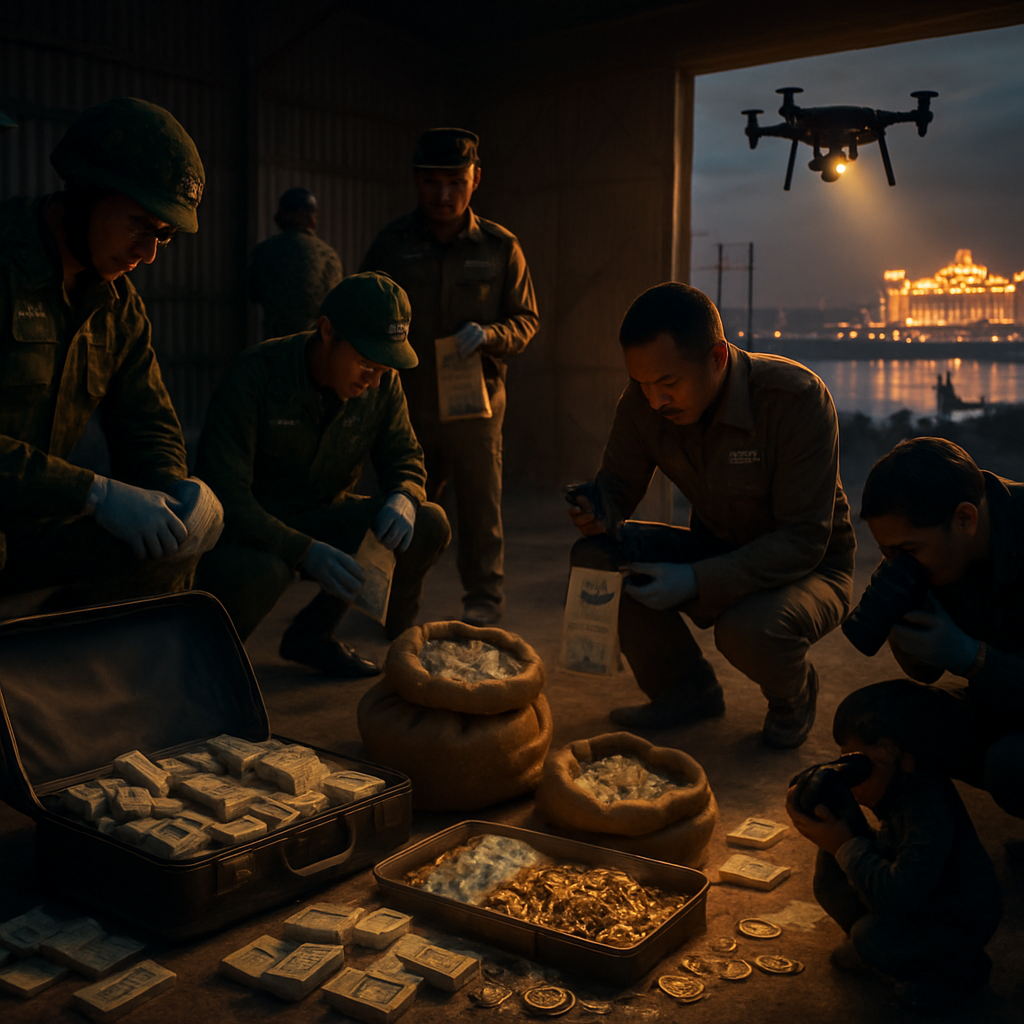
What started as an ordinary pre-Christmas sweep turned into a headline-grabbing border drama on December 18, when officers from the 2nd Army Area and Phu Sing Police Station raided a warehouse in Prai Phattana sub-district, Phu Sing district, Sisaket province — directly opposite a brightly lit casino across the Cambodian border. At about 10 a.m., authorities emerged with suitcases and sacks containing roughly 14 million baht in cash and gold, and questions that are only beginning to be answered.
The haul: about 11 million baht in cash, packed into several suitcases, and roughly 3 million baht worth of gold jewellery stashed in multiple bags. Photographs circulated by local media showed neat rows of luggage and glittering accessories, but what has captured investigators’ attention is not the sparkle — it’s the context.
According to officials, the raid was a response to unusual behaviour by a married Thai-Cambodian couple who refused to evacuate when an official announcement ordered the area cleared. Local security teams also detected drone activity near the warehouse, which raised red flags and pushed the 2nd Army Area and Phu Sing police to inspect the premises. Authorities say the assets are suspected of having links to transnational criminal activity — a worry that goes beyond seized jewellery and notes.
Why the concern? Investigators have voiced fears that unaccounted-for cash could be diverted to finance destabilising operations across the border — possibly the establishment of bases, procurement of weapons or ammunition, or even funding for drones. In an area where cross-border flows and tension can be high, large sums of ready cash attract scrutiny from more than curious neighbours.
The couple at the centre of the sting denied any criminal intention. They acknowledged ownership of the cash and gold but insisted their finances came from legitimate trade run by the Cambodian woman. They explained they preferred to keep their earnings in cash rather than using Thai banking services. The woman also said she could not open a Thai bank account because of her nationality and feared depositing money in her husband’s account in case of future domestic disputes. Thai records confirm they are legally married in Thailand and have operated a joint business for several years.
Nonetheless, the police and army took a cautious approach: the cash and jewellery were seized for forensic examination and verification of origin. The couple were released pending further investigation while authorities comb through financial records and trace the money’s path. For now, the warehouse remains a focal point for investigators trying to determine whether this was simply a couple who preferred cash, or the tip of a more organised cross-border operation.
There are a few dramatic details that make this case feel like something out of a thriller: the warehouse’s proximity to a Cambodian casino, the recorded drone activity, and the decision by the couple not to evacuate when asked. Whether any of these elements point to criminal intent remains to be established, but together they prompted the kind of coordinated response that only grows more common along porous borders where cash, people and goods flow freely between nations.
Local media outlets, including photos shared via PPTV HD and a Facebook page connected to the 2nd Army Area, have been quick to report the seizure, keeping public attention high. For the couple, the days ahead will be spent answering questions: providing documentation, demonstrating the legal origin of funds, and explaining business operations. For investigators, the task is to trace the money, interview witnesses, review transaction histories and, if necessary, follow the trail across the border.
What this episode highlights is a recurring challenge for border provinces like Sisaket: how to balance vigilance and civil liberties, how to spot illicit activity without criminalising ordinary livelihoods, and how to ensure that money flows are transparent enough to prevent abuse. Cash-based economies, cross-border marriages and businesses, and the difficulty some foreigners face in accessing local banking all complicate enforcement work.
As the investigation continues, authorities are keeping a close watch on developments. The seizure won’t be the last word — forensic tests and legal processes will determine whether the 14 million baht ends up returned, confiscated, or used as evidence in a prosecution. For now, the warehouse near the Cambodian casino sits empty of its valuables, and a Thai-Cambodian couple wait to see whether their explanation of legitimate trade will satisfy investigators.
In regions where borders are thin and money is thick, today’s raid is a reminder that what may look like a tidy suitcase of cash can carry far more significance than its weight suggests.

















This feels like a film plot but it’s real money and real people’s lives. The proximity to a casino and drone activity is too many coincidences to ignore, authorities had to act. Still, seizing assets before proof worries me about due process.
Due process is great, but what if that cash finances weapons or militias across the border? Waiting could be dangerous. I’d rather they investigate hard and fast.
My grandmother kept cash at home, this doesn’t mean she’s a criminal. Border regions are cash-based, you can’t automatically assume guilt.
I get that, Somsak, but those are big suitcases of cash next to a casino and drone sightings; context matters. I’m just worried authorities will overreach, not that they ignore risks.
If they’re married and ran a business together why not keep records? Sounds like sloppy bookkeeping at best or deliberate secrecy at worst.
We should remember the woman couldn’t open a Thai bank account because of nationality. That’s a real structural problem that pushes people toward cash. Seizing everything seems punitive.
Structural exclusion from banking is a serious issue and often criminalizes everyday survival tactics. But investigators also must follow leads when drone activity and cross-border casino links appear.
How is it fair to blame banks when laws stop foreigners from opening accounts? Fix that and half these ‘mysteries’ vanish.
Exactly, Nok. Transparency should be enforced, yes, but start by making legal tools accessible so people aren’t forced to hoard cash.
From a criminological perspective, the convergence of cash, proximity to a casino, and drone surveillance is a red flag pattern. Forensics will need to trace serial numbers and look for transaction histories across borders. Still, evidence must be produced before convicting reputations in media.
Tracing cash serials is slow and imperfect, and transnational crime groups know that. I’m skeptical the couple were innocent if the banknotes point to known laundering routes.
Or it could be organized harassment: authorities show up, publicize the seizure, and nobody gets their money back even if innocent. Power dynamics matter here.
Both concerns are valid. That’s why independent oversight of seizures and clear legal pathways for reclaiming funds are essential in these investigations.
Border towns are wild. Casinos, cash, and people slipping money around—it’s a recipe for smuggling and worse. I’m glad the army intervened.
Are we just going to trust the army every time? There have been abuses before. Civilians need protections, not endless military raids.
Military presence is necessary when borders are porous. Local police might be compromised by casino money; that’s why a stronger unit got involved.
Mai, I hear you, but I also don’t want weapons being bought with ‘legitimate trade’ cash. Sometimes a tough hand is needed to stop bigger crimes.
Why would a married couple risk storing that much in one warehouse? Even if foreign banking is hard, that’s reckless. Makes me think there’s more going on.
People store cash in weird ways; maybe they were saving for something big like a wedding or to open a shop across the border. Jumping to conclusions is dangerous.
Fair, but record says they’re in a joint business for years. A proper business keeps ledgers and uses channels, not suitcases.
This is scary. I keep my allowance in a jar, but the idea that money could ‘fund drones’ makes me think of spy movies. Are drones even used by criminals here?
Drones have been repurposed for smuggling and reconnaissance in many regions, including Southeast Asia. The concern is not sci-fi, it’s practical and real.
If money is funding destabilizing operations, freezing it quickly is crucial. However, the system needs transparency so wrongful seizures don’t ruin livelihoods. Balance matters.
Balance is easy to say but hard to achieve. In practice, bureaucracy and corruption can mean seized funds vanish into systems without accountability.
Which is why external audits and open case reports should be standard when large sums are seized. Public trust depends on it.
Why are casinos always suspicious? Maybe some people just enjoy gambling across the border and stash winnings. Not every suitcase is a crime scene.
Casinos attract a lot of cash movement and shady actors, but lumping all gamblers with criminals is wrong. Context and evidence must guide us.
grower_fan, true—casinos aren’t inherently criminal, but criminals use them. The key is targeted investigation without blanket assumptions.
Media sensationalism is part of the problem; photos of suitcases get clicks and shape narratives before facts emerge. Journalists need restraint. Still, the story is newsworthy.
Restraint rarely sells. Outrage drives views and sometimes police love the publicity. That interplay muddies justice.
Exactly. The couple’s reputation is damaged already and we don’t know if any laws were broken.
Make banks accessible to migrants and married foreigners and this would be less common. Governments create the problem and then punish people for symptoms.
Policy fixes take time. In the meantime, law enforcement must address real security risks. You can’t pause crime prevention because of bureaucracy.
But enforcement without reform punishes the vulnerable. Both must proceed together.
I’m torn — on one hand, security and preventing arms flows is vital. On the other, seizing cash on suspicion without clear accountability can look like legalized theft. Where’s the oversight?
Oversight often exists on paper but fails in practice. Independent bodies with teeth could help, but political will is the bottleneck.
So we’re back to political will. Not very reassuring for ordinary people who just want their money.
Drone sightings worry me more than suitcases. Who’s flying them and why? If organized groups are using drones to coordinate smuggling, that’s a serious escalation.
Drones lower the risk for smugglers and increase their reach. Authorities monitoring drone activity was the right call in my view.
Right, but police also need tech to match drones. Citizen safety depends on capabilities, not just raids.
I worry about scapegoating cross-border couples. They live complex lives—some legitimate, some not. We need nuance in enforcement and reporting.
Nuance is key, Karen. The court of public opinion moves fast, and lives get ruined before investigations finish.
And when cases are high-profile, authorities sometimes feel pressured to deliver quick results, which can mean corners are cut.
Honestly, if I had that much cash I’d use a bank or a lawyer trust. Keeping millions in gold and notes at a warehouse is asking for trouble.
Not everyone trusts banks or lawyers, especially if they face discrimination. That fear is real for some people.
Fair, but there’s a difference between distrust and hiding cash in ways that look criminal. Perception matters when dealing with authorities.
This case highlights failure points in cross-border governance: informal economies, selective enforcement, and limited access to formal banking. It’s a textbook case for policy reform, not just policing.
Agreed. Long-term solutions include creating accessible financial instruments, community verification systems, and cross-border legal cooperation.
Yes, and involving local communities in oversight would help prevent both corruption and wrongful targeting.
I don’t trust casinos or border warehouses. Money moves through strange channels there; it’s naive to think this is only about domestic disputes. Follow the money.
Following the money is essential, but that must include safeguards so innocent people can reclaim assets if cleared. Otherwise it’s punishment without conviction.
If the couple are innocent they’ll need legal help to get their assets back. Who pays for that when authorities seize everything? The state should guarantee a fair process.
They can hire lawyers if they have funds, but guess what, those funds are seized. It’s a catch-22 used often to force plea bargains.
Exactly my point. The system advantages the state and punishes the powerless.
Everyone’s so quick to assume malicious intent. Could this just be bad timing for a normal couple who prefer cash? Not every story is a criminal conspiracy.
Normal people don’t usually have suitcases of millions near a casino and then refuse to evacuate during a sweep. Some actions are suspicious on their face.
True, but let’s wait for evidence before calling them criminals. Media loves a scandal more than a fair trial.
From an investigative standpoint, seizure is a tool, not a verdict. Forensic accounting can reveal patterns quickly if agencies coordinate. I hope they do.
Coordination is key, but so is independence. Forensics done without oversight can be manipulated to fit narratives.
Agreed. Transparent protocols and external auditors mitigate that risk and improve credibility.
What worries me: if the funds are returned, will the public ever know? If confiscated, will proceeds be used for public good or wasted? Transparency after action is important.
Public reporting on outcomes should be mandatory. That would build trust and deter political misuse of seizures.
If proven illegal, auction the gold and use proceeds for local anti-trafficking efforts. At least something positive could come out of it.
Only if the auction process itself is clean. Otherwise state seizure turns into enrichment for insiders.
Valid concern. Clean auctions need oversight too, but it’s better than hiding assets in limbo.
I smell opportunism — border authorities get their headline, media feed off the drama, and deeper political issues get sidelined. This is theatre as policy.
Theatre is accurate sometimes, but that doesn’t negate genuine threats. It’s messy and often both theatre and necessary.
I hope investigators will consider the social context: cross-border marriages, informal work, and fear of domestic disputes driving cash-holding. Not everyone is laundering money.
Social context matters, Eka, but context isn’t an excuse for ignoring clear signs of organized crime. Both frames are needed.
Agreed, both are needed — context to avoid injustice, and rigorous investigation to prevent harm.
Authorities released the couple pending investigation which is a decent middle ground. I hope that means evidence is still being collected, not that the public will forget.
Larry D, release pending investigation helps, but public shaming from media photos sticks. The couple may be legally free yet socially condemned.
If nothing criminal is found, restitution should be swift and public. If criminal, follow the law and publish findings. Either way, transparency is key.
Yes — a standardized post-action report on seizures would reduce speculation and help victims of wrongful seizures seek redress.
Policy solutions like that would prevent a lot of pain in communities near borders.