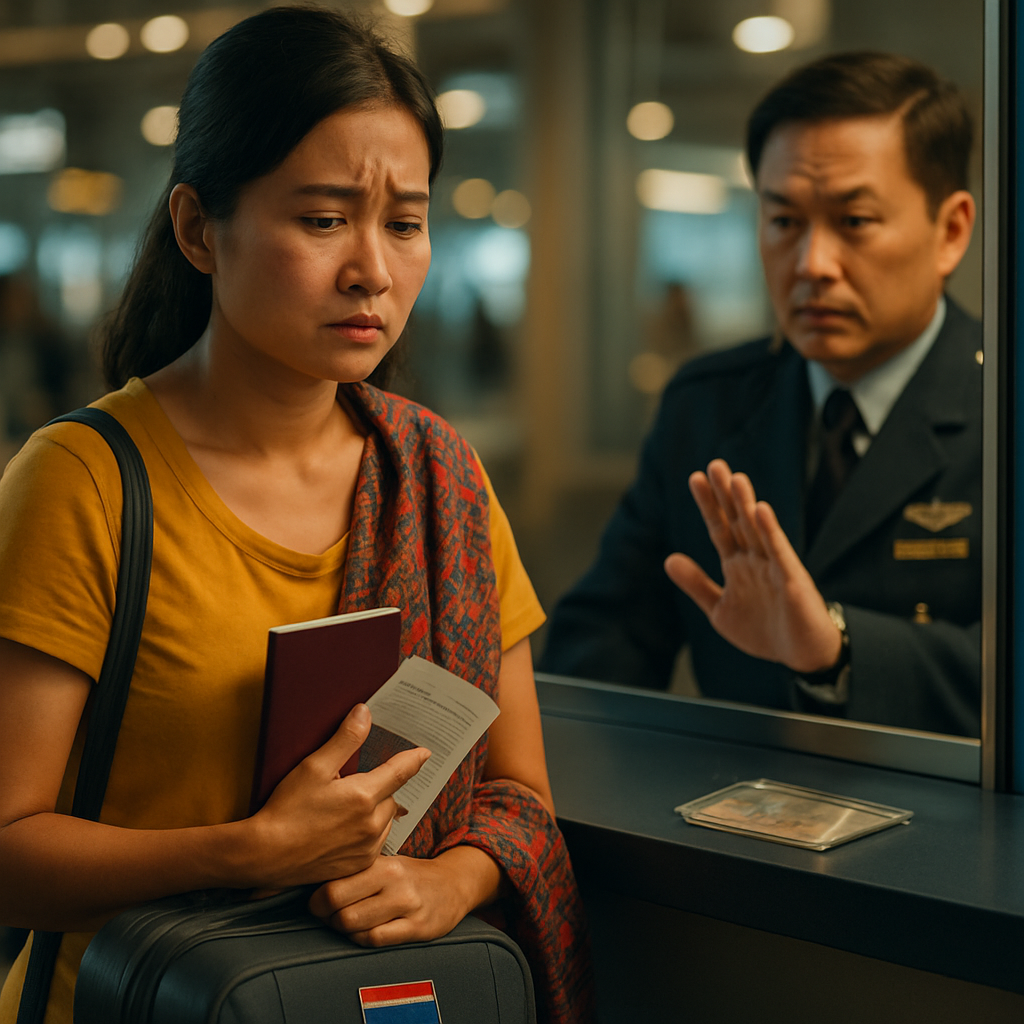
What was supposed to be a sparkling New Year escape to South Korea turned into an abrupt one-way trip home for a 37-year-old Thai woman — not because her documents were wrong or her itinerary suspicious, but because an immigration officer at Incheon International Airport simply said “no.” The woman, a government employee from Loei province, shared her disappointment anonymously on the Facebook page “เที่ยวเกาหลีด้วยตัวเอง” (Travel Korea Independently), and the post has since opened a lively online debate about how Thai visitors are being treated at Korean borders.
In her post she wrote with palpable frustration:
“I feel extremely upset and disappointed about this trip. Korean immigration had no clear reason for investigating me at all, especially the female officer at the central desk. I don’t know what she was in a bad mood about, but she snapped at me for no reason. I had a clear travel plan and a stable job as a government official. Everything was clear, and I had documents to prove it. In the end, I was denied entry. I should have gone to Japan instead. I really shouldn’t have wasted my time coming here. I’m very disappointed. Not a single won that I exchanged was used. #Incheon #BanKorea”
There’s a sting in those words — the feeling of being dismissed despite doing everything “right.” She says she had proof of employment, a clear itinerary, and valid travel papers. Yet, according to her, the immigration officer offered no coherent explanation and was unhelpful during the encounter. For any traveler, that’s the worst kind of whiplash: prepared, hopeful, and then suddenly turned away with a shrug.
As you might expect, social media reactions were mixed. Some netizens empathized, offering condolences and sharing similar horror stories about being held up or questioned at borders. Others were more skeptical, pointing out that the post was anonymous and lacked specific, verifiable detail. A handful of commenters also made the pragmatic — if uncomfortable — point that being a government official doesn’t automatically guarantee entry. There have been cases where foreign officials overstayed visas or took on illicit work abroad due to personal debts; being on a payroll is not, in itself, an ironclad entry ticket, Dailynews noted.
Seasoned travelers chimed in with useful practical advice. The consensus among those who regularly transit Korea: show up with an official ID card, ideally your government-issued ID or the distinctive blue diplomatic or official passport if you have one, and be ready to communicate clearly and calmly with immigration officers. Travelers fluent in simple Korean or who could offer concise answers reportedly had smoother crossings. In short, preparedness and the ability to demonstrate your ties and intentions plainly seemed to matter.
But this incident is not an isolated skirmish — it sits within a broader pattern. In recent years South Korea has tightened scrutiny at its borders, and Thai travelers have been especially sensitive to these changes. Whether due to a spike in asylum applications, work overstays, or other migration concerns, stricter checks at arrival gates have raised anxiety for ordinary tourists. The Loei woman’s experience has reopened conversation about whether random denials are increasing and how travelers can protect themselves.
The story also comes amid other troubling reports involving Thai nationals in South Korea. One grim case involved a Thai illegal worker who lost two fingers in a workplace accident and, despite seeking help from a migrant support center, has received no compensation. Anecdotes like that feed into a narrative of vulnerability for certain categories of Thai citizens abroad — whether tourists, migrant workers, or others on the margins.
If there’s a silver lining in this particular kerfuffle, it’s that the online discussion has become a crash course in border best practices. For would-be visitors to South Korea, consider these takeaways:
- Carry official proof: A government ID, original employment letter, or the appropriate passport can make a difference.
- Keep your story simple: Clear, consistent answers about where you’ll stay, how long you’ll be in the country, and how you’ll support yourself reduce suspicion.
- Be respectful but firm: If denied entry, ask calmly for the specific reason and whether you can appeal or reapply.
- Prepare electronic backups: Have scanned copies of key documents available in your email or cloud storage in case immigration asks to verify anything later.
Travel is supposed to be a joy; no one plans a holiday to be sent home before lunch on day one. While this incident may leave a sour taste for a Loei government employee, the public reaction — a mixture of sympathy, skepticism, and useful advice — could help future travelers avoid the same fate. If nothing else, it’s a reminder that crossing a border isn’t only about papers; it’s a human exchange where tone, clarity and a little luck can matter just as much as a stamped passport.

















This story hits home for many of us; being rejected without explanation feels like being punished for nothing. If Korea is going to tighten borders they should at least train officers to give clear reasons and treat visitors with basic respect. I’m thinking twice before recommending Korea to my friends now.
Totally agree — unclear denials are cruel and humiliating, especially for older relatives or first-time flyers. It’s not just paperwork, it’s about dignity. Embassies should step in when people report abuse.
Policy-wise, countries can refuse entry for any number of closed reasons and they are rarely obligated to explain everything in public. That said, transparency and appeal processes are vital to prevent arbitrary decisions.
Right, Alex I get the law, but arbitrary enforcement without remedy creates corruption and discrimination opportunities. We need both smarter policy and accountability.
I’ve traveled a lot and sometimes it’s just a single officer’s mood that ruins a trip, but that’s not an excuse for xenophobia. Training in cultural sensitivity should be mandatory.
As someone who studies migration law, I’m skeptical of outrage without details but also critical of discretionary power at borders. Administrative discretion is necessary, yet it must be accompanied by clear procedures and record-keeping to avoid abuse. Social media anecdotes should push for policy review, not mob judgement.
Policy review? Or just more excuses for people who lie about work and overstay? Maybe Thailand should tighten who gets passports. Simple fix.
Blaming passports or citizens wholesale is easy but inaccurate. We should distinguish between undocumented workers and tourists who follow rules, and push for fairer, evidence-based screening policies.
Alice is right — evidence-based policy and oversight are key. Also, cross-cultural miscommunication can escalate; officers often lack training in de-escalation and interpreters at peak times.
From research, countries ramping up border scrutiny often do so reactively after crises; unfortunately that increases false positives like wrongful denials. We need independent audits of immigration decisions and mandatory written reasons for refusals. Otherwise you get exactly the kind of anonymous horror stories that erode trust.
Independent audits sound nice but who pays for them? Korea won’t risk national security for optics. Tourists should just bring more paperwork and a Korean speaker.
Cost is real, but so is reputational damage which hits tourism revenues. A pilot audit program or video-recorded interviews could be cost-effective safeguards.
Video recording raises privacy and sovereignty issues. If the officer suspects something, they should act without being filmed for the tourist’s comfort. This is getting tangled between rights and procedure.
I just want to know why the woman was denied. If they can’t say, it feels like racism or sexism. Female officer ‘snapped’ — that line worries me.
Maybe the Thai woman should have gone to Japan like she joked. Korea isn’t a charity and people need to stop expecting special treatment. If you can’t prove ties, don’t be surprised.
That tone is exactly the problem — you’re blaming the victim without evidence. People deserve explanations and humane treatment whether they’re tourists or not.
I’m not blaming anyone blindly, I’m saying bring the proof. If officials are stricter, it’s probably because of past abuse of visas. Toughen up or don’t travel.
That’s so sad. I cried reading this. I would be scared if that happened to me at the airport.
One practical note: always have a paper itinerary and contact details for your hotel and a return ticket. It won’t fix every arbitrary decision but it reduces risk. And ask calmly for the reason and supervisor if denied.
Good point, Karen — calmness is underrated. But asking for a supervisor is often ignored; we need formal channels for appeal at the airport.
This is a reminder that sovereignty lets states make weird choices at borders. Frustrating, but it’s not personal in the legal sense. Still, they owe some transparent accountability to maintain tourism relations.
Not personal? The officer ‘snapped’ at a woman and gave no reason; that feels deeply personal and humiliating. Legalism can’t erase the human harm here.
I hear you, Patcharaporn, and the human element matters. My point is that law enables these actions and we must change the law if we want less arbitrariness.
Can someone explain why embassy contact wasn’t used? If I were denied I’d call embassy immediately and let them pressure for an explanation.
Embassies can help but their influence at port-of-entry decisions varies, and they rarely can reverse an immediate denial. Still, reporting the case later is important for records and potential complaints.
This screams bureaucracy fail. No clear reason, no recourse — airport authorities need complaint desks with real power. Otherwise it’s the wild west at gates.
Wild west is too dramatic but I like the idea of empowered complaint desks. Airports are the first impression of a country; they should be better managed.
I fear this will make ordinary Thai travelers anxious and vulnerable to profiling. These stories multiply quickly and cause long-term damage to people-to-people ties. Governments should negotiate clearer bilateral protocols to protect tourists.
Bilateral talks are a slow solution though. Tourists need immediate practical tips, but diplomats should also demand explanations when citizens report arbitrary treatment.
Agreed, short-term traveler advice and long-term diplomatic pressure should go together. Silence helps bad practice continue.
The anonymity of the original post complicates credibility, yet patterns of similar stories suggest a real trend. We should look at visa overstay statistics and asylum claims to understand root causes before condemning frontline staff.
Exactly — data-driven debate is better than outrage. Still, individual rights and dignity don’t vanish because of trends; case-level accountability matters too.
This story makes me angry because it’s gendered too; female travelers often get grilled more harshly. We need better oversight and perhaps cameras in interview rooms for transparency.
Cameras help transparency but might intimidate people or be misused. There’s a balance between evidence and privacy that must be struck carefully.
I got questioned in Korea once and they took my phone for a while to check messages, which felt invasive. If they start random phone checks more often, tourists will stop going.
Border searches of phones are a growing contentious issue worldwide; legal protections vary and many travelers aren’t aware of their limited rights at borders. Public awareness is crucial.
Tourism boards should issue clear checklists: documents, proof of funds, return ticket, hotel booking, contact, embassy numbers. It’s not glamorous but it works most of the time.
Checklists help but won’t fix rude officers or bias. We need both traveler prep and institutional reforms to reduce arbitrary denials.
I worry about how these stories feed xenophobia back home — some people will say ‘see, foreigners are mean’ and use it politically. We must be careful with language and ensure facts before stoking backlash.
If the officer had a bad day that’s no excuse to ruin someone’s holiday. There should be compensation or at least an apology in clear cases, not just a shrug.