Thailand

Khurusapha, UNESCO set AI teacher standards

Thailand's Teachers' Council is lining up a national AI competency ladder for educators, with six domains, four proficiency levels, and a ministerial proclamation still due this year.
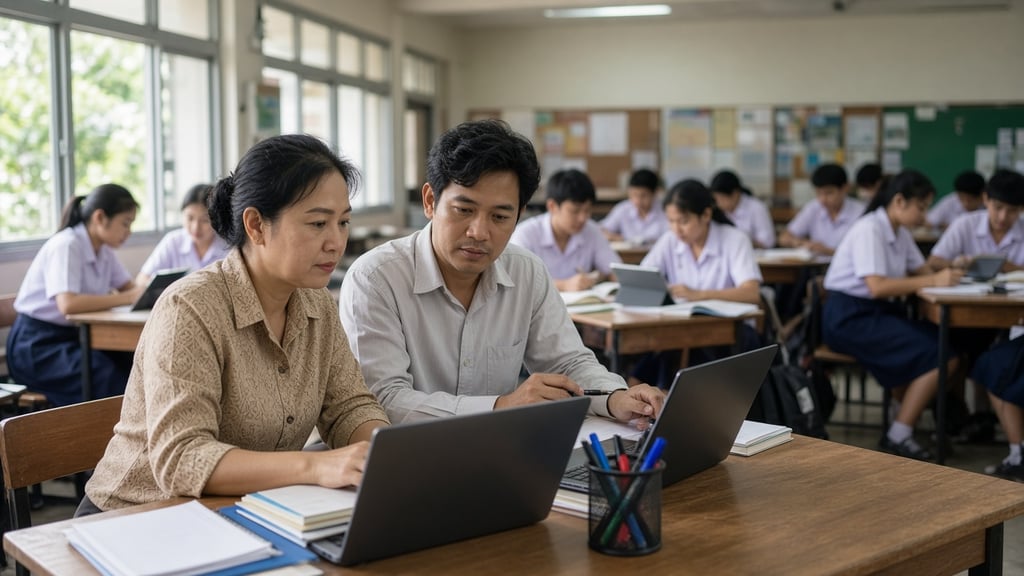
Khurusapha, UNESCO set AI teacher standards
Khurusapha, UNESCO set AI teacher standardsIllustration: THAI.NEWS

Thailand's professional teacher regulator is preparing to treat artificial intelligence as a core classroom competency, after the Teachers' Council of Thailand (Khurusapha) sat down with UNESCO's Bangkok office to finish a national standard for how educators should use the technology. The draft, named Thailand's AI Competency Framework for Teachers, sets six competency domains across four proficiency levels and is meant to receive a ministerial proclamation before the end of 2026.

Dr. Niyom Phaisopha, an inspector-general at the Ministry of Education who is acting as Khurusapha secretary-general, briefed Thai reporters on 29 November after an exchange with UNESCO Bangkok. The council wants a standard that classroom teachers, school administrators, education administrators, and academic supervisors can actually apply, with ethics and equal access treated as part of the job rather than as an afterthought.

A four-rung ladder on UNESCO's global model

The Thai briefing names the four rungs in English: Basic Level, Active User Level, Expert User Level, and Leader/Influencer Level. That is one more step than UNESCO's AI Competency Framework for Teachers, issued in 2024, which moves through Acquire, Deepen, and Create. Khurusapha said the extra rung reflects a Thai decision to score not only classroom practice but also school management and policy work.

The six Thai domain names have not been published. Officials said the matrix draws on UNESCO's global model, research from Chulalongkorn University, learner-competency work, and Thailand's existing professional teacher standards. Until Khurusapha releases the labels, the international reference remains UNESCO's five published domains: a human-centred mindset, ethics of AI, AI foundations and applications, AI pedagogy, and AI for professional learning.

UNESCO's Bangkok team, according to the council, applied three tests to the Thai draft. The standard must fit the real condition of Thai schools. It must be simple enough for teachers to use in ordinary lessons. And it must treat AI as a way to narrow, not widen, gaps between well-equipped urban classrooms and the rest of the system. Thailand is already among the 193 states that endorsed UNESCO's 2021 Recommendation on the Ethics of Artificial Intelligence. The teacher framework is also being presented as a follow-on to a May 2026 meeting between Thailand's education minister and UNESCO's director-general.

What gets signed, and what it may mean for licences

The next administrative step is a set of workshops with school representatives, teacher-training institutes, and UNESCO to write an implementation handbook. The education minister is then expected to sign the official proclamation this year. In 2027, Khurusapha plans to load manuals and training courses onto its Khuru Platform and to take the Thai model to Asia-Pacific and global education meetings.

The briefing did not say the four levels will immediately become a condition for issuing or renewing a teaching licence. Khurusapha is, however, the body that licenses the profession. Pulling pre-service institutes into the workshops is a signal that teacher-education programmes may later be asked to teach to the new matrix. Foreign teachers who hold, or need, a Thai professional licence should watch whether the framework is folded into continuing professional development or licence paperwork after the proclamation, not assume that a test appears overnight.

The sequencing matters because large AI training programmes are already running. A Ministry of Education partnership with Microsoft Thailand and several education agencies reported in April 2026 that 160,507 teachers had completed the AI for Teachers programme, with certificates issued to 135,560 of them. UNESCO-linked workshops in October 2026 at the teacher-development institute in Nakhon Pathom trained further cohorts against the global framework. Khurusapha's document would sit above those courses as the professional standard, rather than as another short module.

The equity test the standard still has to pass

The sharpest constraint is hardware, not vocabulary. A UNESCO Bangkok assessment in 2025 found that more than 97 percent of Thai schools have internet access, yet only about 16 percent of households have a computer at home, with wide gaps in device access between urban and rural schools. Teachers in mountainous southern provinces have described unreliable connections as the daily limit on any digital tool. Bangkok instructors have reported students pasting chatbot answers they cannot explain, and a shortage of basic search and file skills even among well-equipped teenagers.

That split is already a public argument. On Reddit's r/Thailand, a university instructor's thread on weak computer literacy among Thai students drew hundreds of comments, including a Thai upper-secondary student who said classmates needed a lesson on how to prompt ChatGPT in class. On Pantip, parents and teachers are debating whether generative tools help children learn or simply complete the homework.

What This Means for Expats and Travelers in Thailand

Parents in Thai, bilingual, and international schools should expect more structured school rules on when students may use chatbots for assignments, and more teacher training that treats AI as an ordinary classroom tool. The first legal step in 2026 is a ministerial proclamation and a handbook, not a nationwide exam. Families outside Bangkok should not read the new standard as a promise of new devices. UNESCO's own Thailand work has already flagged a second digital divide: connectivity without computers, and computers without the skills to check what a model just wrote.

Foreign teachers who work on a Khurusapha licence, or who may need one for a government-school post, have a practical 2026 to 2027 watch list: whether the six domains are published, whether teacher-training institutes rewrite courses, and whether licence-renewal forms start asking for a proficiency level. International schools outside the public licensing system can ignore that paperwork and still feel the pressure, because Thai colleagues and university-bound students will be measured against a standard Bangkok now intends to show on a global stage.

36Comments
Sort by:
GHGraham Holt··1 pts
GH
Graham Holt
Six domains and they will not name them yet. That is a lot of mystery for a competency framework.
1
PSPimchanok Srisuk··2 pts · 5 replies
PS
Pimchanok Srisuk
If they want teachers at Expert User, someone has to admit the kids already use ChatGPT for homework. My Matthayom 4 class in Nonthaburi turned in a take-home essay last Tuesday and three papers shared the same intro. I can tell. I still cannot prove it in a way that survives a parent meeting.
2
MHMarcus Hale··1 pts
MH
Marcus Hale
That is not a competency gap, that is a detection gap. We banned phones from the exam hall at our bilingual school and the coursework still arrived with the same ChatGPT-era filler.
1
PSPimchanok Srisuk·1 pts
PS
Pimchanok Srisuk
Marcus, I am not asking for a detector. I am asking Khurusapha to put academic integrity in one of those unpublished domains before they print the posters.
1
JWJames Whitfield·1 pts
JW
James Whitfield
International school on Sukhumvit here. We already teach students to cite AI output. The public-school framework should not pretend this is a 2027 problem.
1
NCNattapong Chaiya··1 pts
NC
Nattapong Chaiya
Pimchanok, my school in Khon Kaen has the same essays, but half the teachers still type with one finger. A 4-level ladder will not fix a staffroom that treats the computer lab as a locked closet.
1
MCMay Chanthara··1 pts
MC
May Chanthara
Bangkok parent here. I just want a teacher who can explain when my son should not paste the chatbot answer. The rest is bureaucracy.
1
EVElena Voss··2 pts · 4 replies
EV
Elena Voss
Foreign-licensed teachers are watching this like a visa stamp. If the 4-level ladder becomes a CPD box for license renewal, a lot of international-school contracts will need a rewrite.
2
DCDavid Chen··1 pts
DC
David Chen
It should be a CPD box. I am licensed in Ontario and I still have to show Thai hours. If Khurusapha builds a real course, I will take it. If it is a PDF on Khuru Platform that nobody marks, skip it.
1
EVElena Voss·1 pts
EV
Elena Voss
David, a course I can sit on a weekend is fine. A Leader/Influencer badge that quietly turns into a work-permit condition is not fine. Put the rule in the proclamation, not in a circular two years later.
1
SCSomsak Chaiyan·1 pts
SC
Somsak Chaiyan
Work permits already have enough paper. Please do not make the Teachers Council a second immigration counter.
1
LSLek Siriwan··1 pts
LS
Lek Siriwan
Foreign teachers worry about licenses. Thai teachers in my district worry about unpaid Saturday workshops in Bangkok while the classroom stays at 42 students.
1
SKSiriporn Kaewjai··2 pts · 3 replies
SK
Siriporn Kaewjai
97% of schools with internet is a pretty number until you visit a school where the signal dies in the second building. 16% of homes with a computer is the number that actually decides homework.
2
NBNiran Boonmee··1 pts
NB
Niran Boonmee
My niece in Buriram does homework on her mother's phone, 4 people sharing one screen. A teacher competency framework will not put a keyboard in that house.
1
SKSiriporn Kaewjai·1 pts
SK
Siriporn Kaewjai
Niran, that is why I want the Basic level to include offline work, not only cloud tools. If the course assumes a laptop at home, they have already picked a side.
1
APArthit Phongam··1 pts
AP
Arthit Phongam
UNESCO already knew this. Equity in the document is easy. Equity in a tambon with one tower is a different job.
1
KBKlaus Berger··2 pts · 2 replies
KB
Klaus Berger
Another framework nobody will use. We had 21st-century skills, then coding-for-all, then digital literacy. Teachers smiled, signed the sheet, and went back to the textbook.
2
APAnna Petrova··1 pts
AP
Anna Petrova
I have seen this in Moscow schools too. A ladder with pretty names, then a Google Form, then silence. The question is who inspects the Expert User badge.
1
FHFarid Hassan··1 pts
FH
Farid Hassan
If supervisors are in the same framework, maybe someone actually checks. Usually the supervisor is the last person in the building who opens a laptop.
1
DKDmytro Kovalenko··1 pts
DK
Dmytro Kovalenko
On a two-week trip and still ended up reading education policy. Thailand takes teachers seriously. The 2027 manuals had better reach the provinces, not only the capital.
1
YNYuki Nakamura··1 pts · 2 replies
YN
Yuki Nakamura
160,000 teachers already sat through AI for Teachers. If Khurusapha now starts at Basic again, that is a lot of people asked to repeat a course under a new logo.
1
HTHiroshi Tanaka··1 pts
HT
Hiroshi Tanaka
Repeating is not the insult. The insult is if the new 4-level scale ignores who already taught a unit with a chatbot and who only logged in for the photo.
1
MTMalee Thongdee··1 pts
MT
Malee Thongdee
I did the Microsoft days in Ayutthaya. Useful for prompts. Useless for a class with 40 kids and a blocked YouTube. The framework has to survive the school firewall.
1
CDCatherine Dunn··1 pts
CD
Catherine Dunn
Tourist. Came for the food. Stayed for the comment section. The kids-using-ChatGPT part is every country right now.
1
MTMalee Thongdee··1 pts · 1 reply
MT
Malee Thongdee
Basic, Active User, Expert User, Leader/Influencer. Four names, zero examples. Can someone show me what Expert User looks like in a Prathom classroom on a Friday afternoon?
1
APAnna Petrova··1 pts
AP
Anna Petrova
Leader/Influencer sounds like a LinkedIn job. For a teacher in a small school it sounds like extra unpaid work posting on a ministry page.
1
PMPark Min-jun··1 pts · 1 reply
PM
Park Min-jun
Ministerial proclamation in 2026, manuals in 2027. Kids are using chatbots this term. The timeline is polite. It is not serious.
1
NTNguyen Thi Hoa··1 pts
NT
Nguyen Thi Hoa
Workshops with schools first is reasonable. A rushed rule becomes another form. I still want a draft of the six domains this year, not after the photo session.
1
HBHelen Brooks··1 pts
HB
Helen Brooks
International-school parent in Bangkok. I am not against a Thai framework. I am against finding out in 2027 that my child's teacher failed a badge I have never heard of.
1
OKOat Kaewmanee··1 pts
OK
Oat Kaewmanee
I type with one finger and I still catch the copied essays. Speed is not the skill. Suspicion is.
1
KPKittisak Prasert··1 pts
KP
Kittisak Prasert
Manuals on Khuru Platform in 2027. Please make them downloadable. My school internet dies after 2 p.m. when the whole amphoe comes online.
1
HRHassan Rahman··1 pts
HR
Hassan Rahman
Skeptical tech take: a competency framework is a PDF with verbs. Show me the assessment, or it is branding.
1
SWSomchai Wiroj··1 pts
SW
Somchai Wiroj
They included school administrators, education administrators, and supervisors. Good. I have sat in meetings where the director banned phones and then asked ChatGPT to write the school policy.
1
RSRatchanee Sutham··1 pts
RS
Ratchanee Sutham
UNESCO talking about Thai context and equity is the right sentence. I want to see Isaan and the South in the workshop list, not only demonstration schools in the Central region.
1
SMSuthida Mekchai··1 pts
SM
Suthida Mekchai
Chiang Mai parent. Our school already sent a LINE note about AI homework. The ministry arriving in 2026 feels late, but I would rather they get the equity part right.
1