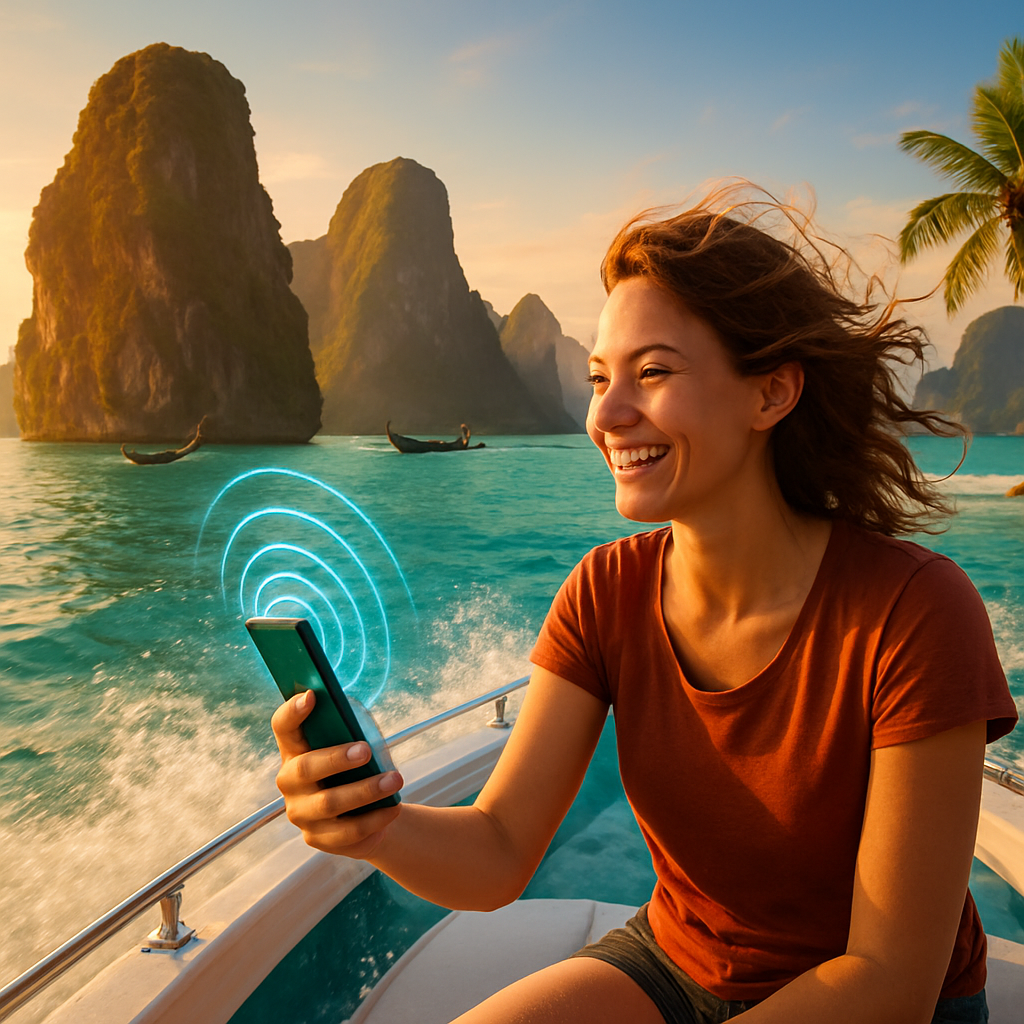
Imagine cruising across the glittering Andaman Sea, wind in your hair, the limestone karsts of Phang Nga sliding by like pieces in a giant postcard — and then glancing at your phone to discover a full 5G bar. That’s exactly what happened to a British traveller during his New Year break in Thailand, and the moment he realised his handset was streaming at top speed from the middle of the ocean became a cheeky little viral triumph for Thailand’s mobile networks.
The clip, uploaded by TikTok user @koopatrooping, shows a seemingly ordinary speedboat ride turned extraordinary by one small, modern miracle: consistent, blazing mobile internet where you’d least expect it. His caption — “5G on a speedboat in Asia but there’s no signal in South London…” — struck a chord, because it flips the script on a widely held assumption: that advanced connectivity belongs to dense Western metros, not to coastal islands and remote Thai waters.
It didn’t take long for the video to sail past novelty into conversation starter. Comments rolled in from all corners of the globe. Some viewers were incredulous: how could 5G work so well in isolated maritime spots? Others shared their own anecdotes — shots of seamless video calls from forest trails, uploads posted from mountain hamlets, live-streams from tiny beaches where you’d expect only crabs and a gentle breeze.
Thai users took the moment to celebrate. For many locals, the clip was less about rubbing it in and more about quiet national pride. Threads filled with stories of dependable coverage in places like the mountainous outskirts of Chiang Mai, small islands dotting the Gulf, and seaside villages where grandparents still fish by hand — all places now graced by reliable mobile internet. The message was clear: Thailand’s digital infrastructure has matured in ways that surprise even seasoned travellers.
Part of the fascination comes from contrast. The clip’s playful jab at South London tapped into an everyday frustration: slow or flaky mobile service in dense urban centres where we’d expect excellent coverage. Viewers from the UK pointed out familiar annoyances — dropouts on the Tube, buffering during live streams, the eternal hunt for a signal in certain suburban pockets. That juxtaposition — rural Thailand’s connectivity versus patchy London reception — made the story unexpectedly relatable and a little bit delightful.
Beyond the memes and man-on-a-boat humour, the video highlighted a practical truth. Mobile operators in Thailand have invested heavily in expanding 4G and 5G networks across the country, aiming to connect tourist hotspots and remote communities alike. For travellers, that means fewer “can you hear me now?” moments and more spontaneous uploads, maps that actually load, and the comfort of knowing emergency numbers and booking apps are only a tap away.
Of course, no travel tale is complete without another Brit deciding to stay. The story’s ripple effects came full circle with a nod to a different kind of expat life: a British woman who traded the UK’s grey skies for a hammock on Koh Samui. She’s now living beachside and volunteering at a dog sanctuary through Worldpackers, spending her days cuddling canines on the very island where the TV show The White Lotus found its sun‑drenched backdrop. It’s an appealing image — good Wi‑Fi, good company, and a shoreline that never goes out of style.
There’s a larger cultural thread beneath the viral clip: the way digital access reshapes perceptions. For tourists it’s comfort and convenience; for locals it’s economic opportunity, education and emergency readiness. Reliable connectivity makes remote communities more visible to the world, supports local entrepreneurs who sell handicrafts and services online, and helps students access resources beyond the classroom.
Still, the video’s charm runs on something simpler: surprise. We love being surprised by the world when it defies our expectations. A speedboat with 5G is an image that reads like modern travel poetry — the ancient landscape of Phang Nga meets the humming pulse of a global network. It’s the sort of detail that gets people smiling, sharing, and swapping their own “wait, really?” stories.
What started as a light-hearted TikTok post turned into a small but potent reminder: the world keeps changing, and sometimes those changes arrive where you least expect them — on a sunlit bow, between limestone cliffs, with the open sea ahead. Whether you’re trying to post the perfect sunset shot or simply map your way back to shore, these little technological surprises make travel feel just a bit more effortless, and a lot more connected.
So next time you find yourself in Phang Nga, Chiang Mai, Koh Yao Noi, or lounging on Koh Samui, don’t be shocked if your phone behaves like it’s in the middle of a city. Instead, take the moment to enjoy it: capture the view, send the clip, and maybe, just maybe, stick around to cuddle a rescue dog or two.

















What a flex for Thailand and an indictment of our networks at home. I get no signal in my basement flat but somehow a speedboat out at sea has 5G. Makes me wonder where operators are actually spending their money.
Basement flats and tubes are nightmare coverage spots, true, but that doesn’t erase the work to beam towers across islands. Maybe urban planning forgot the last mile while rural got investment.
Exactly, Lucy — last mile is everything. I just find it wild that tourists get bragging rights about connectivity more than city residents do.
Or maybe it’s marketing. Tourist hotspots get shiny towers because they bring money. The rest of us get patchy service and price hikes.
You all assume it’s just money and planning. There are technical reasons too like spectrum allocation and small cell placement that make urban coverage tricky.
As someone who works in telecom I can tell you deployment strategies often prioritize tourist belts and major transport routes. It’s less mysterious and more targeted business decisions. Still, seeing 5G on a speedboat makes a great ad.
True but Larry, targeting tourists over locals can widen the digital divide. Remote villages benefit but some urban poor still lack access where speeds matter.
Fair point Ananya, and that is why regulators sometimes require universal service obligations, but enforcement and funding are the hard parts.
As a local I appreciate better coverage. It helped my sister sell crafts online and students can attend lessons. Tourists are part of that ecosystem, not just privileged users.
I saw the clip and felt annoyed. Meanwhile back home my grandma struggles with video calls. It’s like networks show off in pretty places but ignore real community needs.
I get that, but having even pockets of great coverage can change economies. My friend in Chiang Mai runs yoga classes online now and it pays the rent.
I don’t object to tourism boosting incomes, I just want operators to balance profit and public service rather than chasing viral moments.
This is a neat anecdote but we should analyze policy implications. Infrastructure in developing tourism spots often comes with tradeoffs like land use and local price inflation. Connectivity isn’t purely benevolent.
Absolutely. From a development lens, connectivity can empower but also commodify culture. The distributional effects matter and need study rather than just Instagram stories.
Thanks Helen. I hope future reporting includes voices of residents and not just tourists who get the viral clout.
This reads too academic for a beach post, Ananya. People like simple wins: better maps, faster uploads, emergency calls. Not everyone wants a policy lecture.
Proud to see our networks working in Phang Nga. We have hardworking engineers and supportive local policy. It’s not perfect but progress is real and helps small vendors.
Appreciate the local perspective, Somsak. Do locals feel tourism connectivity changes community life for the worse sometimes?
Sometimes yes, Isabella. Prices rise and some places change, but many of us get jobs and students get resources, so it’s complicated.
The clip is a cultural artifact more than a technical marvel. It reveals expectations about where technology ‘should’ be and exposes inequities. The meme of South London vs Thai speedboat is a social mirror.
Helen, you’re reading deep into a TikTok. But I like it. Social media compresses these debates into a single image and that can galvanize people.
Larry D, true, but those compressed narratives shape policy too. A viral moment can redirect public attention and funds, for better or worse.
As someone who moved to Koh Samui after a furlough, I can say good connectivity made the jump possible. It’s not just flashy, it’s practical for remote work and volunteering.
Jealous. Did you find housing and work via apps thanks to 5G or was it old school networking?
A mix of both. Apps helped find places and community groups, but meeting people in person still mattered for long term projects.
I hate these flex posts. Telecom companies love to show off in pretty places while charging horrendous roaming fees elsewhere. This is a PR move disguised as travel content.
Agreed. Show me affordable data and real coverage maps, not a boat selfie.
Exactly. Until pricing and transparency improve, these clips are just distractions.
One small correction: good coverage doesn’t always mean equal quality. Latency, pricing, and network congestion still affect experience. That said, it’s nice to see progress.
I shared a similar video from Koh Yao Noi last year and people lost it. The bigger debate is whether tourists should flaunt infrastructure gains or highlight local needs instead.
Travel influencers have power. They can nudge operators and governments but they also might attract overtourism that stresses communities.
Is it possible that small cell tech and sea reflections make coverage better on water sometimes? Sounds silly but physics matters here. Maybe the boat had a line of sight to a tower.
This made me smile but also worried a bit. More connectivity means more surveillance and data extraction, especially when tourists upload everything. Net neutrality and privacy should be part of the conversation.
Nina, privacy is often sidelined in tourism narratives. Local laws and corporate practices define the real risk and benefits, and those vary widely.
Thanks DrHelen, glad someone mentioned it. We celebrate speed but forget what we give up.