
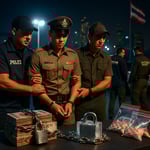
In a case that could be pulled straight from an international crime drama, Thailand’s Immigration Bureau announced the arrest of six foreign nationals this week on charges ranging from large‑scale financial fraud and people‑trafficking to major narcotics smuggling. Deputy Commissioner Police Major General Panthana Nuchanart revealed the sweeping operation, which saw suspects nabbed across Bangkok and Chon Buri as investigators closed in on alleged cross‑border criminal networks.
The first name on the list is Pan, a 41‑year‑old Chinese national wanted back home for allegedly defrauding banks of a staggering 560 million yuan — roughly 2.8 billion baht. Authorities say Pan falsified business information to secure loans and siphoned off more than 80 million yuan for illicit gains. He entered Thailand on a tourist visa in May of last year and reportedly overstayed, settling at a salon in Chon Buri where officers eventually tracked him down and made the arrest.
Next came the trio linked to human trafficking and recruitment scams: 31‑year‑old Yang and 21‑year‑old Zhang, along with Zhang’s 20‑year‑old girlfriend Cheng. The group is accused of luring more than 120 Chinese citizens with fake job offers, then forcing or funneling them into scam call centres operating across the border in Myanmar and Cambodia. Police located the three at separate condominiums in Bangkok’s Sukhumvit and Lat Phrao districts — a reminder that high‑rise luxury can sometimes conceal low‑life crimes.
Not all arrests were made in dark alleys or dramatic midnight raids. Chen, a 37‑year‑old Taiwanese national, walked into an immigration office while applying for a study visa and was detained after authorities flagged him. Taiwanese officials accuse Chen of smuggling more than 54 kilogrammes of cannabis hidden inside a shipping container from Canada. He is said to have fled Taiwan before a court could issue an arrest warrant.
And in what reads like the final act of a neo‑noir subplot, Simone, a 26‑year‑old Italian national, was arrested at a condominium in Ekkamai. Simone is accused of smuggling a cocktail of hard drugs — heroin, cocaine, ketamine, ecstasy and LSD — through international parcels. Investigators believe Simone arrived in Thailand in October and kept a low profile until the arrest.
Authorities emphasized that each suspect now faces severe legal exposure under Thai law. While the facts of each case will be hashed out in court, the likely penalties are stark:
- Fraud (Pan): If classified as general fraud under the criminal code, penalties can include up to five years in prison or a fine up to 10,000 baht. Given the scale of the alleged swindle, prosecutors may push for harsher measures where applicable.
- Human trafficking (Yang, Zhang, Cheng): The Anti‑Trafficking in Persons Act carries prison terms from four to ten years and fines ranging between 80,000 and 200,000 baht for trafficking offences.
- Drug smuggling (Chen, Simone): Drug offences in Thailand are among the most heavily penalized. For major trafficking or smuggling charges, courts can impose life imprisonment or, in the most serious cases, the death penalty.
Beyond the courtroom stakes, these arrests highlight the increasingly transnational nature of contemporary crime. From forged loan paperwork that stretches across financial institutions in China to recruitment ruses that pipe would‑be workers into criminal call centres in neighboring countries, investigators are grappling with networks that exploit porous borders and digital anonymity.
The Immigration Bureau’s announcement also referenced a related case: police recently arrested a Chinese man holding a Vanuatu passport who is accused of embezzling 250 million baht in his home country. That suspect had been on the run for seven years before being located and detained in Thailand — underscoring both the persistence of fugitives and the persistence of law enforcement tracking them down.
For locals and expatriates alike, the wave of arrests is a reminder to stay vigilant. Scammers continue to deploy sophisticated lures — false job offers, seemingly legitimate business deals, or too‑good‑to‑be‑true investment opportunities. Meanwhile, smugglers and traffickers exploit everything from international parcel services to high‑rise condos as part of their operations.
Major General Panthana’s office portrayed the arrests as the result of coordinated investigative work and cross‑border cooperation, but cautioned that the legal processes are only beginning. Each defendant will have the opportunity to respond to the charges in court, and the final outcomes will depend on evidence, judicial scrutiny and, where applicable, extradition procedures.
As the cases move forward, authorities say further arrests and charges could follow. For now, the story reads like a cautionary tale about how money, migration and modern crime intertwine — a high‑stakes drama that unfolded across condominiums, immigration desks and a salon in Chon Buri, and one that is far from over.
















This sounds like a magnet for criminals — too easy to hide in tourist overstays and condos. Thailand needs stricter visa enforcement and faster extradition. Otherwise it’ll just get worse.
I get the frustration, but knee‑jerk tightening of visas hurts legitimate tourists and expats too. We need targeted intelligence and better international cooperation, not blanket bans. Transparency in investigations would help regain public trust.
The case illustrates classic transnational criminal finance: loan fraud, shell entities, and misuse of passports. Extradition is rarely straightforward, especially when multiple jurisdictions and competing evidentiary standards are involved. Thailand’s legal system will have to coordinate with China, Taiwan and European authorities to untangle ownership chains and parcel routing data.
Sounds expensive to chase paperwork when they can just move on to the next condo. Cops are playing whack‑a‑mole.
Dr. Mei, I hear you, but the public wants to see action now — slow legal wrangling feels like impunity. How do we get that balance without violating rights?
Show arrests on TV and people feel safer, even if the problem persists behind the scenes.
My heart goes out to the trafficked victims — over 120 people duped by fake job offers is horrific. We need stronger protections for migrants who are targeted by recruiters. Punish the recruiters, not the victims.
That’s so sad. Why do people fall for fake jobs?
Because poverty pushes people to take risks and slick recruiters exploit trust. Also, cross‑border regulation between Myanmar, Cambodia and Thailand is weak, which makes these call centre networks easy to run. Locals often know something but fear reprisals.
Exactly, Pong — it’s both an economic and enforcement failure. Outreach and safe reporting channels would reduce the power of these traffickers.
Tech platforms are often used to advertise fake jobs, so social media companies should be part of the solution. Simple awareness campaigns can cut recruitment by making job seekers skeptical.
If drug smugglers face life or death sentences, that’s one way to scare them off, but it’s also barbaric and doesn’t address demand. Harsh punishment alone won’t stop organized networks. We need harm reduction and international disruption of supply chains.
I agree — death penalty for drugs is a human rights issue and doesn’t reduce addiction. Rehabilitation and targeting kingpins make more sense.
Harm reduction is fine, but when traffickers force people into distribution or smuggle tons of drugs, someone needs to feel real consequences. Focus on intelligence and follow the money to hit the bosses.
Sam, consequences matter but so does proportionality and evidence standards. Overcriminalization can create miscarriages of justice, especially with foreign defendants and language barriers.
This is scary for kids to hear about. Are foreigners making Thailand unsafe?
Crime isn’t about nationality — transnational actors exploit gaps everywhere. The Vanuatu passport case shows how document fraud complicates policing and requires diplomatic channels.
Thanks, Li Wei. How do passports from places like Vanuatu get used like that?
The article is a textbook case of globalization’s darker side: illicit finance, porous regulatory regimes, and digital recruitment. Policy responses must be multilateral and include banking transparency, parcel‑tracking cooperation, and protections for whistleblowers. Punitive measures alone rarely dismantle sophisticated networks.
From the investigative front, coordination is improving but resource constraints matter. Tracing parcel data and financial flows is labor‑intensive and requires legal requests across jurisdictions. We need better tech and mutual legal assistance treaties that work in practice.
Agreed — capacity building is key. Thailand could also incentivize reporting by offering victim‑witness protections and fast‑track cooperation with countries supplying intelligence.
Let’s not let this become an excuse to demonize Chinese nationals or other minorities. Many are victims too and deserve due process. Media framing matters.
Absolutely, Xiao Ming — we try to separate suspects from communities, but public pressure sometimes pushes harder lines that backfire.
As an expat, this worries me — scams are getting more sophisticated and even safe‑seeming condos can hide operations. People should verify job offers through official channels and be skeptical of recruiters asking for upfront fees. Share info among communities to protect newcomers.
Sometimes locals see foreigners as easy targets, but blaming all foreigners is unfair. Enforcement should focus on criminals, not nationalities.
Totally — my point is about awareness, not xenophobia. Community networks and embassy advisories can help prevent exploitation.
Practical tip: check company registration numbers, ask for contracts before travel, and never pay recruitment fees. Simple checks stop a lot of scams.
Funny how big crooks end up living in luxury condos and then ‘get arrested’ for a headline. I doubt they’ll get the maximum sentences if they have money or connections. Corruption and slow courts always help them.
That’s cynical but understandable. Still, accusing the system wholesale without evidence breeds hopelessness; oversight and public watchdogs are better responses.
Olivia, I’ve seen cases where wealthy suspects get bail or delayed extradition. Until we see convictions, skepticism is reasonable.
Are there examples of successful cross‑border prosecutions in the region? Precedent might reassure people like Krit. Details matter for trust.
The way condos and salons are written about makes me nervous as a renter — landlords should vet tenants more carefully. But privacy and tenancy laws complicate that, and innocent people shouldn’t be harassed. There has to be a balanced policy.
Landlords often lack legal grounds to evict without proof of crime, which is good for renters but can shelter criminals. Maybe mandatory ID checks for long‑term leases would help.
Jade, mandatory checks could work if paired with anti‑profiling rules and clear reporting channels. We should protect communities without scapegoating migrants.