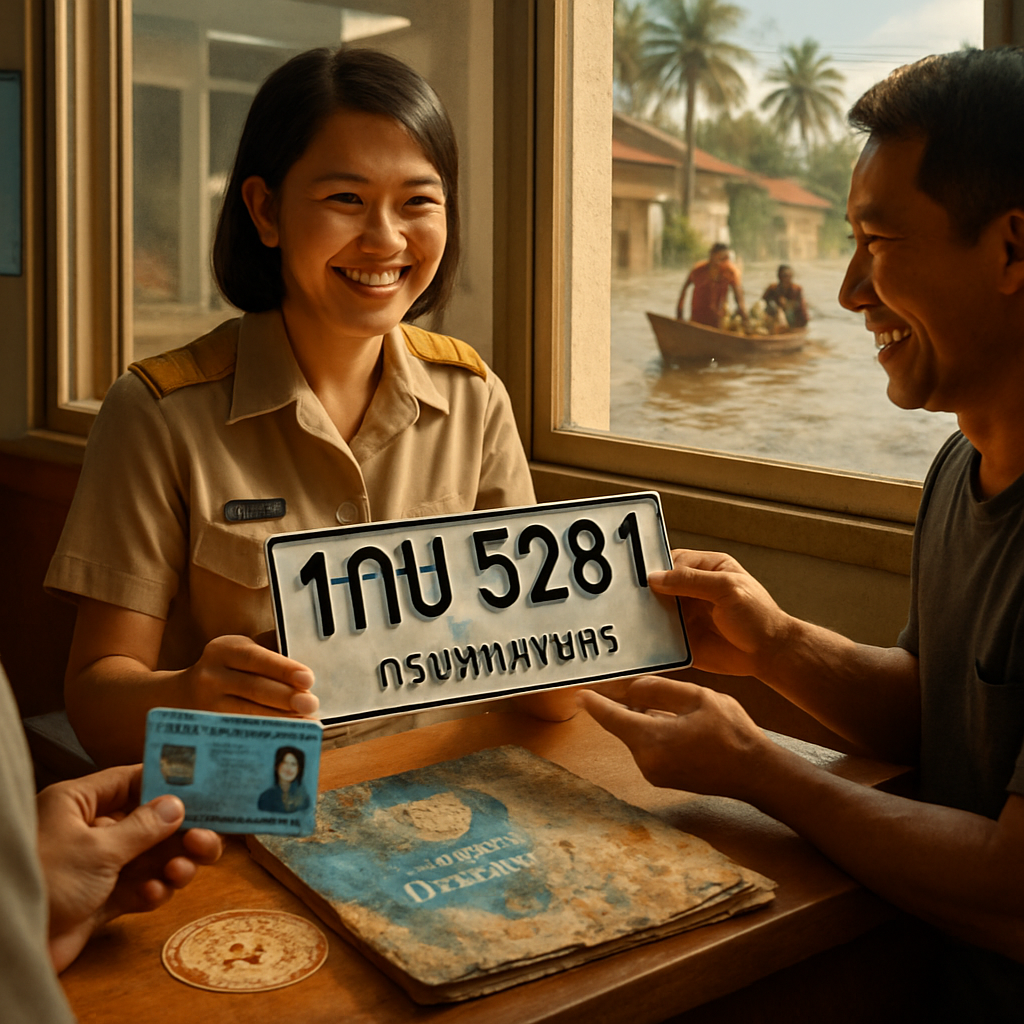
Good news for motorists battered by the recent southern floods: Thailand’s Transport Ministry has waved through a practical, people-first shortcut to replace ruined vehicle documents and licence plates. Announced on December 5 by Deputy Prime Minister and Transport Minister Pipat Ratchakitprakarn together with Deputy Transport Minister Mallika Chirawongwanich, the policy relaxes paperwork requirements so flood-hit drivers don’t have to hunt down soaked or missing registration books and ID cards just to get back on the road.
What’s changed — the practical bits
Department of Land Transport (DLT) Director-General Sorapong Paitoonpong explained the new approach: if your licence plate, tax sticker (those round discs), or registration book was lost or damaged in the floods, you can apply for replacements with much less red tape. In simple terms:
- If your registration book is gone, a person who legally owns the vehicle only needs to present their national ID card at the transport office where the vehicle is registered.
- If the vehicle is financed and the owner does not have the registration book (because the finance company holds it), the owner can still request a copy of their registration data at any transport office in the country using only their ID card.
- To replace a damaged or lost licence plate or tax disc, a copy of the registration book is preferred if available — but if not, an ID card will do. Damaged plates or stickers must be returned when collecting replacements; if they were completely lost or destroyed, you can either file a statement with the transport registrar or submit a police report to verify the loss.
- If someone else is dealing with the paperwork on your behalf, a written power of attorney is required plus ID documents for both the owner and the representative.
- Important: replacement licence plates or tax discs requested outside the province of registration must be picked up at the same office where the application was submitted.
Why this matters — beyond the paperwork
Vehicles in the south aren’t just convenient — they’re vital. Many families rely on cars and motorbikes for commuting, buying supplies, and helping neighbours recover. A lost registration book or a missing plate can quickly become a barrier to everyday life and recovery efforts. By easing documentation requirements, the DLT is prioritising mobility and speeding up the small but crucial steps toward normalcy.
Where and how long: timelines you should know
If you live in Songkhla province, the relaxed service is already available and runs through February 25, 2026 — so you have time to gather what you can and make your request. In other provinces, the window for this assistance is a 60-day period starting from the date the area is officially declared a disaster zone. That means if your district gets the disaster declaration stamp, a 60-day clock begins for simplified replacement procedures.
Practical tips to make the process smoother
- Bring your national ID card first — it’s now central to the relaxed process.
- If your vehicle is under finance, call your finance company to confirm whether a copy of the registration details can be released to you or the DLT. It can speed things up if you arrive at the office with at least some supporting documents.
- If plates or stickers were destroyed, prepare a short statement or visit the local police to file a simple loss report — either works for verification.
- If a family member or friend will collect replacements for you, prepare a signed power of attorney and make sure both parties have ID photocopies ready.
- Keep receipts and serial numbers, if any, for the new plates or stickers — insurance, future resale, or bureaucratic follow-ups will thank you.
Small change, big relief
This policy tweak is not a flashy headline but a practical fix: fewer hoops to jump through in times when people need speed and simplicity. It’s a reminder that bureaucracy can bend when it must — and that small adjustments can ease a lot of pressure for families and small-business owners trying to rebuild after floods.
If you or someone you know was affected in the southern floods, head to your local transport office or the nearest DLT branch for details and to start the replacement process. Bring your ID, a bit of patience, and maybe a cup of tea — the rest is now a lot more straightforward.
For the latest updates and exact office hours, follow official DLT announcements or check local provincial notices where disaster declarations have been made.


















This is actually a smart, small-step policy that will make life easier for flood victims. Too often bureaucracy slows recovery more than the disaster itself. Hopefully they keep it simple at the counters.
Smart on paper, but will clerks in far-flung offices really follow the reduced rules? In my town they make you bring three witnesses for a photocopy.
That’s the worry — local interpretation kills consistency. A national memo doesn’t always translate to uniform practice.
I hear you, Larry. But we should pressure provincial DLT offices with journalists and social media when they backslide. Public scrutiny helps enforcement.
As someone from the south this helps my neighbours a lot. But why only 60 days in most provinces? That’s tight when people are rebuilding homes.
60 days is political theater — floods have long tails. People might still be displaced after two months and can’t get to the transport office.
Exactly, and transport offices should offer mobile teams to reach displaced communities. It’s cheaper than delays and illegal driving risks.
Mobile teams are doable but require logistics and funding. A better approach might be a temporary digital verification system tied to national ID.
I like that they accept just an ID, but what if finance companies refuse to release registration info? That could leave people stranded.
Finance firms could be forced by regulation to grant access after a disaster declaration. Otherwise that’s a loophole for profiteering.
Exactly — there should be a legal clause that compels lenders to cooperate during declared disasters, with fines if they obstruct the process.
Operationally this is sensible: using national ID as pivot reduces dependency on single physical documents. It’s a standard disaster response move.
From an administrative law perspective, temporary relaxation must be time-bound and transparent. Oversight prevents abuse and fraud.
Agreed. Publish a clear audit trail and a hotline for citizens to report noncompliance. Data protection must also be observed.
Data protection? Sounds fancy, but will villagers know how to use hotlines or digital forms? Practicality matters more than theory.
Good on them, but I’m suspicious. Thailand’s bureaucracy often says ‘relaxed’ and means ‘come in at 4am to stand in line.’
People forget the little wins though. Even one hour saved on paperwork helps a family that needs to run errands post-flood.
Fair point, Amira. I just want this to be more than words — actual streamlined queues, extra staff, and mobile units would prove it.
This policy feels compassionate and practical. A lot of flood victims will be grateful not to chase ruined documents.
Minister Pipat deserves credit — it’s people-first leadership. Not every policy needs to be grand to be meaningful.
I agree, small practical fixes are underrated. They should also publicise the process in local dialects so everyone understands.
I’m glad but wary — often these concessions are temporary PR moves and not institutionalized changes for future disasters.
They should let family members pick up replacements without so much paperwork. Many are displaced and can’t travel.
Anong, the policy already allows powers of attorney, but yes, simplifying that further would help people who can’t get home.
Police reports as verification are sensible but may re-traumatise victims. The DLT should offer an administrative self-declaration option with safeguards.
They did mention a written statement works too. It’s a small mercy that police reports aren’t absolutely mandatory.
True, but implementation training for staff to accept statements smoothly is crucial. Otherwise victims get bounced between offices.
Tax discs and plates are small things, but they’re also legal tools — without them people risk fines or impoundment while recovering.
Exactly. The risk of fines forces people to take illegal shortcuts. Waivers during recovery periods could prevent that.
I wonder why Songkhla gets a specific extended period through Feb 25, 2026. Did they lobby harder or is the damage worse there?
Songkhla was hit particularly hard and declared earlier. Politics probably plays a role, but the extra time is helpful for locals.
Who audits whether this relaxed process increases fraud? There’s always the trade-off between speed and verification.
A post-event audit and random checks can mitigate fraud risks. Technology like database cross-checks can maintain integrity.
Audits are fine, but victims shouldn’t be criminalised while waiting for the results. Temporary protections are necessary.
Kids notice when adults struggle with simple tasks like renewing plates. This makes recovery feel slightly less hopeless for families.
That’s a touching point. Bureaucracy can be demoralizing, so these small changes can have outsized psychological benefits.
This reads like a press release. Where are the metrics? How many offices will implement this, and what’s the staffing plan?
Critic is right to ask for KPIs. The DLT should publish expected service times, staff allocations, and a complaint channel for failures.
Local NGOs should partner with DLT offices to help people get documents replaced. Grassroots support could speed up the process.
Great idea. NGOs often have community trust and can carry out outreach and assistance at low cost.
If NGOs are involved they must be briefed officially so clerks accept NGO forms or attestations without resistance.
As a motorbike taxi driver I worry about the pick-up rule: replacing plates outside province requires pick-up at the same office. That’s inconvenient.
That rule does seem backward. If you applied at a different office because you’re displaced, forcing you to return makes no sense.
Exactly — many drivers are living in different provinces right now. They need flexibility or mobile distribution points.
Can foreigners with registered cars in Thailand use these relaxed rules too? Many expats were affected and documents got ruined.
Good question. I hope the DLT clarifies that ID means national ID for citizens and passport/permit for foreigners.
If not clarified soon, expats could face unexpected problems. The DLT should issue multilingual guidance.
Policy is decent, but climate change means floods will be more frequent. Long-term: Thailand must digitise vehicle records fully to avoid physical document dependence.
Absolutely. Digital registries, secure national ID linkage, and disaster-resilient backups are investments that pay off in efficiency and resilience.
Why does every good policy come after public outcry? They should have contingency plans before disasters, not reactive fixes.
Because politics and budgets, sadly. But even reactive fixes are better than nothing if implemented properly.