Eight cheap countries still let foreigners buy homes in 2026. Thailand is a different bet
A 1 to 3 million baht budget can still buy a titled home in several overseas markets. In Thailand, the same money usually buys a condo share under a 49 percent foreign cap, not land.
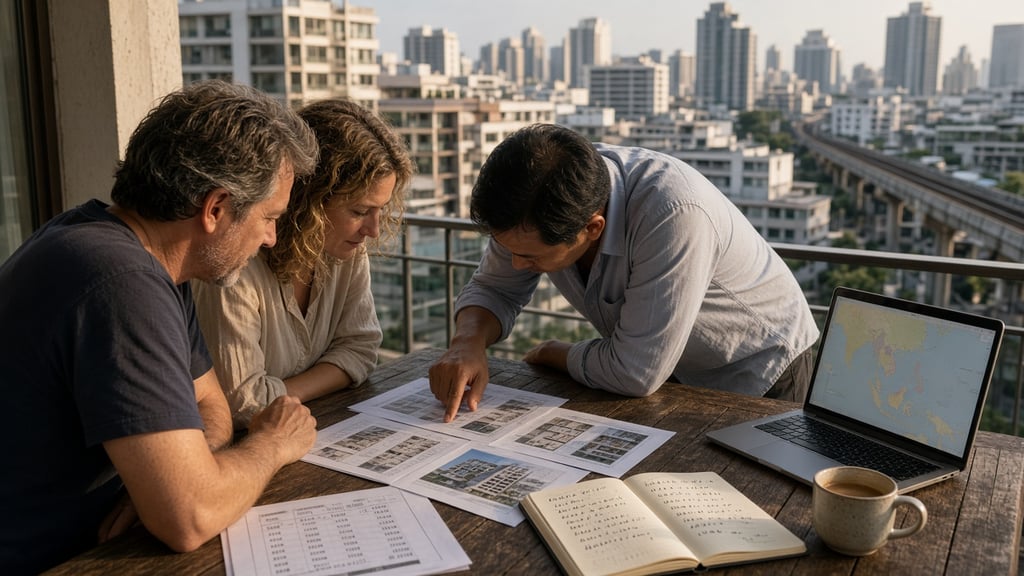
A household with 1 to 3 million baht can still find cities where that sum buys a real apartment, and in a few places a small house, with the foreigner's name on the title. For people already in Thailand, the test is whether that money buys a clean title.
A 2026 composite ranking of eight low-cost markets, built from Global Property Guide and Numbeo square-metre prices plus foreign-ownership rules, places Georgia first. Paraguay, Turkey, Colombia, Albania, Bulgaria, Egypt, and Cambodia follow. The order is not a dare to wire a deposit. It is a map of how far title, process, and price still line up for non-citizens.
Thailand's 49 percent condo ceiling
Official Thai guidance is unambiguous. Foreigners may own condominium units if they entered the country legally, but the foreign share of any building may not exceed 49 percent of the total unit space. Land is a different product. Under Land Code section 96 bis, a foreigner may seek no more than one rai for residence, and only after investing at least 40 million baht for five years.
That 40 million baht floor is more than ten times the budget this ranking is built around. For most expats in Bangkok, Chiang Mai, Pattaya, or Phuket, 1 to 3 million baht therefore buys a condo, a long lease, or nothing they can register in their own name.
Georgia shows what open looks like when the state wants foreigners in the registry. The US State Department's 2026 investment climate statement says property registration at Public Service Halls can be completed in a day. Foreigners may buy apartments and houses; agricultural land stays with Georgian citizens under Article 19. A Tbilisi flat is not the cheapest object on the eight-country list. The title process is among the cleanest.
Cambodia looks generous until you read the statute. The 2010 Law on Providing Foreigners with Ownership Rights in Private Units of Co-Owned Buildings lets legally qualified foreigners own private units from the first floor up. Sub-Decree No. 82 caps the foreign share at 70 percent of private-unit surface, wider than Thailand's 49 percent. It is still a condo market, not a land market, and title quality is a project-by-project question.
Three kinds of title
The eight countries sort more cleanly by legal model than by price.
Open or near-open freehold covers Georgia, Paraguay, Turkey, and Colombia. Turkey's Investment Office says foreigners do not need a residence permit to buy, and title exists only after land-registry registration. Citizenship is a separate, much larger cheque: USD 400,000 in property with a three-year resale lock. Colombia and Paraguay are widely treated as ordinary urban freehold for foreigners, with no company and no residency prerequisite for a standard home.
Bulgaria and Albania let foreigners buy apartments and buildings directly; land typically needs a local company. Bulgaria adds EU legal cover. Global Property Guide's city series, updated in October 2026, still places Sofia among the cheaper European capitals even after a sharp run-up through 2025. Albania's coast is cheaper than Croatia, with EU-candidate status in the background.
Egypt and Cambodia sell cheap units with hard limits. Egyptian investment rules under Law 230 of 1996 allow a non-Egyptian to hold up to two residential properties, each no larger than 4,000 square metres. Cambodia can price a Phnom Penh one-bed inside the 1 to 3 million baht band, but the buyer is purchasing a strata unit above the ground floor, not a house.
Global Property Guide city figures are main-city benchmarks, not national averages, and they move with exchange rates. Anyone converting baht should treat the number as a screen, not a contract.
What This Means for Expats and Travelers in Thailand
If you already live here, treat the ranking as a legal comparison. A 2 million baht studio in Nonthaburi or Chiang Mai is a home you can use next week. A 2 million baht house in Asuncion or a Red Sea walk-up is an asset you may not see for months, in a court system you do not yet know.
Thai citizens have a different calculus. They can buy land at home. The overseas list is useful for diversification or a second-passport track (Turkey's USD 400,000 sits far above 3 million baht). For foreign residents the contrast is sharper. Thailand's 49 percent condo cap and 40 million baht land exception mean the 1 to 3 million baht budget is almost always a condo decision here, and a house-or-land decision in Georgia, Paraguay, or parts of Turkey.
Due diligence does not travel. Confirm the foreign-quota certificate on a Thai condo. Confirm the land category in Georgia so you are not buying an agricultural plot by accident. Confirm Egypt's two-property cap and registration at the Real Estate Publicity Department, not an unregistered private contract.
Travelers passing through Bangkok who are just looking should treat cheap overseas listings the way they treat cheap island land on Facebook: as a lead, not a deal. Cheap and ownable are not the same as cheap and wise.
Comment verification
Step 1 of 3
Verify your email once to publish your comment. Your email is never shown publicly.
Enter the 6-digit code sent to .
Choose the display name shown next to your comments.