Tourist Police hold American in Chiang Mai unlicensed lodging sweep before Yi Peng
A 40-year-old American was arrested in Phra Sing during a 7.30am Tourist Police sweep of unlicensed beds and foreign workers as Chiang Mai opened Yi Peng. A second arrest and a Saraphi warrant file followed.
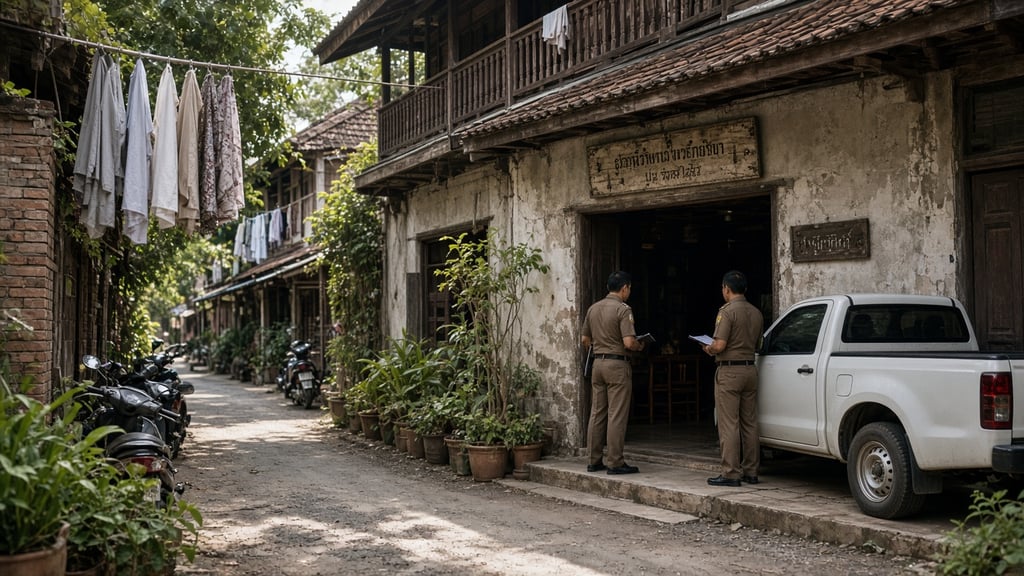
Chiang Mai Tourist Police detained a 40-year-old American man on Monday morning, 23 November 2026, at the first of three sites in a sweep aimed at unlicensed lodging and foreign workers as the city opened Yi Peng. Officers from Tourist Police Division 2 began the operation, named Shadow-Free Yi Peng, at 7.30am across Mueang Chiang Mai and neighbouring Saraphi district. The American was arrested in Phra Sing subdistrict. Police did not release his name.
The Phra Sing stop was a paid accommodation business. Investigators accused the American of operating the lodging without a hotel licence and of working without a valid work permit, or outside the conditions of any permit he held. Those two charges travel together. Nightly rooms are a hotel business under Thai law. A foreigner who takes bookings, checks guests in, or runs the desk is working, even if the visa stamp looks like tourism.
A second team executed a search warrant at an accommodation business in Nong Phueng subdistrict, Saraphi. Officers suspected the property was operating as a hotel without a licence and had not notified immigration of foreign guests staying there. No arrest was announced at that site. The file went to Saraphi Police Station.
The third stop was on Singharat Road in Si Phum subdistrict, inside the old city. Police arrested a 26-year-old woman on suspicion of working without a permit or outside her permitted job. Her nationality was not given. She and the American were both transferred to Mueang Chiang Mai Police Station. Police did not say the two cases were linked.
Local Thai reporting identified the operation as a Tourist Police order from Commissioner Pol. Lt. Gen. Phongsiam Meekhantong, with Division 2 commander Pol. Maj. Gen. Olarn Iampraphas and superintendent Pol. Col. Phitsanu Triamdee directing the teams. Tourist Police said checks on lodging and foreign workers would continue through the festival period.
The calendar explains the hour. Chiang Mai Municipality set Yi Peng 2026 for 23 to 25 November, with Loy Krathong on 24 November, as the start of the high season. Mayor Assanee Buranupakon announced the programme on 11 November, with Governor Thotsaphon Phuean-udom present. Festival weeks fill cheap rooms in Phra Sing, Si Phum, and the lanes off Singharat Road. That is also where unlicensed beds cluster.
What the Hotel Act actually requires
Under the Hotel Act B.E. 2547 (2004), a hotel is a place set up in business to give travellers temporary lodging for payment. Section 15 bars anyone from operating that business without a registrar's licence. Monthly residential leases sit outside the definition. Nightly and weekly lets, including rooms sold on booking platforms, sit inside it.
Section 59 sets the criminal penalty for operating without a licence: imprisonment of up to one year, a fine of up to 20,000 baht, or both, plus a further fine of up to 10,000 baht for each day the offence continues.
Small operators still have a legal path. Accommodation with no more than eight rooms and no more than 30 guests can register with the district as non-hotel lodging, under rules administered through the Department of Provincial Administration, instead of holding a full hotel licence. Registration is still required. Hotel operation is also a List 3 service under the Foreign Business Act, so a foreigner cannot lawfully run the business on a personal visa even if the building is licensed.
The work charge sits on a different statute. The Emergency Decree on Managing the Work of Aliens B.E. 2560, as amended in 2018, prohibits a foreigner from working without a permit or beyond what the permit allows. Section 101 sets a fine of 5,000 to 50,000 baht and, once the fine is paid, removal from the Kingdom. A later work permit is barred for two years after the penalty ends.
Guest reporting is a third layer. Section 38 of the Immigration Act B.E. 2522 requires a householder, dwelling owner, or hotel manager who takes in a foreigner to notify the local immigration office within 24 hours, using form TM.30. Section 77 fines a householder up to 2,000 baht for failing to notify, and a hotel manager from 2,000 to 10,000 baht. The Saraphi warrant file included that failure.
What This Means for Expats and Travelers in Thailand
If you let rooms by the night in Chiang Mai, treat that as a hotel business until a district registrar says otherwise. One room on a booking site is enough. The legal routes are a hotel licence or, for properties at or under eight rooms and 30 guests, non-hotel registration at the district office. A listing on a platform is not a licence.
Foreigners who manage check-in, take cash, answer bookings, or live on site as the operator are working. A tourist stamp, exemption entry, retirement extension, or marriage visa is not a work permit. The American in Phra Sing was held on both the lodging offence and the work offence. The 26-year-old woman on Singharat Road was held on the work offence alone. Names were withheld, and neither case is a conviction.
TM.30 is the host's duty, not the guest's. File within 24 hours of a foreigner moving in and keep the receipt. Unlicensed operators who skip both the hotel paperwork and the guest notification stack two files: Hotel Act and Immigration Act. Licensed hotels still have to file TM.30. Festival weeks are enforcement weeks. Anyone advertising nightly rates in Phra Sing, Si Phum, or Saraphi should assume the next knock can come before the last lantern goes up.

Comment verification
Step 1 of 3
Verify your email once to publish your comment. Your email is never shown publicly.
Enter the 6-digit code sent to .
Choose the display name shown next to your comments.