Police allege Chiang Mai Nimman exchange was a nominee front for scam-to-USDT cash
Cyber police say a Nimmanhaemin Road money-change shop converted online-investment scam proceeds into USDT. The alleged Chinese boss had already left Thailand when officers searched the shop and his Doi Saket home.
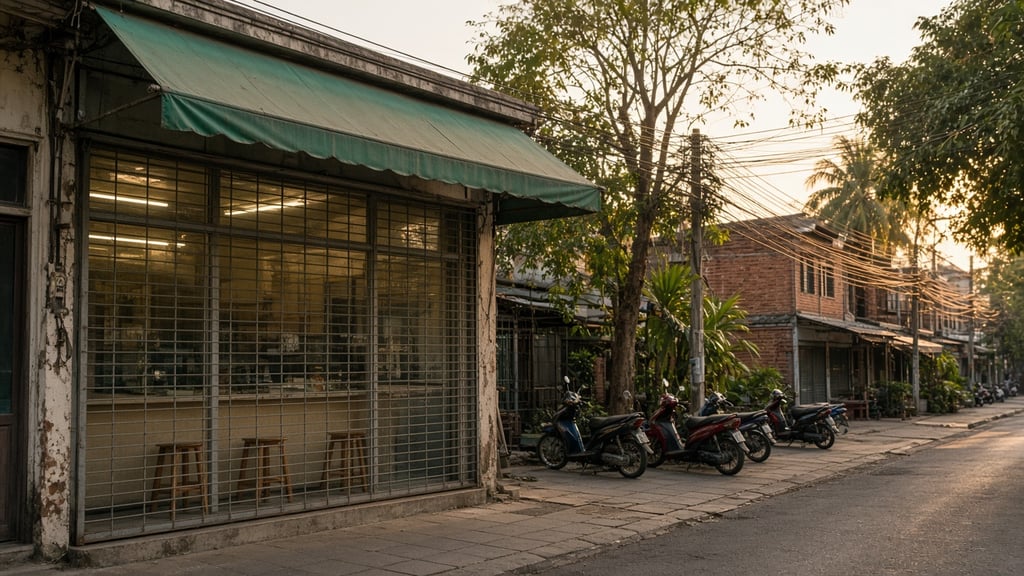
Thai cyber police say a foreign-currency exchange shop on Nimmanhaemin Road in Chiang Mai was used as a front to turn fake overseas-share scam proceeds into USDT. Officers searched the Soi 13 shop and a house in Doi Saket district on 10 November 2026. The alleged organizer, 42-year-old Chinese national Wenjun Feng, known as Tiger, had already left Thailand.
The Technology Crime Suppression Division briefed reporters on 20 November. A Facebook pitch early in 2026 led one victim to send 7,150,884 baht in 14 transfers. Three more complainants followed. Combined losses for the four people named so far are 9,435,607.97 baht. Police say the money moved through 24 mule bank accounts, was withdrawn as cash, and was handed to Feng at golf courses, malls, and coffee shops in Chiang Mai.
Brokers then allegedly converted the cash to USDT for a fee of about 2% to 3% and sent the tokens onward. Feng's personal wallet showed turnover of more than 2,749,566 USDT, more than 92 million baht. Nan Provincial Court issued an arrest warrant on 25 September 2026. Immigration has been asked to watchlist him.
Police say Feng and his 36-year-old Chinese wife, Yaning Yan, ran the visible shop through Juthamat Meechai, a 35-year-old Thai woman known as Nat, listed as sole director and majority shareholder. The company account took in 443,025 baht over nine months. Yan's personal account moved more than 22 million baht in the same window, including more than 11 million baht in counter cash withdrawals. Investigators tracked more than 5.7 million baht from Feng to Yan and more than 1.1 million baht from Yan to Juthamat, whose regular monthly income they put at 19,000 to 24,000 baht.
Both women answered summonses. Yan is accused of running a List Three service business as a foreigner without permission and of letting a Thai hold shares for her. Juthamat is accused of acting as a nominee, of consenting as authorized director, and of giving officials false information. Officers seized 31 items from the shop. Feng was gone from his San Pu Loei home. Police are still tracing mule-account suppliers, large currency buyers, and linked companies.
Nominee shareholding is a criminal offence, not a formality
Currency exchange is a service. Under the Foreign Business Act B.E. 2542 (1999) , most service businesses sit on List Three, which a foreigner may not operate without a foreign-business licence. Section 36 makes it an offence for a Thai national to hold shares as a nominee so a foreigner can run a restricted business, and for the foreigner to allow that arrangement. The penalty is imprisonment of up to three years, a fine of 100,000 to 1,000,000 baht, or both. Thailand.go.th restates the same ban.
The Department of Business Development spent 2026 tightening this pattern. A 1 January order required Thai shareholders in mixed companies to show bank statements proving they paid for their shares. A 16 March order, in force from 1 April, requires directors to certify that every shareholder invested in cash and is not a nominee. DBD said the first checks cut suspect registrations by 65%, and it named Chiang Mai among the provinces it would watch most closely.
AMLO already treats licensed changers as reporters
Thailand's Anti-Money Laundering Office , created in 1999 with the Anti-Money Laundering Act B.E. 2542, treats a licensed money changer as a reporting person. A 2016 ministerial regulation still requires a juristic person licensed to buy and sell foreign currency to file a cash-transaction report on foreign-exchange deals of 500,000 baht or more. Suspicious transactions have no monetary floor and must be filed within seven days of the suspicion.
A shop that books only 443,025 baht through the company account while a related personal account moves 22 million baht sits far outside AMLO's money-changer manuals. A licensed exchange is not a cash drop. It is a regulated counter with identity checks, thresholds, and a duty to tell AMLO when a customer looks like a mule.
What This Means for Expats and Travelers in Thailand
Do not treat a Nimman, Walking Street, or beach-road booth as a private OTC desk. Large cash swaps into USDT belong at a licensed digital-asset operator or a bank that will record the deal. If someone offers to convert baht to crypto for a 2% to 3% cut in a coffee shop, that is the fee structure police described in this case, not a bargain.
Thai friends, spouses, and employees who agree to sit as sole director of a foreigner's shop are not doing a paperwork favour. Section 36 is a criminal offence, and DBD is routing suspect certifications to the Central Investigation Bureau. Expats who already hold shares through a Thai nominee should unwind that structure with a licensed adviser before a raid, not after one.
Victims of Facebook foreign-stock pitches should report to cyber police quickly. The four complainants in this file recovered nothing by waiting, and mule accounts are emptied within hours. Keep transfer slips. Anyone later contacted about the Nimman shop should answer the summons.

Comment verification
Step 1 of 3
Verify your email once to publish your comment. Your email is never shown publicly.
Enter the 6-digit code sent to .
Choose the display name shown next to your comments.