Wuhan passenger detained five days after tossing coins at a jet for luck
A 61-year-old first-time flyer at Wuhan Tianhe International Airport threw four coins toward a Sanya-bound aircraft on 16 November. Ground crews spent more than 50 minutes hunting the debris. Airport police imposed five days of detention.
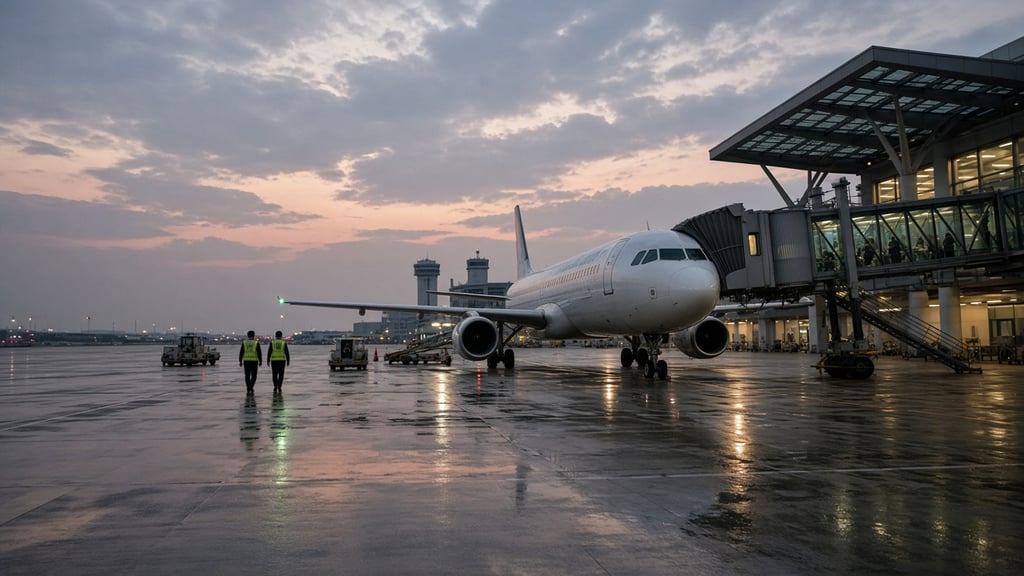
A family trip to Hainan became an aviation-safety case at Wuhan Tianhe International Airport on 16 November 2026, when a 61-year-old woman tossed four coins toward a parked jet as she left the boarding bridge. She meant it as a folk prayer for a safe journey. Ground crews treated the coins as foreign object debris on the apron. The Sanya-bound flight sat for 58 minutes while technicians searched the stand and the engines. Hubei airport police then imposed five days of administrative detention.
Police identified the passenger as a woman surnamed Zhou, travelling with three relatives. She was carrying a small child at the cabin door when she took the coins from a pocket and threw them toward the nose of the aircraft. The coins slipped through the gap where the jet bridge meets the fuselage and fell onto the apron. Cabin crew stopped boarding and called airport police. Nearly ten maintenance staff spent more than 50 minutes walking the stand, checking engines and landing gear, and recovering every coin before the jet was cleared to push back. Zhou told investigators she had never flown before. She believed tossing coins while crossing a bridge keeps travellers safe, and she treated the airbridge as that kind of crossing. Police said she later expressed regret and asked for clearer warnings so other first-time flyers would not copy the ritual.
Why a handful of coins can stop a departure
Civil aviation treats loose metal on a stand as foreign object debris, or FOD. China's Civil Aviation Administration set that rule in its 2022 Measures for the Prevention of Foreign Objects at Transport Airports: keep movement areas clear of any inanimate object that has no operational function and can endanger an aircraft. Coins vanish into pavement joints or a landing-gear bay, and they are dense enough to scar a fan blade if an engine ingests them on taxi or takeoff. The jet bridge sits above the nose gear and the path an engine follows as the aircraft leaves the stand. That is why Wuhan ordered a full stop, a multi-person search, and an engine inspection. Police said every coin was recovered and no aircraft damage was found. Fellow passengers still lost the better part of an hour.
A ritual that collides with aviation law
Hubei airport police applied Article 26 of China's Public Security Administration Punishment Law, which covers disruption of order on public transport, including aircraft. Lighter cases can draw a warning or a fine of up to 500 yuan. More serious disruption can bring five to ten days of detention and a possible fine of up to 1,000 yuan. Five days sits at the lower end of that heavier band. If debris is ingested and an engine is damaged, Chinese criminal law on damaging means of transport can apply. The Civil Aviation Law, revised with effect from 1 July 2026, also bars throwing objects from a civil aircraft in flight except for safety or rescue. A coin toss at the cabin door is treated as debris in a controlled area, not as a harmless blessing. Chinese state television returned to the case on 23 November. Police said similar coin throws have appeared at Chinese airports in recent years, often involving older first-time passengers who bring a temple habit onto the airbridge.
What This Means for Expats and Travelers in Thailand
Thai airports run the same FOD logic. The Civil Aviation Authority of Thailand treats any object in the wrong place on an aerodrome as a threat to airframes, engines, and people. Airports of Thailand says Suvarnabhumi inspects runways and taxiways at least four times a day under ICAO standards and has installed 252 FOD sensors on the runway, designed to spot objects from about 9 square centimetres within a minute, around the clock. A coin on a Bangkok or Phuket stand would trigger the same stop, search, and paperwork.
That matters on the China-Thailand corridor. Chinese visitors remain a large share of arrivals at Suvarnabhumi, Don Mueang, Phuket, and Chiang Mai. Family groups often include older relatives who have flown little and may carry temple coins or a habit of tossing offerings at a threshold. A jet bridge is a controlled interface with a live aircraft, not a shrine gate. Throwing anything onto the tarmac can delay a departure, open a police file, and, in a serious case, end a holiday in a cell. For expats meeting family in Thailand, keep coins, keys, phones, and bottles in pockets at the cabin door. Do not toss objects from an airbridge. If an older relative talks about a luck ritual before boarding, explain the FOD rule first. If you see debris, tell crew. Do not retrieve it yourself. Wuhan shows how fast a four-coin blessing becomes a 58-minute hold for everyone else on the aircraft.

Comment verification
Step 1 of 3
Verify your email once to publish your comment. Your email is never shown publicly.
Enter the 6-digit code sent to .
Choose the display name shown next to your comments.