Ang Thong Highway 32 Van Stop Puts Informal Migrant Hiring on Notice
A gray Toyota van packed with 19 undocumented Myanmar workers was stopped before dawn on Highway 32 in Ang Thong. The 2,000 baht per person fee, and the charges that followed, matter most to anyone in Thailand who still fills a kitchen, a site, or a household with cash labour.
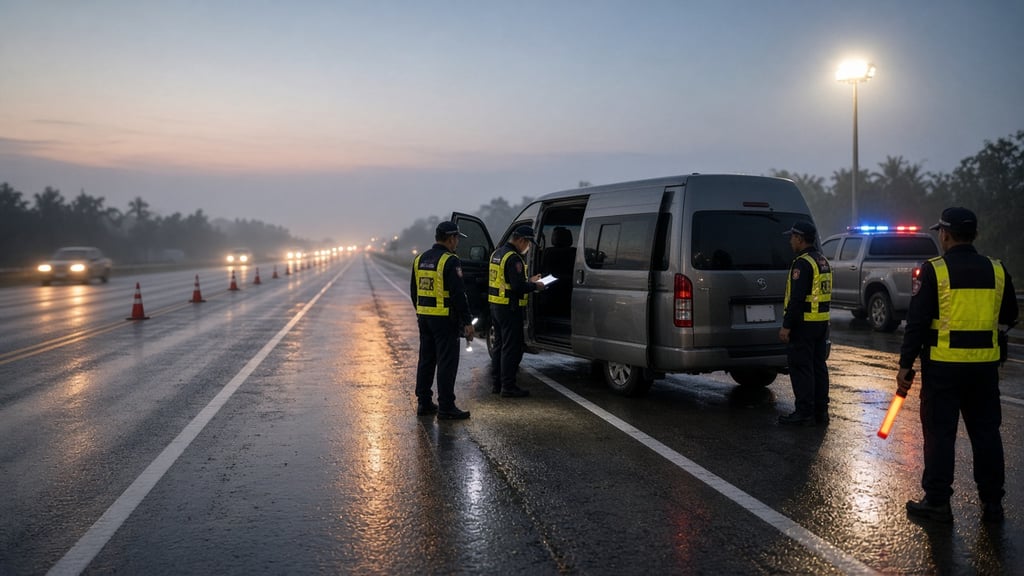
A gray Toyota van rolling south on Highway 32 in the small hours of 24 November 2026 was not a tourist transfer. Highway Police from the Central Investigation Bureau, with Ayutthaya Immigration and suppression units, stopped it at about 02:45 at kilometre 63 in Chaiyaphum subdistrict, Chaiyo district, Ang Thong. Inside were a Myanmar driver, 19 Myanmar passengers packed onto the benches, and no passports.
The driver was identified as Mr. Maung Maung, 43. He told investigators he had rented the Commuter for 2,800 baht a day, hung black curtains to hide the cabin, and was on his second paid run. A Shan (Thai Yai) contact in Myanmar had hired him to collect the group from a Chiang Mai roadside and drop them in Bangkok for 2,000 baht a person, cash on arrival. Passengers said they had crossed through natural border channels, then been placed on the van. Officers seized the van, two phones, and a key, and moved everyone to Chaiyo Police Station.
The geography is the point. National Highway 32 is a 150.5-kilometre Asia Road from Bang Pa-in to Chai Nat, cutting through Ang Thong on Asian Highways AH1 and AH2. A night van that starts on a Chiang Mai verge and aims for the capital is using that corridor the way informal labour networks have used it for years: get people past the border provinces and into kitchens, sites, and houses before morning traffic.
The charge sheet reaches past the driver. Thailand's Immigration Act B.E. 2522 still treats knowing concealment as a standalone crime. Section 64 sets up to five years in prison and a fine of up to 50,000 baht for anyone who harbours, hides, or otherwise helps an illegal entrant evade arrest. Section 63, for bringing a foreigner in or facilitating illegal entry, goes up to ten years and 100,000 baht. Police charged Maung Maung under the harbouring rule. The 19 passengers were charged with entering and remaining without permission.
The Bangkok payer is in the statute too
Most readers of this site will never drive a curtained van. Plenty still hire a cook, nanny, gardener, or fit-out crew. The Emergency Decree on Managing the Work of Foreigners B.E. 2560, restated by the Prime Minister's Office on 4 September 2026, still makes the employer a target. Taking on a foreigner without a work permit, or letting that person work outside the permit, is a 10,000 to 100,000 baht fine per worker on a first offence. A repeat offence can mean up to one year in prison, a 50,000 to 200,000 baht fine per worker, or both, and a three-year ban on employing foreigners. Workers without a permit face 5,000 to 50,000 baht, removal, and a two-year bar on a new work permit.
In fiscal 2026, inspectors visited more than 74,000 workplaces that use migrant staff and recorded more than 1,700 cases of foreigners doing jobs reserved for Thai nationals, including massage, hairdressing, beauty work, and driving.
A legal channel already exists. The 2003 Thailand-Myanmar labour memorandum of understanding, summarised in public accounts of Burmese residents in Thailand, recruits workers in Myanmar and issues a temporary passport, identity certificate, two-year visa, and a change to legal work status. The 2014 Myanmar census counted about 1.42 million former Myanmar residents in Thailand, with published estimates putting their contribution at roughly 5 to 6.2 percent of GDP. Informal head-fees of 2,000 baht a seat compete with that channel, and they leave the destination employer exposed if the van's passengers were headed for a shift.
What This Means for Expats and Travelers in Thailand
If you employ household or site staff, the documents have to exist before the first paid hour: a valid work permit, a current stay stamp or visa, and a job that matches the permit. Asking after a raid is not a defence. A broker who can replace a dishwasher this week from Chiang Mai or Mae Sot at a flat head fee is describing the same logistics this van used.
Hospitality is not a loophole. Giving a spare room, a lift down the Asia Road, or a cash day-rate to someone you know walked in through a forest path can be read as assistance under Section 64. Couples who help a friend's worker while papers are in process are the fact pattern the harboring presumption is built for.
Travelers are not the target of this stop, but they sit next to it. Overnight vans on Highway 32 with covered windows, overloaded benches, and a driver who will not open the sliding door at a rest area are not a cheap way north. They are a police target. The slower MOU and nationality-verification path costs more than 2,000 baht a seat. That gap is the product, and closing it is an employer problem.
Comment verification
Step 1 of 3
Verify your email once to publish your comment. Your email is never shown publicly.
Enter the 6-digit code sent to .
Choose the display name shown next to your comments.