Marine police arrest Pakistani man in Narathiwat over 250,000 baht Thai ID card scheme
Marine police arrested a 37-year-old Pakistani man near the Malaysian border in Su-ngai Kolok. Investigators say he admitted paying a broker 250,000 baht for an illegally obtained Thai national ID card.
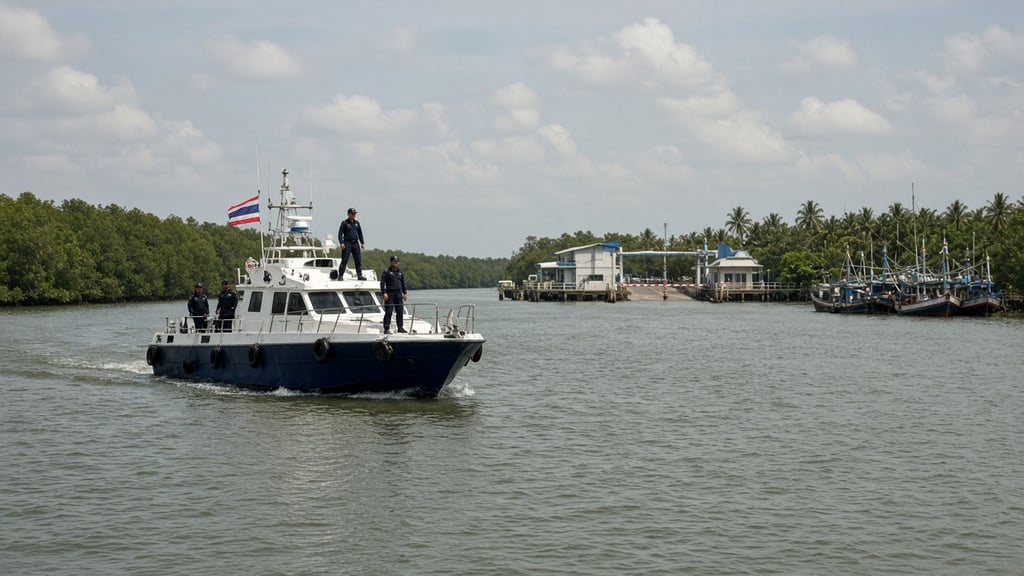
Marine police from the Central Investigation Bureau detained a 37-year-old Pakistani man in Su-ngai Kolok, Narathiwat, on 23 November 2026, a short walk from the Malaysian frontier. Officers identified the suspect only as Inam. They said they found him hiding in a second-floor bedroom and that he admitted paying a broker 250,000 baht for an illegally obtained Thai national identity card.
Su-ngai Kolok sits on the Kolok River opposite Kelantan, Malaysia, and is one of the busiest land crossings in Thailand's far south. Investigators said the man had been staying with his Thai wife in Mueang Pattani district, then left before a search team arrived. Technical tracing later placed him at the Narathiwat house, which officers treated as a last stop before an attempt to leave the country.
The arrest grew out of a CIB marine-police operation against networks that insert foreign nationals into Thailand's civil-registration system. On 14 November, a related suspect, a 27-year-old Indian man identified as Gopal, was detained after a facial-recognition camera at the Don Sak ferry pier in Surat Thani flagged him on a crossing to Koh Samui. Police tied that file to a 2019 civil-registration entry in Mae Lan district, Pattani, and to an alleged 60,000 baht payment to a Thai broker who offered to change his nationality.
Pattani Provincial Court had already issued an arrest warrant for Inam on 13 September 2023. After the Samui arrest, Pattani marine police moved to locate remaining members of the same network. Officers then transferred Inam to Mae Lan Police Station in Pattani, which is handling both investigations.
What the charges actually cover
Investigators listed alleged offences of supporting an official who falsifies documents, giving false information to obtain an identity card, and arranging civil-registration records for a person who is not a Thai national. Those counts sit under the Identity Card Act B.E. 2526 (1983), as amended in 2011, and under civil-registration law administered by the Department of Provincial Administration.
Section 14(1) makes it a crime for anyone who is not a Thai national to apply for a Thai identity card by presenting false evidence or concealing facts from the registrar. The penalty is imprisonment of one to five years, a fine of 20,000 to 100,000 baht, or both. If the offender is a card-issuing official or other competent officer, the range rises to three to 15 years in prison and a fine of 60,000 to 300,000 baht. Thai national ID cards are issued only to Thai citizens aged seven to 70 who appear on a house registration. Lawful foreign residents may apply for a separate identity card for persons without Thai nationality. That document is not a citizen card and does not confer nationality. Police have not named the broker, and they have not said whether district officials will face charges.
Why a citizen card is worth that much
A Thai identity card carries a 13-digit personal number tied to the national civil register. Banks, mobile operators, hospitals, and many government counters treat that number as default proof of identity. A brokered card is a key into systems built on the assumption that the holder is a citizen.
Marriage to a Thai national does not, by itself, grant citizenship or a national ID. Naturalisation remains a separate Interior Ministry process. A Thai wife in Pattani, if confirmed in court, would not legalise a purchased citizen card.
What This Means for Expats and Travelers in Thailand
Foreigners living in Thailand, including those married to Thai citizens, have no legal route to a national identity card except through formal naturalisation. Anyone offered a "fast" citizen card, a household-registration insert, or a 13-digit number for cash is being invited into a criminal offence. Lawful documents for non-Thai residents are a passport, a visa or stay permit, a TM30 residence notification, and, where eligible, DOPA's identity card for persons without Thai nationality.
- Do not pay brokers who claim they can "change nationality" or put a foreigner on a Thai house registration.
- Marriage, a Thai child, or years of residence does not convert a foreigner into a citizen.
- Using a fraudulently obtained card can add document and immigration offences on top of Identity Card Act counts.
- Expect more facial-recognition checks at ferry piers and land borders as CIB and immigration units expand the warrant database that flagged the Samui suspect.
CIB marine units presented the Su-ngai Kolok arrest as part of a standing order to disrupt transnational registration fraud. Whether that order produces charges against the unnamed broker, or against officials in Mae Lan, will decide if this file stops at two suspects or opens a wider inquiry into how non-citizens were written into the register.

Comment verification
Step 1 of 3
Verify your email once to publish your comment. Your email is never shown publicly.
Enter the 6-digit code sent to .
Choose the display name shown next to your comments.