Stranded AirAsia X passengers may seek damages in court over Narita delay
Thai rules on flight delays do not cover flights leaving Japan, so Narita passengers can take claims beyond Thai AirAsia X's 5,000-baht credit to court, the Transport Ministry says.
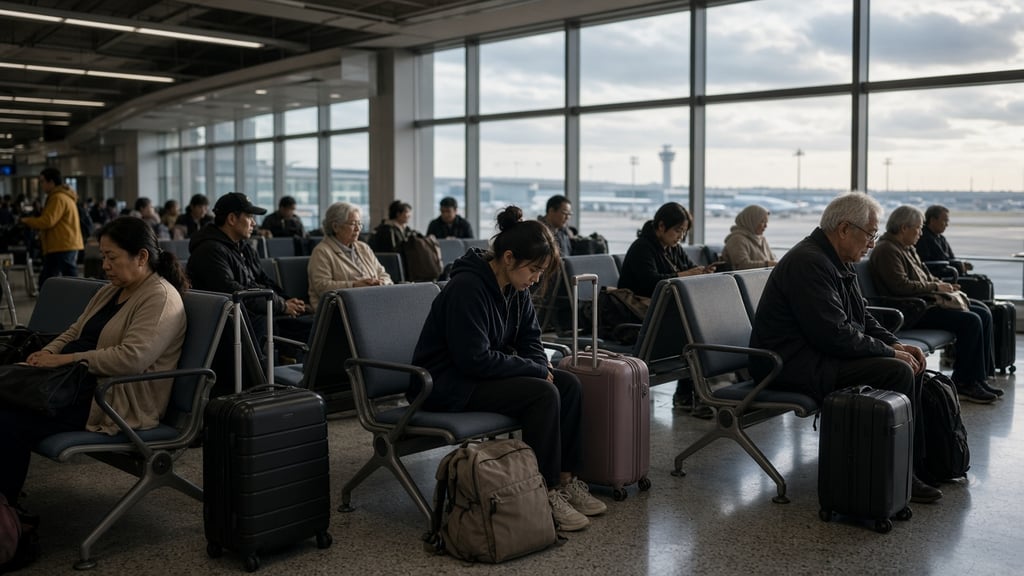
Passengers held overnight at Tokyo Narita after a delayed Thai AirAsia X flight back to Bangkok can still take the airline to court for losses above a 5,000-baht travel credit. Thailand's care-and-pay rule does not follow that aircraft home. Deputy Transport Minister Phattharaphong Phattharaprasit told a 23 November meeting with the Civil Aviation Authority of Thailand and Thai AirAsia X that Civil Aviation Board Regulation No. 101 covers domestic services and international flights that leave Thailand. It does not cover a sector that starts in Japan.
Flight XJ607 from Narita to Don Mueang was held on the night of 20 November 2026 after engineers found a fault in the aircraft's flight-control equipment. Replacement parts had to come from Thailand. The repair ran past the first plan, and more than 300 passengers waited into the next day. Japan's Labour Thanksgiving Day holiday on 23 November had filled rooms around Narita, so ground staff could not place everyone in hotels. The airline handed out sleeping bags, meals and drinks in the terminal, then said special recovery flights, including Thai AirAsia flight FD9611, had carried remaining guests home.
Thai AirAsia X said on 22 November that every affected guest would receive 5,000 baht in AirAsia Credit Account value with no extra paperwork: 2,000 baht for the delay and 3,000 baht for overnight lodging. Guests who bought a seat on another carrier could file receipts for the fare gap. Other options were a free date change on the same route within 90 days, credit usable for a new booking within 730 days of approval, or a full refund. A dedicated assistance line was listed as +66 2-078-1094.
Why Thailand's delay rule does not reach Narita
CAAT's public guidance on Regulation No. 101, in force from 20 May 2025, is blunt. Thai and foreign operators must care for passengers on domestic flights and on international flights departing from Thailand. A disruption after a foreign departure sits outside that schedule of meals, hotels and cash or voucher payments. On a Don Mueang departure to Narita delayed more than 10 hours, the same rule would have required 4,500 baht in cash or equal-value credit within 14 days, plus care. XJ607 was about 4,600 kilometres. It still does not qualify, because the aircraft was leaving Japan.
Japan's Ministry of Land, Infrastructure, Transport and Tourism does not run an EU-style statutory delay-pay scheme. Under Article 106 of the Civil Aeronautics Act, carriers file conditions of carriage for MLIT approval, including liability terms. There is no dedicated national statute that forces a set payment for delay or cancellation. International carriage still sits under the Montreal Convention, which Japan joined in 2003 and Thailand joined in 2017.
The court route under the 2015 Air Carriage Act
Passengers who want more than the credit can file in Thailand's Central Intellectual Property and International Trade Court under the International Carriage by Air Act B.E. 2558 (2015) and its amendments. Section 12 makes the carrier liable for delay damage unless it proves that it and its staff took all measures reasonably required to avoid the loss, or that those measures were impossible. A 2025 royal decree raised the delay cap in Section 15 to 6,303 Special Drawing Rights per passenger. At mid-November 2026 IMF rates, that is roughly 288,000 baht. Claims must be brought within two years of arrival, or of the date the aircraft should have arrived. The ministry is considering a CAAT-airline mediation panel for delay and baggage disputes so travellers are not forced into court first. Complaints can also be filed at complaint.caat.or.th.
What This Means for Expats and Travelers in Thailand
The inbound gap is the point for anyone who lives in Thailand and flies home from Japan, Korea, Australia or China on a Thai carrier. Care, hotels and the published cash scale in Regulation No. 101 attach to the departure from Thai soil. They do not attach to the return. A 5,000-baht credit can still be useful. It is not a ceiling if you can prove extra hotels, replacement tickets or other out-of-pocket loss, and it is not automatic cash.
Keep boarding passes, delay notices, hotel invoices and the other-airline receipt if you buy your own way home. File at complaint.caat.or.th even on an inbound disruption so the regulator has a record. Travel insurance with missed-departure and delay cover is the practical hedge, because Japan does not copy EU261 and Thailand does not extend CAB 101 to Narita. A court claim must show actual damage. The two-year clock starts when you land, or when you should have landed.
Comment verification
Step 1 of 3
Verify your email once to publish your comment. Your email is never shown publicly.
Enter the 6-digit code sent to .
Choose the display name shown next to your comments.