Starbucks Thailand Portfolio Shifts to DFI
DFI Retail Group is taking Maxim's licensed Starbucks chain of about 1,110 Asia stores, 574 of them in Thailand, as Seattle reworks Japan and China.
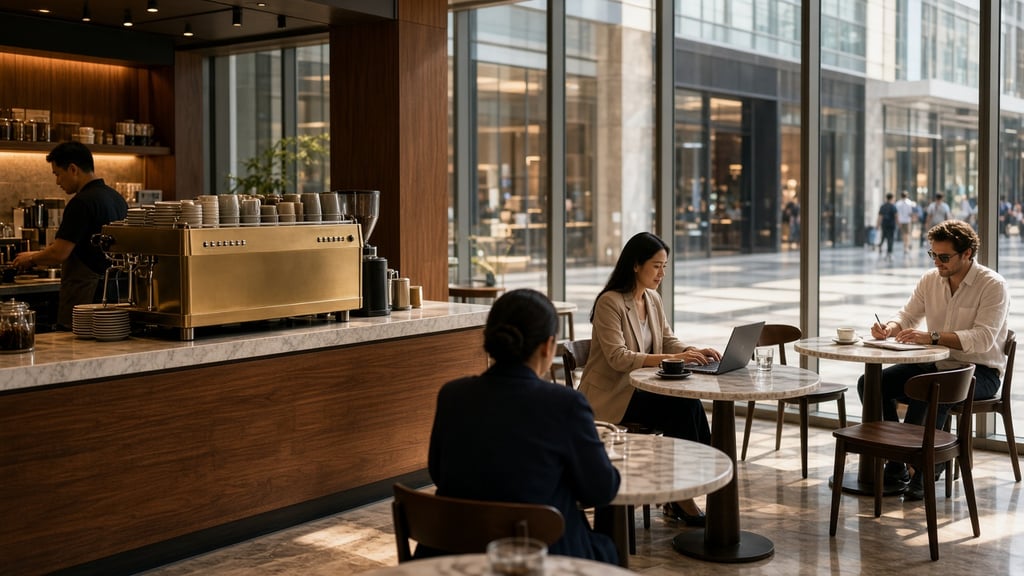
The largest licensed Starbucks network in mainland Southeast Asia is changing owners at the holding-company level, not at the espresso machine. DFI Retail Group, the Jardine Matheson retail arm listed in London and Singapore, has agreed to take Maxim's Caterers' interest in Coffee Concepts, the licensee behind more than 1,100 coffeehouses in seven Asian markets. Thailand is the biggest slice of that book.
Seattle is not taking the keys back in Bangkok. Starbucks Corporation has been the brand licensor in Thailand since May 2019. The stores are run by Coffee Concepts Retail Co., Ltd. What is moving is Maxim's stake in that licensed platform, as DFI and Hongkong Caterers unwind a 50-50 Maxim's joint venture that has lasted four decades. Completion is targeted by the end of March 2027. Day-to-day operations are described as unchanged until then.
Who actually owns Starbucks in Thailand
The Thai chain has not been company-operated by Seattle for seven years. In May 2019, Starbucks licensed retail operations to Coffee Concepts Thailand, a joint venture between Maxim's Caterers of Hong Kong and F&N Retail Connection Co., Ltd., in a deal Thai advisers put at about US$650 million with exclusive rights for 40 years. The first shop opened in 1998 at Central Chidlom.
ThaiBev's 23 May 2019 Singapore exchange filing set out the stack. F&N Retail Connection, a Thai Beverage and Fraser and Neave joint venture, took 70% of Max Asia Food & Beverage (Thailand). That vehicle took 51% of Coffee Concepts (Thailand). Maxim's vehicles, MX Caterers (Asia) and Coffee Concepts (Hong Kong), held the balance: about 30% of the first company and about 49% of the second. The shop-level operator in Thai filings is Coffee Concepts Retail Co., Ltd.
DFI has held 50% of Maxim's Caterers through Jardines, with Hongkong Caterers holding the rest. The 30 September 2026 notices transfer Maxim's interest in Coffee Concepts, the regional licensed Starbucks business, to DFI. Hongkong Caterers becomes sole owner of Maxim's restaurants. The notices do not say F&N Retail Connection is selling its Thai stake. On the public record, the Thai stores remain a licensed joint venture, not a Seattle-owned chain and not a clean 100% DFI asset.
574 Thai stores inside a 1,110-store Asia book
DFI's 1 October 2026 investor pack counted 1,110 coffeehouses as of June 2026: 574 in Thailand, 177 in Hong Kong and Macau, 156 in Vietnam, 138 in Singapore, 59 in Cambodia, and 6 in Laos. Thailand is the largest market in that licensed perimeter. It is not 1,100 stores on its own. That round number is the seven-market total.
Starbucks' Form 10-K for the year ended 27 September 2026 reported 581 licensed Thai coffeehouses, up 31 from 550. Coffee Concepts Retail's 2025 accounts showed more than 10.8 billion baht of revenue and about 1,038 million baht of net profit. Local management has talked of 600 Thai stores by early 2027, 30 to 40 openings a year, and 25 provinces still without a branch, with Bangkok and the metropolitan area still about 65% of sales.
The 2025 licensed Starbucks book did about US$746 million of revenue at a 7% underlying operating margin. DFI has sketched about 250 extra stores over three years and a 1,350-plus network by 2029. Andrew Wong, who already leads DFI's IKEA licence, is slated to run Starbucks after close.
Seattle's wider Asia pivot: Japan for sale, China already partnered
The Thai transfer is one leg of a move away from owning Asian stores on Seattle's balance sheet. In Japan, still a largely company-operated market, Starbucks has tapped Citigroup and Morgan Stanley to sound out a possible sale of several billion dollars. Starbucks Japan counted 2,155 stores at the end of September 2026; the US 10-K shows 1,945 of those as company-operated. No sale is signed.
China has already shifted. Boyu Capital closed a joint venture on 30 March 2026, confirmed on 2 April, taking 60% of Starbucks China retail. Starbucks kept 40% plus the brand. About 8,000 company-operated coffeehouses moved onto a licensed model. The 10-K shows 8,340 licensed China stores at year-end, with a long-run aspiration of as many as 20,000.
The three structures differ. Thailand and six neighbours are already licensed; DFI is consolidating the Maxim's-side ownership. China went from company-operated to a local-majority joint venture. Japan is still mostly company-operated and may be sold. In each case Starbucks is trading direct store control for royalties, product margin, and a lighter capital load.
What This Means for Expats and Travelers in Thailand
Nothing at the counter needs to change this week. The same licensed operator is scheduled to keep running Thai shops through the first-quarter 2027 close, with the same brand standards, mobile app, and Gold Card mechanics. A Seattle buy-back is not what the disclosures describe.
Watchpoints sit further out. DFI wants more food, later-day visits, and new stores in provinces and tourist towns. That could mean shops in some of the 25 uncovered provinces, and more competition with Cafe Amazon, speciality cafes, and Chinese chains. Treat March 2027 as the legal close, not as a guaranteed change of service. Japan and China are separate events. They do not rewrite the Thai licence on their own.
Comment verification
Step 1 of 3
Verify your email once to publish your comment. Your email is never shown publicly.
Enter the 6-digit code sent to .
Choose the display name shown next to your comments.