BOT freezes new money-changer licences for 2027 as a reserved baht coin takes shape
Thailand's central bank will stop taking new money-changer applications through 2027 after a 1-30 December window, while a public-hearing paper points to March 2027 supervision of a fully reserved 1-for-1 baht stablecoin.
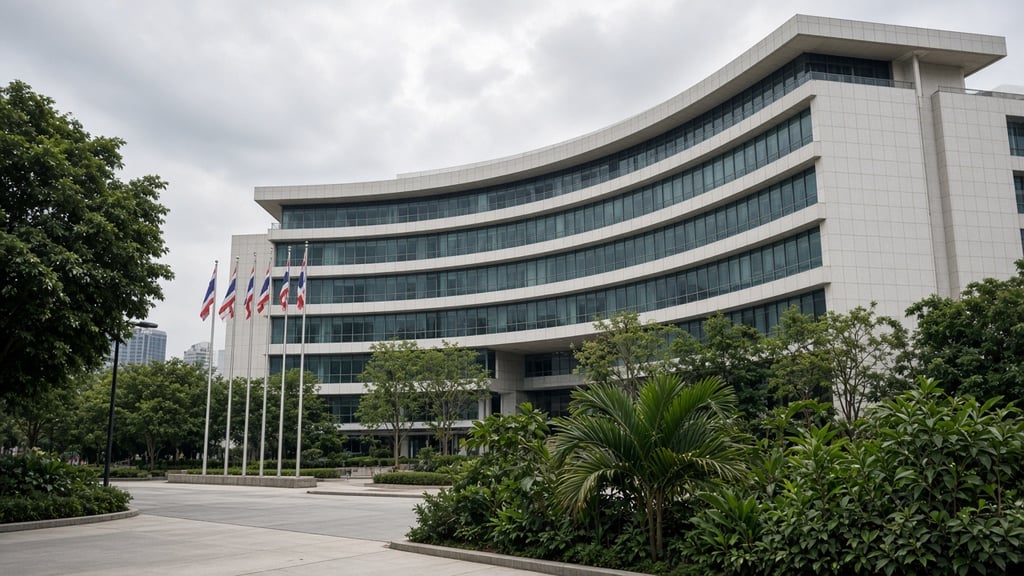
Thailand's central bank spent early November pinning down two payment decisions. New licences for authorized money changers will not be accepted in 2027 after a last filing window in December. A Thai-baht stablecoin is moving from a public-hearing paper toward scheduled supervision in March 2027.
Street FX shops buy and sell foreign banknotes. The proposed baht coin would be a licensed payment token, fully reserved, and built for domestic digital transfers. The Bank of Thailand wants cash-like instruments inside a supervised perimeter, with grey-money risk treated as a structural concern.
A year-long pause, with one December door still open
On 5 November 2026, in Bank of Thailand News No. 43/2569, Assistant Governor Pimpun Charoenkhwan of the financial markets group said the bank will raise standards for authorized money changers and temporarily close new applications in 2027. Existing operators will be brought up to the new standard first. The pause is framed as risk-proportionate supervision, aimed at keeping licensed FX shops from being used for illegal activity, grey money, and fraud.
Anyone who still wants to start a money-changer business in 2027 can file under the current rules from 1 to 30 December 2026. Applications go to the Bank of Thailand head office or a regional office, with a complete file as set out in the citizen handbook.
From 2028 the bank will reopen under revised criteria, with two intake rounds a year in March and September. Details of the new criteria are scheduled for publication in December 2026 through official Bank of Thailand channels. Qualifying paths include a hotel business, registered capital of at least 10 million baht in certain tourist-facing trades, or at least 1 million baht when all shareholders and directors are Thai.
A separate consultation on draft licensing criteria, posted on the central legal portal, already flagged likely changes in registered capital, branch numbers, operating standards, and customer limits. In July 2026 the Bank of Thailand also reminded authorized money changers that they cannot use digital assets as a medium of exchange in the licensed FX business.
A baht coin designed as payment, not a yield product
The stablecoin track is still a consultation, not a finished notification. From 19 October to 17 November 2026 the Bank of Thailand is taking comments on a THB stablecoin principle paper. The coin would be digital money pegged 1-for-1 to the baht and fully reserved. The bank presents it as a complement to PromptPay and other retail payment systems, not a replacement.
Issuers and wallet providers would be licensed as payment services under the Payment Systems Act B.E. 2560 (2017). In the first phase the number of issuers would be limited. Wallet providers would be accepted in rounds without a fixed cap. Use would start as domestic. Users could obtain or redeem coins at 1-for-1 through an issuer or a wallet provider, or at a market price through a digital-asset operator under the Securities and Exchange Commission.
First-phase backing is strict: 100 percent of coins in bank deposits, spread across more than one bank and kept apart from the issuer's own assets. Holders would be able to redeem 1-for-1 within one business day. Issuers would be barred from paying interest or holding-based returns, so the coin is a payment instrument rather than a savings product.
Wallet providers would have to identify every user and allow transfers only between KYC-checked wallets. They would not be allowed to serve or connect to overseas digital-asset exchanges outside SEC supervision, a limit aimed at stopping the coin from becoming a side door around foreign-exchange controls. The same GovernorConnect deck lists THB stablecoin supervision for March 2027, on the same 2027 measures list as the money-changer upgrade planned for January.
What This Means for Expats and Travelers in Thailand
If you change cash at a licensed booth this week, the December freeze does not close that counter. The practical risk for users is not a sudden nationwide shutdown. It is a slower map: fewer new booths in tourist corridors, and a year in which existing operators must meet a still-unpublished standard.
Licensed money changers still tend to post tighter cash spreads than bank teller rates. Banks remain the cleaner paper trail for large conversions tied to visas, property, or tax. Cross-border fintech still handles inbound salary and pension transfers more cleanly than either a booth or a bank wire fee.
Crypto-to-baht shortcuts are the piece the bank is fencing off. Money changers have already been told not to use digital assets in the FX business. If you need baht in 2027, plan on a licensed changer, a bank, or a regulated transfer firm, and watch the December 2026 criteria.

Comment verification
Step 1 of 3
Verify your email once to publish your comment. Your email is never shown publicly.
Enter the 6-digit code sent to .
Choose the display name shown next to your comments.