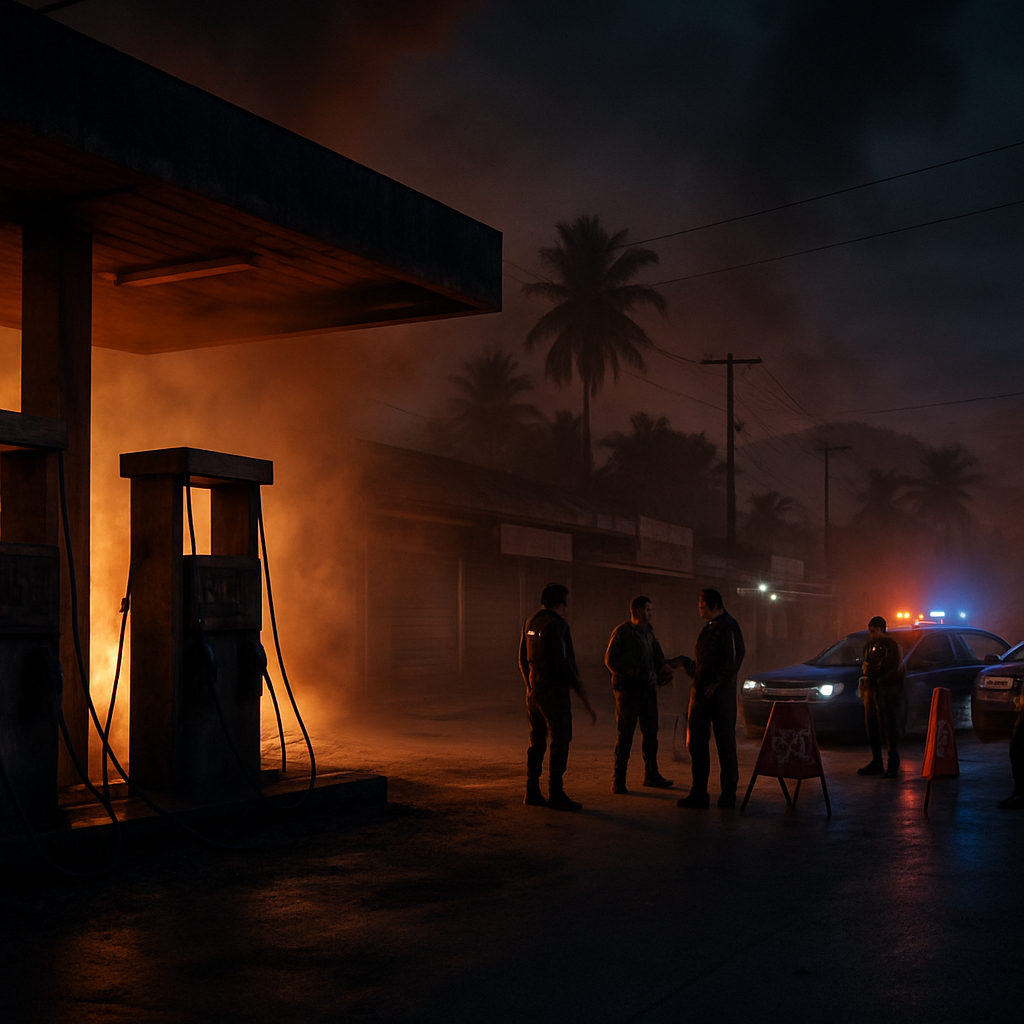
The night air over Thailand’s Deep South turned tense on Saturday, January 10, when a string of explosions and fires erupted at petrol stations across three provinces. Eleven PTT stations in Pattani, Yala and Narathiwat were hit in what local authorities are calling coordinated attacks. The incidents sent shockwaves through communities already weary from floods and unrest — and prompted Narathiwat officials to impose a nightly curfew from 9pm to 5am until further notice.
Images and videos circulated on social media showed blackened pumps and scorched forecourts; thankfully, those scenes did not spiral into mass casualties. One police officer, Prasit Bamrung from Ra-ngae Police Station in Narathiwat, was wounded during an attack at a PTT station in Ra-ngae district. He was rushed to hospital with a wound to his right arm and is reported to be in stable condition. Apart from that, no other injuries were officially recorded.
Still, the psychological impact of the attacks is pronounced. Residents described an eerie calm the following morning, with increased military and police patrols and checkpoints tightened, especially along the Thai–Malaysian border. Business owners, commuters and visitors found themselves navigating an enforced curfew and heightened security at once — a tough double hit for an area whose economy depends heavily on small-scale trade and tourism.
Authorities have opened multiple lines of inquiry. While investigators comb through blast patterns, witness statements and CCTV footage, they have not ruled out any possible motives. Officials are probing everything from politically motivated disruption tied to local or national election cycles to links with the long-running insurgency in the region. For now, the motive remains a blank space waiting to be filled by evidence.
Offering an early analysis, Ekkarin Tuansiri, an associate professor of political science at Prince of Songkla University, told Thairath that the attacks were unlikely connected to recent sub-district administrative organisation elections. He also dismissed religious conflict as a probable cause, pointing out that the petrol stations targeted were locally owned — which would make purely sectarian motives less plausible.
Instead, Ekkarin suggested a couple of alternative scenarios. One possibility is that the attacks were a deliberate show of force by groups opposed to the state, aimed at demonstrating reach and capability without intentionally maximizing casualties. Another is that these incidents could stem from business-related disputes; the pattern — damaging property while apparently avoiding mass casualties and not directly targeting government buildings or officials — could indicate a calculated message rather than indiscriminate terror.
“It’s critical to wait for the official investigation,” Ekkarin cautioned, reminding the public and media to avoid jumping to conclusions. His warning carries more weight considering the Deep South’s history: sporadic episodes of violence have long complicated daily life, development efforts, and intercommunal relations across Pattani, Yala and Narathiwat.
For locals, the concern is immediate and practical. Curfews disrupt livelihoods, particularly for those who work late shifts or rely on nighttime trade. Tourism, an already fragile sector after recent floods and travel advisories, risks another setback if visitors — domestic and international — decide to steer clear of the region. Hotels, restaurants and small vendors that were just beginning to recover now face renewed uncertainty.
Security forces say they’re mobilizing resources to prevent further attacks: increased patrols, reinforced checkpoints, and tighter surveillance along border crossings. Neighbouring communities have been put on alert, and civil authorities are coordinating with military units to ensure that the curfew is enforced without creating panic or obstructing essential services.
Meanwhile, ordinary citizens are doing what they can: sharing information cautiously, checking on neighbours, and keeping children and elders indoors once the clock nears 9pm. Local leaders have urged calm and patience while promising a swift, transparent investigation.
What remains clear is that the Deep South continues to live with a complex mix of grievances, political dynamics and security challenges. Whether this series of petrol station attacks will mark an escalation or a one-off provocation will depend largely on what investigators uncover in the coming days and whether security forces can deter copycat actions.
As Thailand’s authorities work through forensic leads and witness accounts, residents wait for answers and reassurance. For now, Narathiwat’s curfew stands as both a protective measure and a reminder: in a region where tensions can flare quickly, vigilance and measured responses are essential to prevent fear from turning into chaos.
Officials have asked anyone with relevant information — dash-cam footage, eyewitness testimony or suspicious activity observed near the affected PTT stations — to come forward and cooperate with investigators. The coming days will be crucial in piecing together who carried out the attacks, why they chose those targets, and how best to safeguard communities against further violence.















This is terrifying; eleven petrol stations hit in one night feels like a message, not random vandalism. Curfews will hurt small shops and people who work at night. Authorities need to explain quickly so people stop guessing.
A message to whom though? The government or rival businesses? It almost feels like someone flexing power without wanting to kill people. Either way it’s intimidation and that should be condemned.
Flexing power, yep — looks staged to me. No big blasts, just enough damage for panic, maybe to sway local votes or protect black-market fuel deals. Too neat to be random.
Staged or not, the people living there pay the price. Floods then curfew then less trade — when does the government step up to protect livelihoods? That’s the real question.
From an analytical perspective, the choice of locally owned petrol stations makes sectarian motives less convincing, which aligns with the expert quoted in the article. The deliberate avoidance of mass casualties suggests signaling rather than pure terror. Investigators should prioritize forensics and ownership disputes while monitoring for political exploitation.
I agree with the forensics angle, but we must also look at supply chain and licensing records; business rivalries in border areas can be complex and violent. Political actors sometimes piggyback on local grievances to amplify impact.
So it’s not simply terrorists vs state, it’s messy. Families and kids suffer when grown-ups fight over money or power. We need schools to be safe, not politicized.
Exactly, and public communication should avoid speculative labels like ‘terrorist’ until evidence supports them, to prevent stigmatizing communities already fragile from floods and unrest.
I live two towns over and we barely slept. Military patrols are everywhere now and shops closed early. People are scared and want clear answers, not rumours.
My colleague was hurt at Ra-ngae and we’re stretched thin responding to calls. We are gathering CCTV and witness reports, but public help with dashcam footage would speed things up. Please send tips to the station.
Thanks for the update, officer. I will check my neighbour’s CCTV and post what I find to your tip line tonight.
Media always loves these dramatic scenes, but calm down — it might be opportunists or criminals, not insurgents. Jumping to conclusions will just rile people up before facts come out.
Media or not, there were real burns and damage. Saying ‘calm down’ ignores trauma. People lost income and a cop got hurt, that’s serious regardless of motive.
I think both are right: don’t panic, but don’t minimize. Demand a proper investigation and explain the pattern quickly so towns can reopen safely.
Fair point, Nida. I’m just worried that baseless accusations could inflame tensions in a place already on edge.
This reeks of insurgent tactics — hitting soft targets to prove capability and instill fear without causing mass casualties. The history in Pattani, Yala and Narathiwat supports that reading.
As I told the press, election linkage and sectarian motives seem unlikely given the owner profile of the stations. A show of force or business dispute are plausible. We must not rush to attribute it to one single cause.
Professor, could a hybrid motive exist, where political groups exploit business feuds? The Southeast Asian literature has examples of such blended rationales.
Appreciate the nuance, Dr Ekkarin, but locals still need protection now. Whether insurgent or criminal, the impact is the same — fear and economic harm.
Tourism-dependent families are going to be hit hard; any travel advisory will starve hotels and guides of income. Recovery from floods was fragile and this could tip many into bankruptcy.
As someone who guides in Pattani sometimes, bookings already dropped after the curfew. People cancel even for daytime tours because of fear and bad press. We need a fast, honest plan to reassure travelers.
Yes, concrete reassurances and visible security at transport hubs might help, but messaging must be careful not to overstate safety either.
What if this is about fuel markets? Hit a competitor’s outlets, scare buyers, then push black-market sales up. Classic cartels do strange stuff. Don’t assume ideology when profit fits.
You think cartels operate like that here? It’s possible. Corruption and informal fuel trade have been problems at borders for years.
There are known smuggling networks in the region but linking this to those networks requires evidence. Smuggling tends to avoid attention; orchestrating attacks is risky even for a cartel.
Risky maybe, but sometimes they send messages to rivals. The pattern of damage without mass casualties feels like a message to market players as much as to the state.
Please slow down with speculation. The article says forensics and CCTV are being checked. Let investigators do their job and avoid sharing unverified videos that could mislead the public.
Easy to say when you’re not the one who lost customers overnight. People will share what they see to protect neighbours. Not all sharing is harmful.
I get that, but panic sharing can cause copycats if instructions or false claims spread. Responsible sharing matters in volatile areas.
Could this be election-era sabre-rattling, aimed at signaling reach before ballots? Historically violence spikes near political cycles in some regions.
The expert in the article downplayed election links and stressed local ownership of stations, which weakens the electoral disruption theory. But every hypothesis needs evidence.
True, but actors often use plausible deniability. Investigators should check timing and any coordinated messaging across groups.
Schools nearby have parents calling to keep kids home. Curfews protect people but they also disrupt education and child care. Authorities must ensure essential services remain open.
My niece’s kindergarten canceled classes because teachers couldn’t commute under the curfew. It’s a ripple effect that hits the weakest first.
Exactly. We need clear exceptions for essential movements and safe corridors so families aren’t trapped between safety measures and survival.
Why are checkpoints always heavier on ordinary citizens and not where the real criminals pass? This feels like theater to show the public something is being done.
I understand frustration, but checkpoints are part of preventative measures. We try to balance security with civil liberties, and feedback helps us improve targeting. We’re collecting evidence and following leads.
Collecting evidence is great on paper, but transparency matters. Publish some non-sensitive updates so people stop making wild accusations on social media.
Stay safe everyone. Check on elderly neighbours and don’t spread unverified clips. This region has been through enough.
Good advice. Small acts like checking on neighbours make a big difference during curfews. Collective care is underrated in crises.
Thanks, and if anyone has dashcam footage please share it with investigators rather than posting it publicly to avoid misinterpretation.