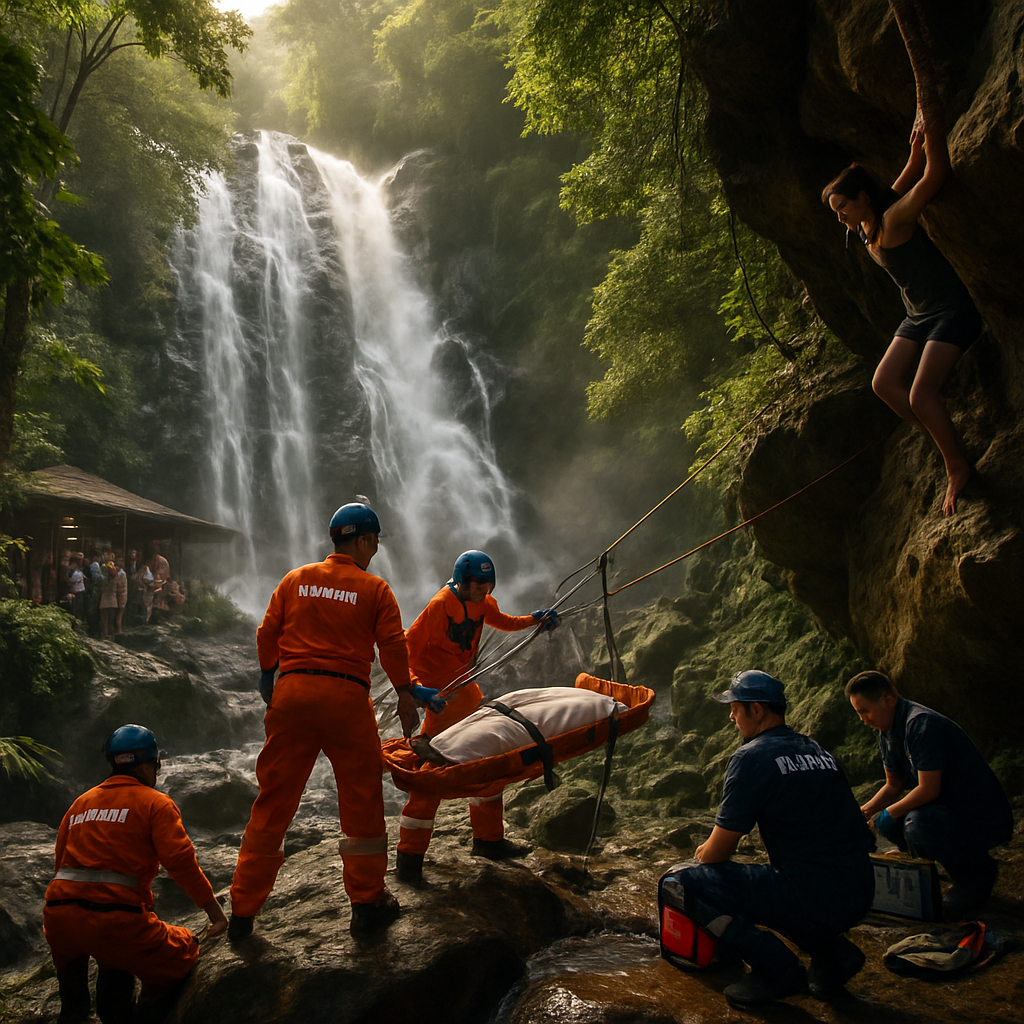
It was meant to be another sun-drenched memory from an island holiday — a couple perched on the rocks of Na Muang 2 Waterfall in Koh Samui, framing a selfie with the jungle’s roars and glints of water in the background. Instead, the afternoon of January 5 turned tragic when 22-year-old French tourist Alexis Vergos slipped from the fifth tier of the cascade and was later found lifeless in the pool on the fourth tier.
According to local authorities, Alexis and his girlfriend, identified by interpreter Pimprapha Sakulpram as Romane, climbed up to the waterfall’s higher tiers earlier that day. While attempting to take photos, both reportedly lost their footing on the slick rocks. Romane miraculously managed to grab a tree branch and hold on — a desperate, split-second move that saved her life. Vergos, however, was swept away by the current and plunged to a lower level.
Those onshore at a nearby restaurant heard the commotion and rushed to help, alerting Koh Samui Police Station and emergency responders. Rescue teams — police, medics and local officials — launched a careful search and found Alexis’s body in the pool below. A doctor from Koh Samui Hospital conducted a preliminary examination at the scene and determined he had suffered severe head injuries; he was pronounced dead there.
Recovering a body from a waterfall is never straightforward. The vertical, moss-slick rocks and the tumbling water make any operation hazardous. Crews spent roughly two hours planning and executing the recovery: rigging ropes, carefully lifting the body from the pool, placing it on a stretcher and painstakingly carrying it down the uneven slope to waiting vehicles. Local rescuers moved with the kind of deliberate caution born of hard experience — knowing a single misstep could create another emergency.
That experience is not just theoretical. Na Muang 2 has a worrying history of serious accidents. In June 2024, an Italian tourist slipped and suffered hip and leg injuries. Later that year, in November, an Indian tourist tragically lost his life after falling from a cliff at the same waterfall. In another incident in May, a British soldier sustained severe injuries and later faced hospital bills reportedly exceeding 4.4 million baht. Those events, stitched together, paint a clear picture: beautiful waterfalls can quickly become dangerous playgrounds when nature, steep terrain and human risk-taking collide.
Local officials have installed warning signs and repeatedly urged visitors to heed safety instructions — advice that reads less like a lecture and more like common sense for anyone contemplating a climb above a cascade. “Exercise extreme caution,” they say, especially during wet or slippery conditions. Wear sensible footwear, stay on marked paths, and don’t tempt fate by edging out onto slick rocks for the perfect shot.
There’s a growing, almost morbid rhythm to these kinds of reports around the world: an eye-catching view, a selfie attempt, a slip. Social media offers instant validation, but nature offers no retakes. It’s worth reminding ourselves — politely, insistently — that some photos are not worth the risk. The pause between “this will look amazing on my feed” and “this could kill me” is often measured in seconds.
For Romane, the afternoon will be forever marked by what she did to survive: grabbing a branch and holding on while everything else fell away. For the family and friends of Alexis Vergos, that same day will remain an unbearable loss. Rescue teams, the police and local officials now face the grim, necessary tasks of investigation and coordination with consular services.
Na Muang 2 remains one of Koh Samui’s most photographed natural attractions, and its cascading tiers draw visitors for swimming, picnics and yes — photos. But beauty on this scale commands respect. If you plan to visit waterfalls anywhere, consider these simple rules: stay on designated paths, avoid climbing when rocks are wet, keep a safe distance from fast-moving water, and never attempt daring poses alone or without a secure foothold.
Tragedies like the one that claimed Alexis’s life serve as stark reminders: nature is stunning, but it is not a prop. Enjoy the view, but do so with humility and caution. In the age of the perfect picture, the wisest shot you can take is the one where everyone walks away safely.













Terrible news from Koh Samui — a young tourist lost his life chasing a photo at Na Muang 2. This keeps happening and it should spark a serious discussion about access and safety. Please read the safety guidelines before you climb near waterfalls.
I feel so sad for the family, but tourists also ignore clear signs all the time. Warnings are posted, so where does responsibility lie?
Responsibility is 50/50 — locals should enforce rules more strictly, but adults also need to use common sense. People will risk anything for likes.
I agree enforcement could help yet policing every scenic spot is unrealistic, especially on busy islands. Better education and stronger penalties for risky behavior might reduce incidents.
Stronger penalties are only effective with consistent enforcement and cultural education; infrastructure improvements like guardrails and designated photo points are cheaper long-term investments. Tourists react more to visible barriers than to fine print on a sign.
A guardrail at every spot would ruin the experience though. There must be a balance between preserving nature and keeping people safe.
This is why I never take selfies near water. One slip, and that’s it. People have to learn the hard way sometimes.
This is so dumb, why stand on slippery rocks? My kid knows better than that. Tourists act like rules don’t apply to them.
Not everyone grew up around cliffs or knows the force of moving water, Joe. Blaming victims rarely helps prevent future tragedies.
Fair, but basic caution is not exotic knowledge. Social media glamorizes danger and parents should talk to their kids about it.
I was there and I lost him, I clung to a branch and watched it happen. Slippery rocks and a split second — no one tells you that video likes cost lives.
Romane, I am so sorry for your loss, you survived a nightmare and your words matter. Thank you for speaking up if you feel up to it.
From a public-health perspective, clusters of similar accidents suggest systemic failure: signage alone is insufficient. We need behavioral nudges, physical interventions and stronger tourist education campaigns in source countries.
As someone who helped on similar recoveries, I can attest that physical measures and trained local guides prevent a lot of risky stunts. But budgets are limited.
Would insurance companies push for safety if they had to cover more of these hospital bills? High costs might incentivize better local measures.
Insurance incentives could work, but they need international coordination; many tourists have limited coverage abroad and that reduces leverage on local operators.
Honestly, tourists who take stupid risks deserve a wake-up call. Travel isn’t just about content creation. Respect nature.
That sounds harsh — people make mistakes, not all risks are arrogant stunts. Compassion matters for grieving families too.
Calling grief a ‘wake-up call’ is tone-deaf. We should focus on prevention without shaming victims.
Install more ropes and trained attendants at popular spots. Problem solved.
Attendants could reduce incidents but staffing every site might be impossible — and it could commercialize natural spaces into theme parks.
This is why I prefer nature tours with a guide. Guides know the spots to avoid and actually care about safety.
Good guides cost money and then only wealthier tourists use them — a class issue appears when only some can afford safety.
We keep saying ‘don’t risk it for a photo’ but influencer culture rewards spectacle. Platforms share the blame for incentivizing dangerous behavior.
Social media algorithms literally push extreme content, so yeah, platforms profit from risk taking. Ban certain hashtags or limit virality for dangerous stunts.
Exactly, policy on platform responsibility could reduce incentive, though enforcement would be messy and contested.
Is it possible that local tourism boards are reluctant to put up too many barriers for fear of deterring visitors? Money talks and safety sometimes loses.
Money shouldn’t come before human life, but local economies depend on tourism. Finding the balance is politically fraught and often slow.
People underestimate how slippery moss is when wet. It’s physics, not courage. Respect the math and stay back.
Simple physics posters near sites might actually be effective — explaining the forces might change behavior more than generic warnings.
Agreed. Make safety messages memorable and visual, not just bland signs.
I keep thinking about the rescue team’s two hours of careful work — good on them for not creating another casualty. Rescue crews need support and training.
Thanks for the shoutout. We train constantly but equipment and personnel are stretched thin during peak season. Donations and government funding help.
Why aren’t consulates doing more to warn travelers before they go abroad? Pre-trip advisories could highlight dangerous attractions.
Consular warnings exist but people ignore them; maybe integrate risk notices into booking platforms and airline messages instead.
That’s a practical idea — airlines could show local hazard alerts during the flight intro video.
As someone who lives near waterfalls, tourists often block paths and damage vegetation to get a shot. It’s frustrating and dangerous for everyone.
Local voices need amplification — show day-in-the-life content of residents to shift the narrative away from ‘mine the view for content.’
Glad you said that, Kai. When tourists respect locals, everyone benefits.
This reads like a pattern — repeated incidents, same causes. Isn’t it time for regional regulators to mandate certain safety standards at high-risk sites?
Regional mandates could standardize signage, require rescue equipment, and fund training. Politics and funding are obstacles but it’s feasible with international tourism revenue backing it.
Then let’s get lobbyists and NGOs to push for it — tourists’ money is part of the problem and the solution.
We should have more visible first-aid stations near tourist hotspots. Quick response saves lives and reduces long-term costs.
First-aid stations are great but need clear signage in multiple languages otherwise visitors might not find them in time.
Some people think rules are optional when they’re on holiday. It isn’t funny when someone dies. Maybe tourist visas need a safety briefing.
Safety briefings at visa issuance would be heavy-handed and unlikely to change behavior, but targeted education campaigns might help.
There’s also a mental-health angle; some people take risks for validation or to escape. It’s not just stupidity, it’s complex behavior.
Excellent point, Kelly. Addressing deeper drivers of risky behavior could complement physical safety measures.
I visited Na Muang years ago and the signs were tiny and faded. Maintenance matters as much as posting instructions.
Maintenance reflects priorities. If a tourist spot generates income, the operators should keep it safe and clean.
Insurance companies should stop covering risky selfie stunts — reduce payouts and people might think twice. Market forces can change behavior fast.
That could penalize victims rather than deter behavior beforehand; better to tie premiums to demonstrated safety practices.
I can’t stop thinking about Romane’s trauma; surviving while losing a partner is a lifetime burden. Media should be careful how they cover survivors.
You’re right, Zoe. Journalists must avoid sensationalism and respect survivors’ privacy while still reporting the facts and systemic issues.
Isn’t there a legal angle where site owners could be held liable if safety measures were insufficient? Lawsuits might force change.
Liability depends on local law and whether the area was officially managed. Many natural sites are technically unmanaged, shielding owners from claims.
We should fund local rescue teams directly through tourist fees — a small surcharge could make a big difference without hurting businesses.
Tourist fees work in theory but often disappear into general budgets. Require transparent accounting for safety funds.
Transparency is the key; tourists will pay if they know the money helps emergency services and conservation.
Education campaigns in source countries could shift norms before people even arrive. Teach travel safety in schools and travel agencies.
Agreed, proactive education is cost-effective. Collaborations between embassies, airlines and influencers could spread practical safety tips widely.
We can’t bring back the dead, but maybe this tragedy will finally make someone act. I hope authorities and platforms take responsibility.