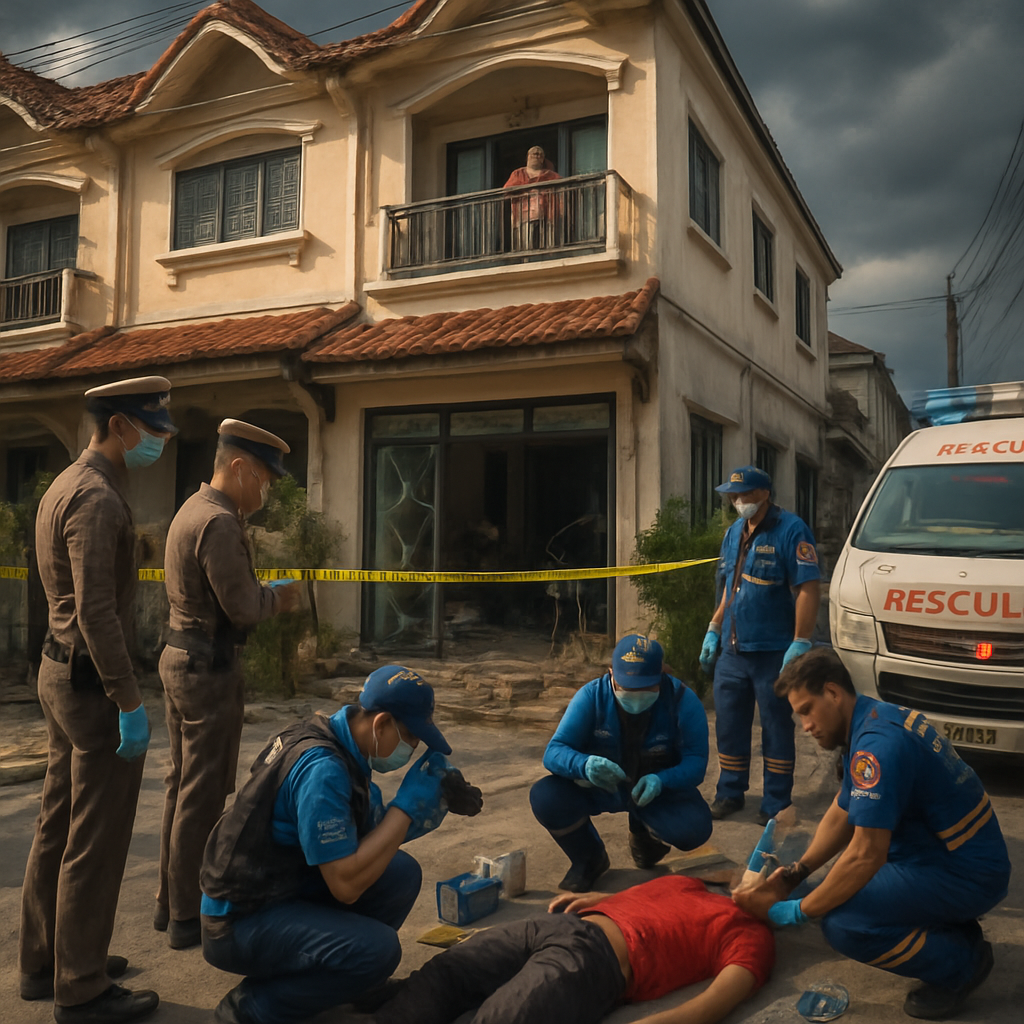
Late on the morning of December 23, a quiet three-storey townhouse in Moo 19, Bang Pakong district, Chachoengsao was jolted from routine into chaos when the household heard an unwelcome disturbance downstairs. Inside were a homeowner, her daughter and a one-year-old granddaughter — ordinary residents who, by the afternoon’s end, would find themselves at the center of a forensic sweep and a community whispering about how quickly an attempted burglary turned tragic.
Acting on instinct, the family called Bang Pakong Police Station. Police, led by Police Lieutenant Noppadon Taweechart, arrived promptly alongside local rescue workers and found clear signs of a forced entry. The ground-floor layout had been ransacked: wires and valuables torn apart and strewn across the floor. Shards of glass littered the scene, and the presence of blood marked the grim trail of what had occurred.
Investigators followed that trail — not just a line on a kitchen tile but a path that led nearly 300 metres down the street. There, in front of another house, officers found a man collapsed on the pavement. He was described as wearing a red shirt and shorts, bearing multiple lacerations consistent with having come into violent contact with broken glass. Rescue teams provided first aid and transported him to Bang Pakong Hospital, but despite their efforts the man succumbed to heavy blood loss.
At this early stage, authorities have yet to confirm the identity of the deceased. The police are treating the case with procedural caution: documenting the townhouse scene thoroughly, collecting physical evidence and canvassing for witnesses, all in an effort to piece together whether the man acted alone and how the injuries were sustained. Khaosod reported the developing investigation, which remains active as forensics and local officers work to fill in the remaining blanks.
The homeowner later recounted that she and her family were upstairs when they first heard noises coming from below. Moments after they alerted authorities, they heard a loud crash — likely the moment the intruder attempted to flee by smashing through a glass door or window. Blood spots both inside the house and along the escape route offered a stark roadmap of what followed, turning a simple burglary into a forensic puzzle with a life-or-death outcome.
While the immediate human story draws the eye — an alarmed family, a wounded intruder, paramedics rushing to help — the case also highlights routine challenges for local police when a crime goes sideways. Determining identity, reconstructing the timeline and establishing motive are all standard, but crucial, tasks. Officers must also confirm whether anyone else was involved, whether the intruder lived nearby or was an opportunistic passerby, and whether CCTV or neighbors caught useful footage.
This is not the first time a break-in in Thailand has ended with dramatic community involvement. In November, quick-thinking residents of Pattaya used CCTV footage to stop a late-night gas theft after the suspect returned to the scene, demonstrating how modern surveillance can make the difference between a successful escape and an arrest. That incident serves as a reminder that in many neighborhoods, cooperation between residents and police — paired with digital evidence — can help close out investigations quickly and prevent further incidents.
For the Bang Pakong case, investigators are carefully cataloguing evidence left in the townhouse: the pattern of broken glass, the scattered valuables, and any fingerprints or DNA that may illuminate the sequence of events. Authorities will also be seeking statements from the homeowner, her daughter and any nearby witnesses who might have seen the man before the entry or during his flight.
Community members are likely to follow developments closely. Incidents like this tend to prompt conversations about home security, neighborhood watch routines and the vulnerability of multi-storey townhouses where noise can be muffled and entrances are sometimes exposed. For now, residents are watching as police move through the deliberate, methodical work of confirming identity and determining if the tragedy was the result of a lone opportunistic break-in or something more complicated.
As the investigation continues, police have asked anyone with information — particularly drivers or pedestrians who were in the Moo 19 area around the time of the incident — to come forward. Even small details can be pivotal when reconstructing a crime that escalated into a fatality.
Ultimately, the morning’s events in Bang Pakong serve as a sobering reminder: what begins as an ordinary day can shift in an instant, and the ripple effects of a crime touch both families and first responders. Authorities remain committed to piecing together the facts, offering answers to the household that called for help, and bringing clarity to a case that ended far more tragically than anyone watching the scene unfold could have imagined.


















This is terrifying, but I feel weirdly relieved the family was okay upstairs. If someone breaks in and ends up dead, it still feels messy morally—was it self-defense or a freak accident?
It sounds like the intruder cut themselves on the glass while fleeing; that doesn’t necessarily imply the family used force. We should wait for forensic evidence before judging.
True, forensics will say more, but public reaction is quick. People assume the worst on both sides and that can ruin lives even before facts are out.
Facts aside, if someone is robbing your home you can’t be expected to be calm. I wouldn’t want criminals near my kid, end of story.
From a forensic standpoint, the blood trail and lacerations consistent with broken glass strongly indicate accidental self-inflicted wounds during escape. DNA and fingerprints will clarify whether he was the sole intruder.
As a forensic tech myself, I agree. But I worry about chain-of-custody and rushed reporting skewing public opinion before lab results.
Exactly. Media sensationalism can pressure investigators, but methodical cataloguing safeguards conclusions and any later legal process.
Why do people always blame the media? People just want answers fast, it’s understandable.
Isn’t it weird that identity hasn’t been confirmed? In a town you’d think neighbors or CCTV would help quicker.
We often need time to match dental, prints or DNA, especially at busy hospitals and mortuaries. It’s procedural, not negligence.
This is why we need neighborhood watches and cameras. If CCTV was around, they’d know if he was alone or part of a gang.
CCTV helps, but having cameras everywhere raises privacy concerns and sometimes people weaponize footage against neighbors.
Sure, privacy matters, but safety trumps it when your child could be in danger. You can balance both with sensible rules.
In my building people already share footage in a WhatsApp group. It’s saved us more than once, but not everyone wants that sharing.
If he died while committing a crime, the family’s conscience is clear. I don’t buy the ‘mystery’ angle — most burglars get hurt fleeing through glass.
That’s a bold claim. Sympathy isn’t binary; poor people sometimes steal because of desperation. We should examine root causes, not just punish.
Desperation or not, breaking into a house with a baby in it is crossing a line. Consequences happen.
You can condemn the act without endorsing lethal outcomes. Community programs could reduce these incidents long-term.
Bang Pakong needs better street lighting and safer glass doors. Simple infrastructure changes cut crime more than blame games.
Exactly. Crime prevention is design: shatterproof glass, locks, motion sensors. Invest in prevention, not just investigations.
Glad you see it. Even low-cost measures would make a difference for townhouses like these.
But who pays? Poorer neighborhoods are often last in line for upgrades, which keeps a vicious cycle going.
Police procedure is clear: secure the scene, document, then identify. There’s no instant answer until post-mortem and witness statements are analyzed.
People always say ‘let the police do their job’ but accountability matters. We need transparency about timelines and findings.
Transparency is our goal, but premature leaks can compromise the investigation. We release facts when they won’t harm outcomes.
Sounds like a cop excuse to me. If police are doing their job, they should update the public faster.
This story makes me sad for both the family and the man who died. Crime impacts everyone, even if outcomes are complicated and morally gray.
Complicated indeed. We should avoid jumping to vigilante applause or immediate condemnation until facts are known.
Agreed. Empathy for victims should include careful pursuit of truth, not emotional verdicts.
Empathy is fine but families also deserve to feel safe. Hard to sympathize when kids are endangered.
Why are there always glass doors at the back? Builders should rethink plan layouts for safety and escape routes.
Architectural changes help, but cultural and economic shifts are needed too. Crime isn’t just about weak doors.
I know, but design is an easy start. Make it harder to break in and you reduce impulse crimes.
Design, policy, and effective policing together reduce incidents. One measure alone rarely solves systemic issues.
The reporting felt a little sensational. Mentioning previous Pattaya incident seems like editorializing to stoke fear rather than inform.
That’s media for you — they connect dots to build narratives. It’s on readers to distinguish facts from framing.
True, but editors should resist conflating separate crimes just to boost engagement.
Engagement or not, people need to be warned. Better safe than sorry when local crime seems to be rising.
I feel bad for the family who found all that blood. Even if they didn’t harm him, they’ll be haunted by the memory and community gossip.
Exactly. Trauma lingers. Support for victims should include counseling, not just police reports.
Yes, trauma services are often overlooked in the aftermath of crime scenes.
Therapy is fine but we also need harsher penalties for burglars so this doesn’t keep happening.
This is scary. Could the family have done more, like call neighbors or shout? I’m only in 6th grade but I worry about safety.
You did the right thing telling your parents to call police, and they acted. Sometimes silence helps avoid escalation.
Thanks, that makes me feel better. I just hate the idea of someone getting hurt.
Calling police immediately is often the safest move, especially with infants present. Good instincts from the family.
I read this and think about the legal aftermath: manslaughter claims, self-defense laws, and insurance. It becomes a courtroom puzzle.
Courts will look at intent and proportionality. If the family didn’t pursue the intruder, legal culpability is unlikely.
Right, but civil suits against the property owner by the intruder’s family could be messy even if criminal charges don’t stick.
Forensic timelines will be crucial in court. Proving when injuries occurred determines legal responsibility.