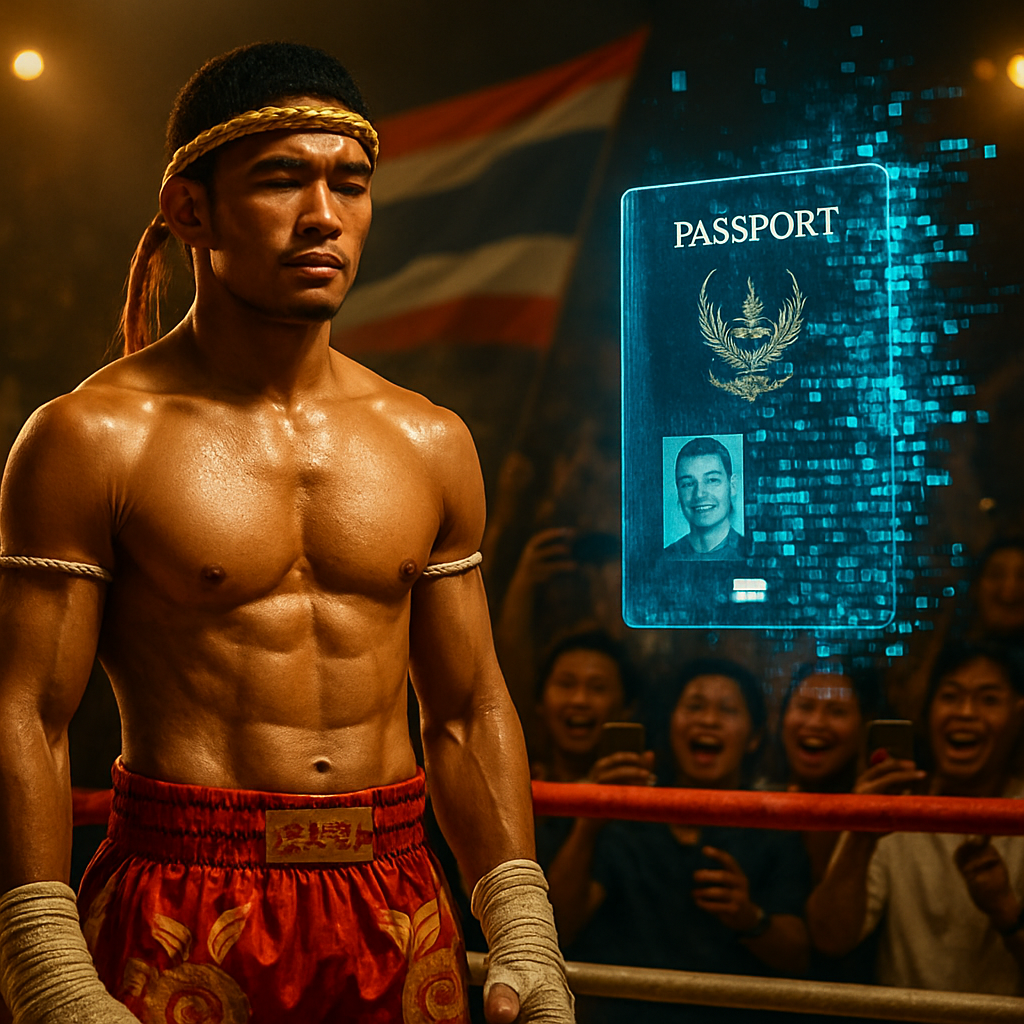
Thailand’s beloved Muay Thai titan Sombat “Buakaw” Banchamek found himself in the middle of a bizarre online identity drama on December 20, when the Army Military Force Facebook page accused a Cambodian-led information campaign of using AI to fabricate a passport that supposedly listed the fighter as a Cambodian citizen. According to the post — cited by The Nation — the image was presented as part of a Cambodian Information Operation (IO) aimed at confusing Thai viewers about Buakaw’s nationality.
If you’re picturing shadowy figures huddled over keyboards and conjuring fake documents like movie villains, you’re not far off. The army’s post claimed the AI-generated passport was used to push two main narratives: that Buakaw was actually Cambodian by birth, and that he avoided fighting Cambodian Muay Thai or kickboxing opponents out of some misplaced national loyalty. The post went further, suggesting the fighter was “ungrateful” to the country that raised him — a spicy allegation that predictably did not sit well with fans.
Enter the internet: where rumors go to die — and sometimes to be roasted. Thai netizens were quick to mock the claim, treating the alleged passport revelation like the internet tabloid scoop it resembled. Buakaw’s official page, Banchamek Gym, shared the Army Military Force post and essentially asked followers to do a reality check. His short, sardonic response read, “Don’t tell me someone believes this. If you believe it, press the ‘considering’ emoji. If you don’t believe it, press the ‘laughing’ emoji.” The message was simple and perfectly Buakaw: a little humor, a little disbelief, and a whole lot of calm.
Why does this matter beyond the meme-ability of the whole affair? Because it highlights how fast information — and disinformation — can travel when AI tools are involved. A convincing-looking document can be generated, shared, and weaponized before anyone pauses to verify it. In this case, the claim touched on a sensitive point: national identity, which in Southeast Asia carries deep historical and emotional weight.
Buakaw himself has already addressed his roots publicly. In January 2023 he clarified that he is Thai of Kui (or Kuoy) descent, an ethnic group traditionally found in northeastern Thailand — notably in provinces like Ubon Ratchathani and Surin. The Kui are historically linked to elephant training and have cultural ties that crisscross modern borders, including parts of what is today Cambodia. But Buakaw was unequivocal then, and his tone was the same now: his heritage is embedded in Thai history, and attempts to label him otherwise are misleading and disrespectful.
So what’s the takeaway? In a world where AI can render passport pages, photos, and official-looking paperwork in minutes, skepticism and source-checking have become essential survival skills. Whenever a flashy allegation appears — especially one that seems designed to provoke — it’s wise to ask: who benefits if this is believed? In this instance, the claim seemed structured to stir nationalistic anger and undermine a public figure’s standing, rather than to illuminate any genuine truth.
There was other chaotic news that day in the Thai combat sports world. Former boxing world champion Amnat Ruenroeng made headlines for a less cerebral but equally headline-grabbing incident: a video circulated showing the ex-champ getting into a fistfight with a young man inside a convenience store while allegedly heavily intoxicated. That episode, while unrelated to the Buakaw controversy, served as a reminder that fighters make news both in and out of the ring — and that both kind of stories can quickly become public entertainment or public relations problems.
Back to Buakaw: the reaction on social platforms suggested that his fans weren’t having it. The laughter emoji clearly won the imaginary poll he set up, and the general online sentiment leaned toward amusement and ridicule rather than outrage. For someone who has spent decades beating opponents in arenas and building a reputation that transcends borders, a bogus passport claim is more of a nuisance than a threat — albeit an annoying one that underscores the viral risks in today’s media environment.
Ultimately, this episode is a microcosm of two modern phenomena colliding: the cultural sensitivity of national identity in Southeast Asia, and the accelerating ease with which AI can manufacture plausible-looking falsehoods. For Buakaw, the best response was what he offered — a light, public dismissal that invited his followers to laugh it off rather than amplify it. For the rest of us, it’s a nudge to pause, verify sources, and remember that the internet’s loudest headlines are not always the truest.
Whether you’re a Muay Thai fan, a social media skeptic, or just someone who enjoys a good online roast, the Buakaw passport saga delivered equal parts absurdity and a cautionary lesson. If nothing else, it reminded everyone that even legends can be dragged into the age of AI stunts — and that sometimes the best defense is a well-timed laughing emoji.


















Don’t believe everything online, friends. Laugh it off and train harder.
Heck yes, legend status untouchable. People make up drama for clicks.
Exactly, I’ve followed him since I was a kid and this is pathetic.
Clicks are currency now; nationality drama sells. Sad but predictable.
This should have been shut down by authorities immediately, it insults Thailand.
The image quality and font alignment scream deepfake-passport to anyone who knows how these forms look.
The army shared it though — why would they spread fake stuff? Seems off.
Institutions leak misinformation too, intentionally or by poor vetting. Question the motive.
Possibly a signal operation or sloppy social media management, both are concerning.
Security institutions amplifying unverified claims can inflame ethnic tensions; responsibility matters.
So you’re saying the army might have an agenda? That’s a heavy claim but maybe true.
This incident is a textbook case of AI-enabled IO tactics. The tech lowers production cost and raises dissemination speed.
As a media student, I agree — virality outpaces verification; platforms should flag such doctored docs faster.
And when identity and nationalism are entangled, the social cost of a falsehood multiplies.
We need digital provenance standards for official documents, not just platform labels.
This is dumb. Why would someone pretend he’s Cambodian? He’s Buakaw.
Sometimes people try to claim famous fighters to boost their own narrative or media presence.
Tbh people make up stranger things. Internet is wild.
Political actors love muddying identity lines, especially in border regions. This smells of a campaign.
Borderland identities are complex; exploiting them for political theatre is unethical and dangerous.
So you think this was planned? Who benefits then, exactly?
Either foreign IO or local politicos wanting distraction. Hard to prove but motives match.
Buakaw’s Kui heritage illustrates cross-border cultural ties that predate modern borders, but cultural affinity is not a political passport.
Well said; ethnicity and citizenship are distinct, yet social media collapses them for drama.
Also worth noting: invoking ethnicity can be used to delegitimize someone in nationalist narratives.
This is an attack on Thai pride and should be punished. We must protect our heroes.
I get the anger, but calling for punishment without facts can backfire and create more harm.
Defend him, yes, but don’t turn into trolls. Keep dignity.
Technically speaking, current generative models can output believable documents; we should teach digital literacy in schools.
Agreed, teach kids to check sources. I nearly believed it at first glance.
Media literacy is crucial but platforms also need to slow down virality mechanics for flagged content.
Coaches used to teach respect and verification of records; now we need to add online checks to training rooms.
As a fan, this made me so angry at first but then I laughed. Why target someone who gave us so much?
Thanks for the support, Mai. Keep believing in him and not the trolls.
Laughing is fine, but don’t forget to demand accountability from those who spread lies.
I trained fighters for 20 years; national identity comes from community, not a piece of paper some bot made.
Nice perspective, coach. Real life beats pixels any day.
But pieces of paper still have legal weight; fabricated documents used in public discourse can have real consequences.
We should be suspicious of any sensational claim, especially when it aligns with a divisive narrative.
So how do we fix it? Platforms, laws, education — pick one and act.
A combination: stronger platform moderation, legal standards for deepfakes, and widespread education.
This is why I only trust direct statements from the athlete or official records.
Direct statements help but can be misrepresented too. Context matters.
And even records can be falsified; cryptographic verification of government docs would be ideal.
The army posting this raises questions about vetting and media literacy at institutional levels, not just among citizens.
They shared it to alert people, not to endorse it; clarity from institutions is needed in such cases.
Public institutions must adopt verification protocols before amplifying unverified materials.
Or it was intentional; sometimes institutions leak to shape public conversation.
People forget how hurtful false identity claims are. It trivializes people’s lives and heritage.
Yes, it’s not just about Buakaw, it’s about communities that get erased or misrepresented.
But the meme culture turns everything into a punchline, which is dangerous sometimes.
This whole saga is a lesson: stop forwarding anything that looks juicy until you check the source.
I promise to pause next time, hardest part is resisting sharing instantly.
Yeah same, but sometimes the outrage is part of the entertainment economy.
Weaponizing identity in Southeast Asia is sadly historic; modern tech just scales the harm exponentially.
Historical grievances make societies fertile ground for such IO tactics, very true.
That’s why multi-layered responses are necessary: tech fixes, public education, and diplomacy.
Why are people still surprised when AI is used for deceit? We saw this coming years ago.
Because adoption outpaces regulation; we’re always playing catch-up with new tech.
And because humans prefer sensationalism; ethics don’t go viral like drama does.
Back in my day, rumor died at the water cooler, not in your feed. Different world now.
True, but now water cooler gossip hits millions in minutes, that’s the worry.
I fear this sets a norm: if you can fake a passport, you can fake anything about public figures.
That’s why reputation and consistent public behavior still protect legends more than a single image.
Reputation helps but it’s fragile; a well-placed fake can shape initial impressions badly.
I think the bigger story is why this mattered to people at all; sad commentary on society’s priorities.
If it were reverse—claiming a Cambodian fighter was Thai—would reactions be the same? I doubt it.
Responses often mirror existing power dynamics and historical narratives between groups.
Double standards exist, but defending national icons should be universal.
I laughed at Buakaw’s emoji poll — best response. Humor deflates these kinds of attacks quickly.
Agreed, he handled it like a champ and didn’t escalate the hate cycle.
This shows we need legally mandated provenance for official documents, not just social shame.
Provenance plus public education would be the strongest combo, but implementation is tough.
Tough but necessary; otherwise bad actors win by default.
As someone who studies borders, this makes me sad. People weaponize fluid identities for clicks.
It’s a reminder to center human stories rather than sensationalist headlines.
Very true, Ling. Our histories are complex and should never be reduced to clickbait.
I hope Buakaw sues whoever made the fake passport. Make an example.
Legal action could deter others, but it might also amplify the lie unless done carefully.
He should absolutely pursue it. No impunity for identity attacks.
Sometimes silence is the best answer, and sometimes public mockery is. Buakaw chose well.
We follow his lead. Laugh, move on, support the real stories.