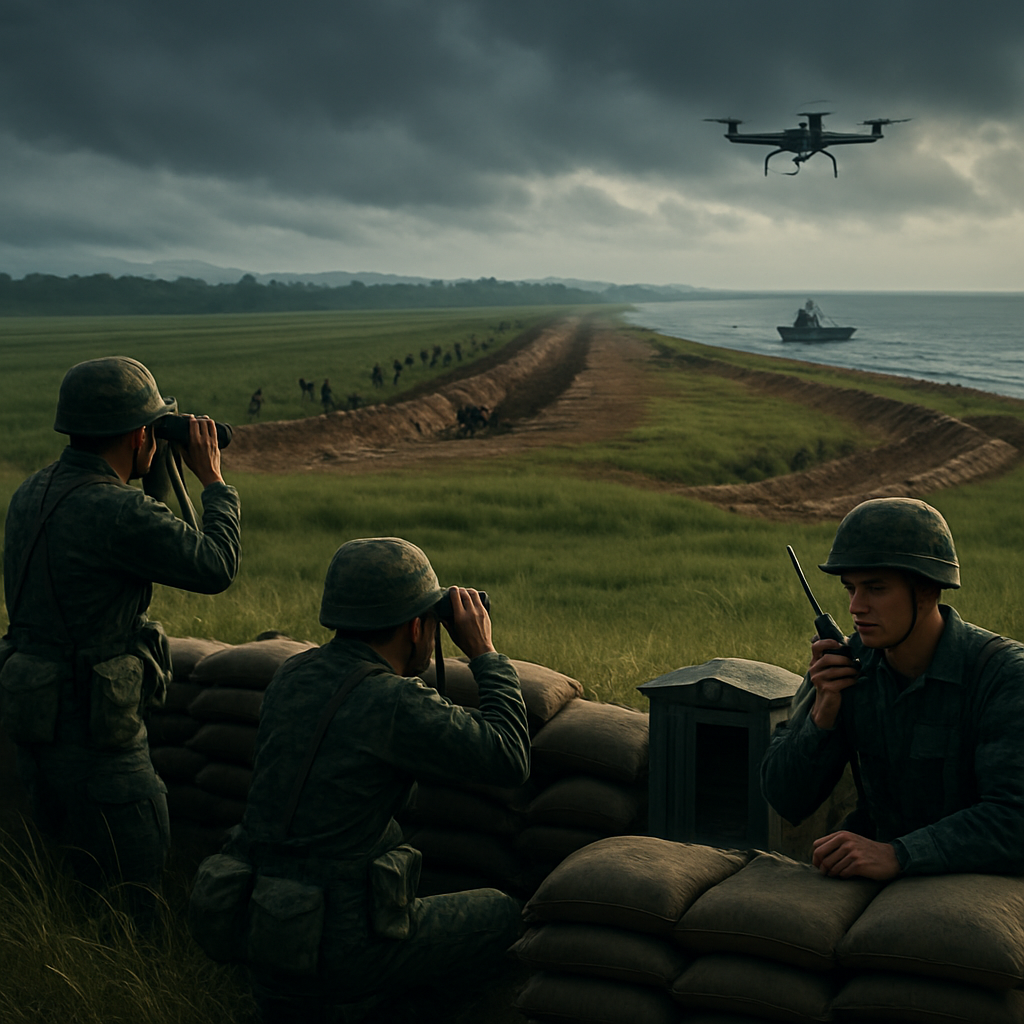
Images released on 26 January 2026 captured a striking scene along the border in Trat province: Cambodian soldiers methodically digging trenches in three spots directly opposite Thai military positions. The longest of those earthworks stretches for more than one kilometre, carving a clear line of fortification that now faces Thai forces stationed roughly 500 metres away.
According to a naval security source cited by Khaosod, the construction sites were identified as Ban Tha Sen, Ban Nong Ri and Ban Chamra — all located opposite Ban Sam Lang in Trat. The source emphasized that, based on the available imagery and on-the-ground intelligence, the trenches sit inside Cambodian territory and are oriented toward Thai positions, rather than crossing the international boundary.
What makes the photographs notable is not only the length of the trenches but the timing. Cambodian troops reportedly expanded and reinforced these defensive works after the end of a previously agreed ceasefire period. That activity included a trench running roughly parallel to Thai lines for about one kilometre and improvements to other defensive features approximately 500 metres from existing Thai trenches.
Thai response: staying within recognised lines, protesting drones
Thai military officials have been clear: Thai forces have remained within recognised Thai territory throughout this period. Authorities say there has been no incursion into Cambodian land by Thai personnel and that troop placements have not changed. At the same time, Bangkok has lodged a formal protest over suspected drone flights believed to have come from the Cambodian side.
Thai reports allege that drones flew over or near Thai coastal areas — an activity that prompted the submission of an official complaint through diplomatic and military channels. The naval source told reporters it is not yet known whether further aerial surveillance will be attempted, and Thai security units have been ordered to maintain heightened observation due to the strategic sensitivity of the area.
Why these trenches matter
On the surface it may look like a farmer’s field being reshaped, but trenches near a contested border are far more than landscape modifications. They serve as defensive lines, observation points and psychological signals: a clear way for forces to assert presence without crossing a line on a map. The fact that construction continued after a ceasefire window closed raises the temperature in a region where proximity is measured in metres rather than kilometres.
Being placed about 500 metres apart, Thai and Cambodian positions are close enough that sightings, drone flights or even loudspeakers can be perceived as provocations. That closeness makes accurate monitoring and disciplined rules of engagement crucial — and gives both sides reason to keep channels of communication open, however tense.
What the sources say
Khaosod published the images and the initial reporting, citing military sources familiar with eastern Thailand border security operations. Those sources affirmed that the trenches are within Cambodian soil and stressed the importance of keeping surveillance and reconnaissance up to ensure there is no unintended spillover.
On the Cambodian side, officials have maintained their construction activity is confined to their territory. Thai authorities, while protesting the drone activity, have not announced immediate changes to troop deployments — instead opting for continued monitoring and intelligence collection.
Possible scenarios and what to watch next
- Diplomatic engagement: Expect both sides to press diplomats and military liaisons to verify boundaries and intent. Formal protests and replies will likely be exchanged in the coming days.
- Heightened surveillance: Thai security units are already keeping a close watch. More drone sightings or increased troop activity on either side would raise international concern.
- Local tensions: Communities near Ban Sam Lang, Ban Tha Sen, Ban Nong Ri and Ban Chamra could experience heightened anxiety as soldiers fortify positions. Movement and routine along the border may be affected.
For now, trench lines and drone sightings have opened a new chapter in a long-standing border dynamic — a chapter being written in dirt and imagery, with diplomatic notes acting as footnotes. Observers should watch official channels for updates, verification and any move toward de-escalation.
Images like those released on 26 January serve as stark reminders of how quickly landscapes can be militarised and how close two nations can stand while still insisting they respect recognised frontiers. In this case, both sides appear to be following different scripts: Cambodia reinforcing defensive works inside its claimed territory, and Thailand maintaining its positions while lodging protests over aerial surveillance. The coming days will reveal whether those scripts hold or whether the plot thickens.
Sources: Khaosod; naval security source; official Thai statements.

















Those trenches look like a clear escalation. Building a kilometre-long trench facing troops 500 metres away is a deliberate strategic choice. That almost guarantees a spike in tensions unless both sides manage it carefully.
Or maybe Cambodia is simply fortifying what’s theirs after months of uncertainty. We shouldn’t assume every defensive measure is an attack. Context matters and we need independent verification.
I agree context matters, but timing after a ceasefire is alarmingly bad optics. Even defensive works should be communicated to avoid misreads. Local commanders need rules to prevent misunderstandings.
Trust between border garrisons is already fragile, and earthworks change how people perceive proximity. Trenches are cheap to build but expensive in diplomatic capital. Locals will feel the change more than policymakers.
From an international law perspective, fortifications inside recognised territory are not illegal per se, but intent and effect matter. When you’re digging parallel trenches a few hundred metres from a rival’s positions, you are de facto changing capability and risk calculus. That can violate the spirit if not the letter of ceasefire arrangements. Careful diplomatic engagement is needed to prevent escalation.
Agreed, the legal niceties don’t obviate the tactical effects. A trench of that length functions as a forward defence and observation line. Confidence-building measures should have accompanied any work.
Exactly — legality and prudence diverge here. The smarter path is transparency and mutual inspections.
Drones complicate everything because they blur attribution quickly. Even if trenches stay inside sovereign borders, aerial incursions can prompt reactive fire. Both sides need clearer aerial rules.
This is dangerous for people like me who farm next to the border. Fighting will wreck crops and livelihoods, and trenches make clashes more likely. Politicians should be thinking about civilians, not just military posturing.
My cousin lives near Ban Sam Lang and they’ve stopped going to the fields at night. The fear is real and immediate. People are already talking about leaving if things worsen.
Exactly, local anxiety isn’t abstract. Buying a few extra metres of defence isn’t worth losing community trust. There has to be a way to separate military signaling from daily life.
Cambodia digging trenches? Sounds like land-grab theater. Even if they claim it’s defensive, perception of aggression matters. History shows how quickly such standoffs can spiral.
Reports from sources say the trenches are inside Cambodian territory, which complicates the ‘land grab’ narrative. Journalism should stick to verifiable facts and avoid hyperbole. Still, reporters must highlight the civilian impact.
Fair point about facts, I’m just worried optics drive politicians. Public perception can force leaders into risky moves. Media narratives shape those perceptions.
Maps and legal lines don’t capture how communities actually use the land. Fortifications sever shared grazing and fishing patterns, harming livelihoods. Coverage should include voices of cross-border families.
Drones are the real wildcard here, capable of turning a tense border into chaos in minutes. Unidentified flights over coastal areas are provocations even if no weapons are dropped. We need agreed no-fly corridors or notification protocols.
Transparency is crucial; open-notice systems for surveillance drones could reduce accidental escalation. ASEAN or bilateral military liaisons could broker such mechanisms. Technology cannot outrun diplomacy.
Agreed, and tech like geofencing might help if both sides agree. But trust is the limiting factor. Without trust the tech fixes won’t stick.
Satellite photos are an early warning sign of creeping militarisation. Trenches and fortifications often presage long standoffs or deterrence postures. International observers should be invited to verify locations.
They could also be legitimate defensive measures in response to perceived threats. The key is whether there is an intent to alter the boundary or merely to secure it. Independent verification would settle much of the debate.
Verification is necessary but slow. Meanwhile, the psychological effect on frontline units and civilians is immediate. That psychological effect can push political leaders into harsher rhetoric.
Historically, ‘defensive’ works have been used as springboards for later offensives if politics shift. That risk is why transparency and timelines matter. Otherwise trenches calcify into permanent features.
Why are governments still solving land disputes with soldiers and trenches in 2026? It’s embarrassing and dangerous with modern weapons. Diplomacy should have long replaced these rituals.
Because border ambiguity, national pride, and domestic politics make it easy for leaders to justify shows of strength. Fixing borders costs money and political capital. Until that changes, we’ll see cycles of fortification.
You’re right about political incentives. We should push for third-party mapping and demilitarised zones. Public pressure might force concessions if citizens demand peaceful solutions.
Local villagers are terrified, and that fear isn’t hyperbole. They can’t tell routine patrols from escalatory moves, and rumours spread fast. Managing information locally is as important as high-level diplomacy.
Civilian fear should be central to conflict management strategies. Designating humanitarian corridors and communication channels mitigates panic. Both militaries have obligations to protect non-combatants.
Exactly, NGOs and community leaders need access and a voice. Media coverage should center their experiences. And local reporting must be supported to counter misinformation.
Could this be domestic posturing — governments trying to look tough for internal audiences? Showing strength at a border is low-cost politically but risky in reality. We’d see more saber-rattling around elections.
ASEAN has a role but often lacks teeth to enforce de-escalation. Still, a neutral observer or joint military-liaison mission could reduce misinterpretation. Early mediation beats late intervention.
Thailand lodging a drone protest is standard diplomacy, but what happens if drones are misidentified? Accidents can escalate quickly and create a narrative of provocation. Both governments need to publish transparent incident logs.
I’ll be watching satellite updates and official communiques to see if trenches expand or are removed. Visual evidence will drive public understanding and diplomatic pressure. Reporting should include maps, dates, and civilian testimony.