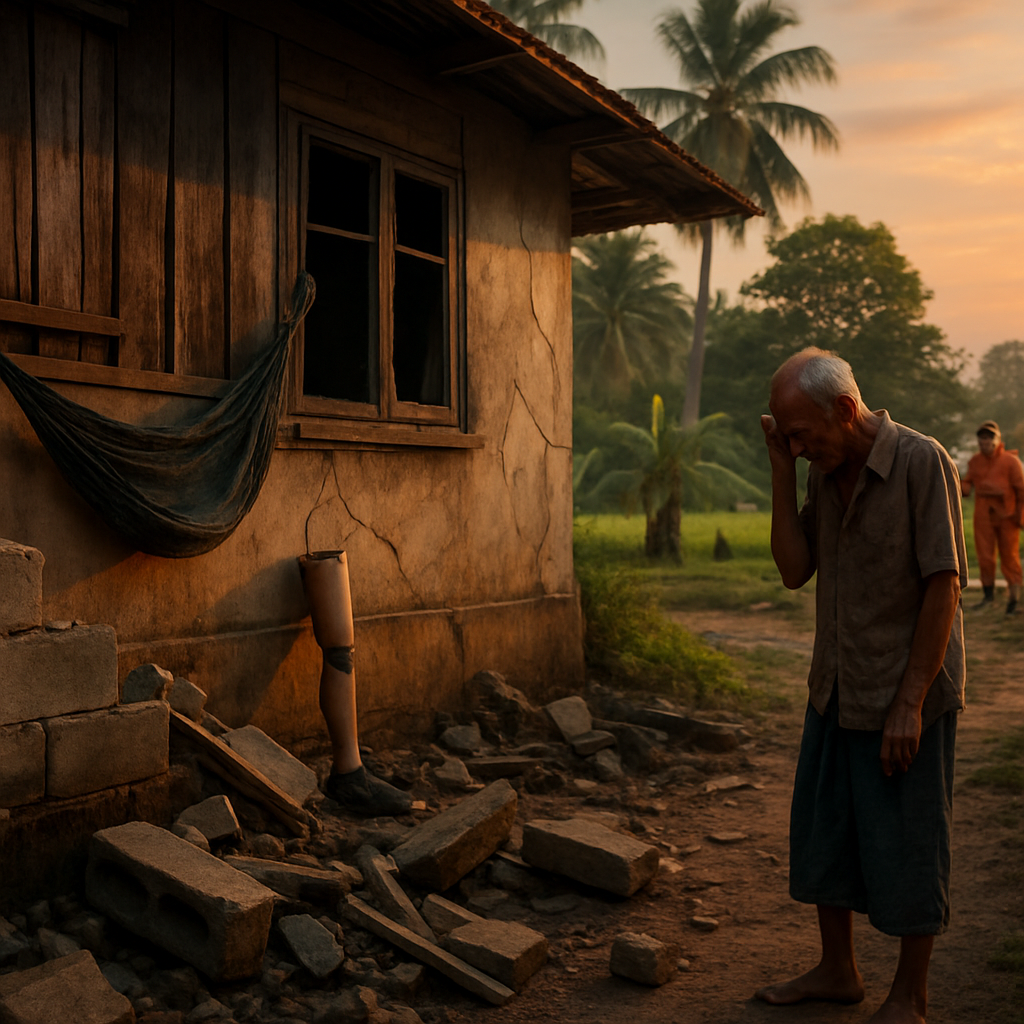
A quiet morning in Ban Mae Rahan turned tragic on January 8 when a concrete wall gave way and crushed a 43-year-old man who was resting in a hammock beside his house. The victim, identified as Chainarong, was pronounced dead at the scene in Moo 10, Ban Krang subdistrict, Mueang district, Phitsanulok. Local police, rescue teams and doctors from Naresuan University Hospital rushed to the property after an emergency call, only to find the collapsed portion of a partly wooden, partly concrete home and the hammock-keeper pinned beneath the rubble.
The image is painfully ordinary: a fisherman who had returned home at about 7 a.m., tying one end of a hammock to a concrete window frame and the other to a nearby tree, then settling in for a well-deserved rest. What turned that ordinary moment into a catastrophe appears to have been the house itself. According to his father, 59-year-old Weera, the family home has repeatedly suffered flood damage over the years, leaving visible cracks and weakening the structure. Officers at the scene later noted that the section of wall that failed reportedly lacked steel reinforcement, a critical element in concrete construction.
Investigators believe the combined factors—the age and damage from flooding, the absence of proper reinforcements, and the pull created by the hammock attached to the window frame—may have been enough to bring the wall down. When the concrete gave way, the man was buried beneath the debris. Authorities documented the scene carefully and sent the body to Naresuan University Hospital for an autopsy to establish the precise cause of death, as reported by Dailynews.
The tragedy is made even more poignant by personal details that help paint a fuller picture of the man who lost his life. Chainarong had a disability: his right leg had been amputated and he used a prosthetic limb. He earned his living as a fisherman, a job that often keeps people outdoors and on the move. On the morning of his death, he had come home from work and, as many do in Thai villages seeking shade and a quiet moment, set up his hammock next to the house to rest. His father, visibly shaken, has suggested that years of flooding and the deteriorating condition of the house were likely contributors.
Beyond the immediate heartbreak for a grieving family, the incident raises broader concerns about building safety in areas prone to flooding and structural wear. Concrete alone is not enough for a wall that must endure seasonal water, shifting soil and everyday stresses. Steel reinforcement—rebar, mesh or other forms of tensile support—are standard in sound construction and can mean the difference between a wall that stands and one that collapses under stress.
This fatal collapse echoes a similar, unnerving event that occurred last October in Pattaya. During home renovations, a concrete section roughly two metres high and one metre wide suddenly fell apart. The wall shattered into fragments, scattering debris across the site and trapping a contractor beneath the broken concrete. Emergency teams had to extricate the injured worker before rushing him to hospital, and authorities launched an investigation into the cause. That earlier incident, like the one in Phitsanulok, spotlighted the dangers of weak or improperly supported concrete structures—especially when renovation, age or environmental damage is involved.
For communities across Thailand where seasonal floods are a reality, these accidents form an uncomfortable pattern. Houses that have weathered multiple floods often show hairline cracks, spalling concrete and weakened foundations—signs that should trigger repair, reinforcement or, in extreme cases, rebuilding. Yet many homeowners, faced with limited resources, delay such work until problems become urgent. The recent tragedies serve as stark reminders that structural warnings are not merely cosmetic issues; they are potential threats to life.
Authorities in Mueang Phitsanulok are continuing their inquiry, while local residents are left to grapple with the sudden loss and to rethink the safety of their own homes. For neighbors and relatives of the deceased, the sorrow is immediate and raw. For local officials, the case is a prompt to re-examine building inspections, public awareness campaigns and support mechanisms for households living in flood-affected areas.
What can be learned from these incidents? Practical takeaways are straightforward: inspect walls and foundations after each flood; consult a qualified engineer if cracks appear; ensure concrete elements have adequate steel reinforcement; and avoid attaching anything—especially items that place tension on structural elements—to compromised frames or walls. In short, small investments in prevention and inspection can prevent irreversible loss.
As investigations continue and the autopsy results are awaited, the community around Ban Mae Rahan mourns. The story of a fisherman who sought a morning rest in a hammock has become a cautionary tale about the quiet dangers that hide in weathered walls. While nothing can undo the loss for Weera and his family, their tragedy may yet wake others to the risks that come with living in weakened structures—and perhaps spur action that prevents the next collapse.


















This is heartbreaking and feels preventable. Builders and inspectors should be held accountable if corners were cut. Too many families live with ticking time bombs because of cost cutting.
My son came home tired from fishing and rested in our hammock; the wall has been cracking since the floods and I asked for repairs. I never thought the frame would give way like that. I want answers and help to prevent another family from suffering.
People keep blaming the government but have you seen how many houses around here are rebuilt without permits? Poverty forces risky choices. Still, tying a hammock to a window frame seems reckless.
Grower134, poverty explains risks but does not absolve responsibility of building standards. If the wall lacked rebar it was inherently dangerous regardless of who rigged the hammock.
This reads like a tragedy made of small failures stacking up—flooding, weak materials, and everyday use. One broken link can break a life. We need community assistance programs, not blame games.
Technically the described failure is classic: unreinforced masonry or concrete under tensile load will fail catastrophically. Rebar or mesh is essential in flood-prone zones to control cracking and shear. Policy should mandate retrofit standards and subsidies for vulnerable homeowners.
Subsidies sound nice but money disappears. Who enforces retrofits in remote villages? Corruption and bureaucracy slow relief while people die. Maybe local community trusts could manage small repair funds directly.
I live nearby and we all hang hammocks by our houses. Nobody thought it could collapse like that. This scares me and my kids because we rest in hammocks every day after market.
From a clinical point of view, crush injuries from structural collapses are often fatal due to hemorrhage and asphyxia. Autopsy will clarify, but prevention is the only cure. Public health outreach after floods must include structural checks.
NaresuanDoc, please come speak to our village if possible. People listen to doctors more than officials. We need simple guidance and maybe a checklist after floods.
Why would the hammock pull down a whole wall? I thought concrete was strong. This is confusing and scary for a kid like me.
Mai, concrete resists compression very well but is weak in tension unless reinforced. A window frame end can create a lever and tensile forces on the wall that, over time and with existing cracks, can cause collapse.
That’s a good explanation, Dr Anan, but the technical fix costs money. How do we make it affordable and enforceable without displacing people?
Community skillshares to teach basic reinforcement and simple repairs could help. Not everyone can hire an engineer, but neighbors can learn to spot dangerous cracks and temporary shoring methods.
As an engineer working in rural infrastructure I agree with free training. But beware of quick fixes. Improper shoring or DIY rebar can look safe but fail in a storm. Professional guidance is key.
Engineer_Phat, professional things cost money and time. What about low-cost, proven designs for rural homes that are resilient to floods? Why isn’t there a simple national standard for that?
Also, we should ask why building codes are so laxly applied. If the contractor or builder didn’t use rebar, someone cut costs, and someone looked the other way.
As a former municipal officer I can say inspections are underfunded and understaffed. We often rely on self-reporting and occasional spot checks. It’s a systemic problem, not a single bad actor.
There is also a cultural element: people repair only when broken. Preventive investment seems wasteful until tragedy hits. We need incentives, not just new rules.
Layla, incentives plus education could change behavior. Make inspections free after floods and pair them with microgrants for basic reinforcement work.
I think the hammock detail is being exaggerated to shame the victim. He deserved a rest, and the real failure was the crumbling wall. Blaming the hammock is easy shorthand for deeper neglect.
Somsak, I agree. It feels like blaming the poor person instead of the problem. We should be kinder to families who already suffer.
Thanks Mai. Sympathy matters because it changes whether people ask for help or hide damage out of shame.
My family is ashamed but mostly grieving. I just want other families to check their walls and for officials to help pay to fix things. Public shame won’t bring my son back.
Weera, the hospital can coordinate a community seminar on post-flood hazards if local leaders request it. Medical teams often work with engineers after major flooding.
Thank you, doctor. That help would mean something to us. We will ask our village leader to contact the hospital.
This is also a human rights issue: the right to safe housing. The state has obligations to protect citizens from avoidable hazards, especially after environmental events they cannot control.
HumanRight88, rights are empty without implementation. Advocacy can raise awareness but must connect to budgets, local governance, and technical assistance to be meaningful.
I will say one practical step: mandate immediate structural safety checks in flood-affected zones and provide tax breaks or small grants for essential reinforcement. It won’t solve everything but it’s a start.