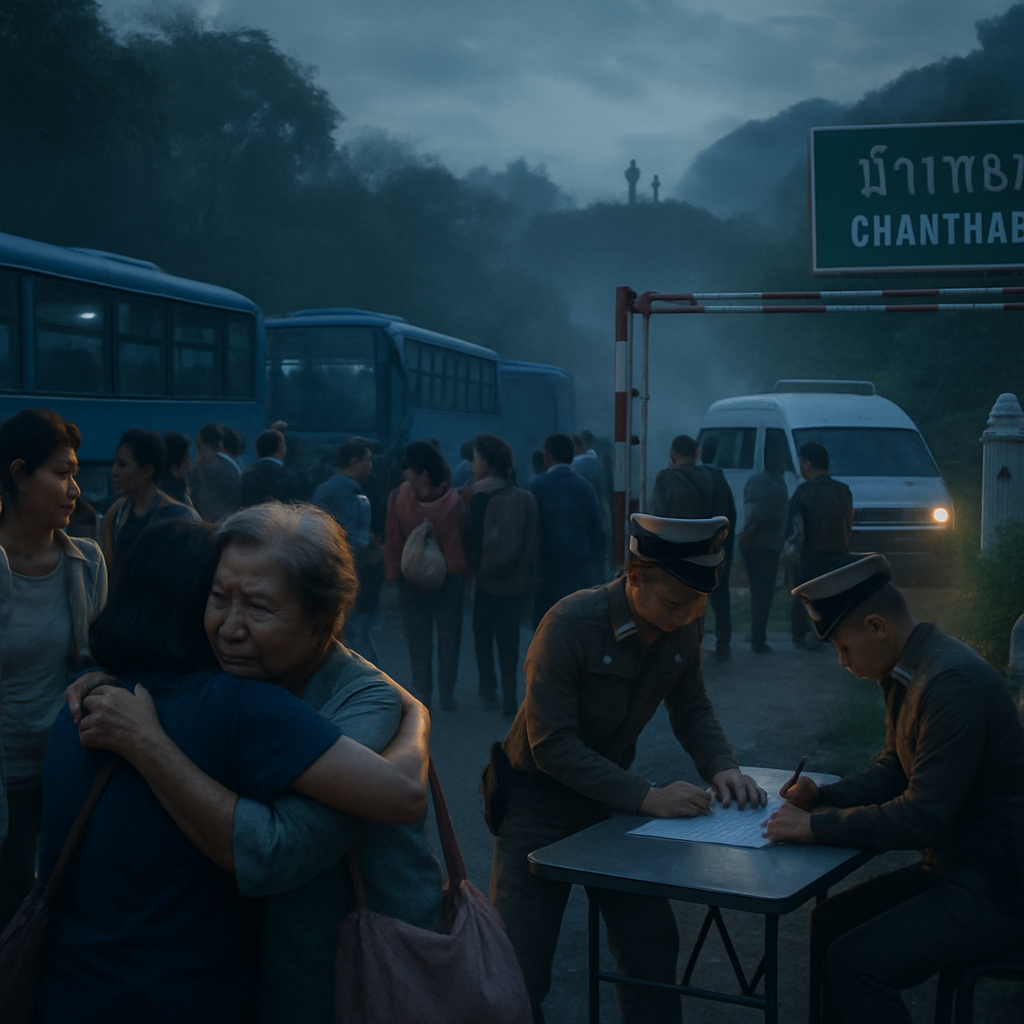
On Saturday, January 3, 2026, a quiet, early-morning operation at the Chanthaburi border checkpoint turned into a small but consequential moment in the simmering saga along the Thai–Cambodian frontier. Cambodian officials escorted four buses of Thai nationals to the crossing opposite Thailand’s Ban Laem Permanent Border Checkpoint in Pong Nam Ron district, Chanthaburi — and 162 people were allowed to cross home. What might have been a routine repatriation quickly took a sharper turn when Thai authorities found six of the returnees were wanted on criminal warrants.
From Battambang to Chanthaburi: the route home
The buses had arrived in Battambang province in the predawn hours, ferrying people who had been stranded in Cambodia. Many were part of the larger flow of Thai workers who had been pushed back after a recent ceasefire between the two countries — a move that saw hundreds sent home amid heightened tensions. Cambodian officials escorted the group to the crossing point at Pong Nam Ron, where Thai authorities carried out screening and background checks before admitting them.
Screenings, suspicions and six suspects
Authorities say the screening was intended to be thorough: officials separated those who might be victims of trafficking from those suspected of crossing into Cambodia to work illegally. During the checks, the Royal Thai Police identified six people with outstanding warrants. The suspects are wanted on serious allegations — joint murder and online gambling offenses — and were taken away in a police van for further questioning and legal processing.
Officials also flagged that the wider probe will look beyond those six individuals. Investigators plan to examine possible related offenses, including the use of mule accounts, a common tool in transnational crime schemes that funnel illicit gains through unwitting or complicit accounts.
Where they’d been and what’s next
Thai authorities reported the group had been staying in several Cambodian locations, including Chong Chom, O Smach and Siem Reap. These towns — some close to bustling border crossings and others more tourist-facing — have long been part of cross-border labor and movement patterns. With the returnees now back in Thai custody, inquiries will expand to trace networks, employment arrangements, and any links to larger criminal operations.
Tensions remain despite no heavy-weapon fights
Military sources from Thailand’s 2nd Army Area noted there have been no major heavy-weapon engagements along the border in recent days. Still, both sides continue to deploy and reinforce forces, signaling that calm is fragile. The diplomatic and security atmosphere remains prickly: Cambodia has accused Thailand of violating its sovereignty, while Thailand has responded with its own accusations, alleging war crimes and breaches of humanitarian law, including attacks on civilian areas.
So while the buses that rolled into Battambang didn’t bring headlines of battle, they occurred against a backdrop of serious mutual recrimination — a reminder that the absence of large-scale clashes is not the same as peace.
Human stories among headlines
Beyond the warrants, patrols and political rhetoric, the episode underscores two human realities. First, thousands of workers cross or attempt to cross borders in search of livelihoods; when tensions flare, they are often the most immediately affected. Second, the return screening highlights the thin line authorities walk between protecting trafficking victims and cracking down on illegal labor and criminal activity.
For the 162 people who made it back to Thai soil on January 3, it was a return to family and country, tempered for some by police detention and investigation. For the six now facing charges, the bus ride ended at a very different destination: legal scrutiny. And for everyone watching the border, the episode is a fresh reminder that the border’s future will be shaped by a mix of security operations, law enforcement cooperation, and — crucially — diplomatic give-and-take.
Looking ahead
Investigations into the suspects and broader networks will continue, authorities say, while both militaries keep an uneasy watch along the frontier. The situation remains fluid: ceasefire or not, deployments and accusations are likely to shape the coming weeks. If there’s one takeaway from the January 3 episode, it’s that borders are where politics, livelihoods and law collide — and every repatriation can carry more than one story.

















Six arrests out of 162 says something is wrong with how people are moving across the border. We need tougher screening but also better support for migrants so they aren’t easy prey. This looks like a law-and-order moment wrapped in human tragedy.
Tougher screening won’t stop organized groups who use forged papers and mule accounts. Blaming returnees is easy politics when the real criminals hide behind layers of brokers.
So are the brokers in Cambodia or here? I think both sides are dirty sometimes. It’s not fair to treat all workers like suspects.
Exactly — both. But we can’t pretend arrests like murder and organized online gambling are minor. Law enforcement needs to follow the networks, not just detain desperate people.
This incident is symptomatic of a larger geopolitical friction where civilians and irregular labor flows become diplomatic bargaining chips. The mutual accusations of sovereignty violations and war crimes complicate routine cooperation on migration management. Investigators must be careful not to conflate trafficking victims with criminal actors when tracing networks.
So are the victims being used by both governments to make a point? That sounds awful and unfair to families. We need more transparency about who gets detained and why.
Transparency is essential, and so is independent monitoring by NGOs or international bodies. Otherwise, each side will weaponize repatriations to score diplomatic points instead of protecting people.
Local sources say many of these workers were pushed out after recent skirmishes near checkpoint towns like Chong Chom. The pattern often mixes economic displacement with security operations, which blurs lines for investigators.
I just want my cousin to come home safe. This politics stuff scares regular families like mine.
Families suffer when borders harden, and it’s true some returnees are wrongly suspected. But we also can’t ignore that criminal rings exploit poor people to launder money and run scams across borders; it’s both tragic and dangerous.
Yeah I get that, but the cops should tell families what’s happening and not just vanish people into the system.
The legal implications here merit scrutiny: allegations of joint murder and transnational gambling signal organized crime elements, but the surrounding diplomatic dispute raises questions about jurisdiction and evidence sharing. If Thailand and Cambodia cannot cooperate due to mutual recrimination, prosecutions will be hampered. International law offers mechanisms, but they require political will and transparent processes.
Or both governments will use these cases to justify militarization of the border while ordinary people pay the price. Sounds like a classic security dilemma.
Media frenzy loves a neat narrative: bad guys on buses, six arrested. The messy middle — labor brokers, legal migrants, trafficking victims — rarely makes the headline, and that’s how bad policy gets made.
Agreed, headlines simplify complex phenomena and can distort public expectations of justice. A judicially anchored, evidence-led approach would be the antidote, but it needs safeguards against political interference.
So what should ordinary people ask the government for? Clear reports and family access to detainees, I guess.
Online gambling rings have been moving money through small accounts for years, so the mention of mule accounts doesn’t surprise me. But six arrests seem small if it’s a network. Either they caught the foot soldiers or the wrong people.
From a labor perspective, countless workers are forced into informal channels because legal migration options are limited. Crackdowns without creating safe legal pathways will only strengthen criminal middlemen.
My neighbor went to Cambodia for work and barely had any paperwork; brokers promised everything. She returned with nothing because the job was fake.
Exactly, Kanya and Mai. Stop criminalizing poverty and start regulating labor migration better. Otherwise, the same cycle repeats.
Those towns mentioned—Chong Chom, O Smach, Siem Reap—have varied roles: some are transit hubs, others service tourist circuits where unregulated labor is common. Mule accounts often pass through family members who don’t realize they’re complicit. Intelligence-led probes should map financial flows as much as people movement.
Mapping flows is fine, but who will be blamed when the maps show long-standing local practices? Thai authorities have a habit of scapegoating migrants when domestic problems spike.
That’s a realistic concern, Pakorn; accountability must accompany investigation so communities aren’t unjustly targeted. Cross-border cooperation with safeguards can reduce scapegoating if done transparently.
We need better banks and rules so small accounts can’t be used by criminals. Make it harder to hide money and easier to track.
This headline hides a bigger truth: borders are where politics and people’s lives collide in ugly ways. The arrests will be used by some as proof the crackdown is needed, while others will cry human rights violations.
Can’t both things be true at once though? Some are criminals, some are victims. The state should be able to tell the difference without punishing everyone.
Yes, both can be true, and that complexity is why independent oversight matters. Otherwise narratives win over facts and families lose.
Ceasefire or not, this just looks like managed chaos. Borders become a theatre for power plays and ordinary people get shuffled like chess pieces.
The human stories in that article are the ones that matter to me; 162 people returning home is a big deal even without arrests. We should focus on reintegration and support rather than just headlines about warrants.
Reintegration is vital, but governments love headlines about arrests more than quiet social services. Watch where funds go in the coming weeks.
True, and NGOs should push for both: transparency in the legal process for those accused and immediate social support for the rest. Preventing exploitation requires both law enforcement and social policy.
Six people with warrants does not justify militarizing an entire border region. Arrests must follow evidence and due process. Turning repatriation into spectacle erodes trust.
Why do you think militarization happens then? Because states prefer visible force to slow administrative reforms that would make migration safer. It’s cheaper politically to point guns than change laws.
Exactly, and the cost falls on migrant communities who are already vulnerable. Policy should be about protections, not posturing.