Chiang Rai rivers: chemical export ban on 30 Nov
Thailand plans to stop ore-smelting chemical exports around 30 November and is asking Myanmar for a three-year plan to track arsenic in the Kok, Sai, and Ruak.
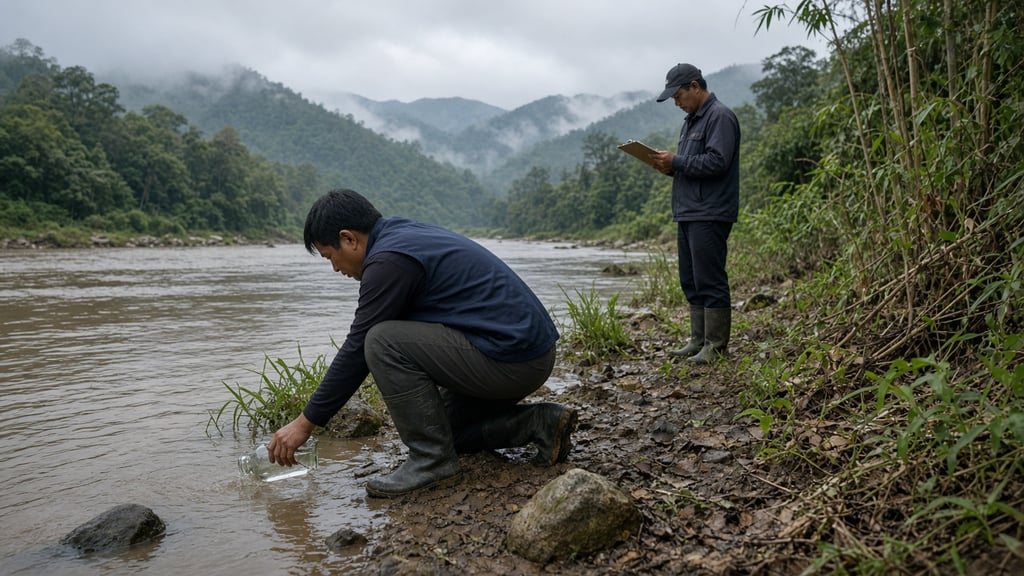
Thailand plans to stop exports of ore-smelting precursor chemicals around 30 November and wants Myanmar in a three-year plan against arsenic and heavy metals in Chiang Rai's Kok, Sai, and Ruak.
Prime Minister Anutin Charnvirakul, also interior minister, linked the curb to mining sediment from Myanmar. He raised it in China, where some smelted metal is shipped, and said Beijing does not back industries that harm public health. The step is a plan for about 30 November, not a customs notice yet.
Three trade tracks, not one ban
The November plan covers smelting chemicals. A draft, not yet in force, would require permits for antimony, lead, gold, rare earths, copper, and tin, plus origin papers and a licensed mine for neighbor trade. Officials have not blamed those six minerals for the river readings.
On 27 November, permanent secretary Rawiwan Phuridej's Pollution Control Committee backed certificates and self-certification for scrap iron, aluminum, and copper imports, and reviewed export taxes on that scrap. The package goes to the National Environment Board on 2 December. Commerce would write the rules.
A six-month halt, and Beijing's reply
On 24 November Deputy Prime Minister Yodchanan Wongsawat, who oversees science policy and the northern response, asked Myanmar to halt for six months the mines suspected of sending arsenic into the Kok and Sai, and to allow sampling where sediment enters the water. On 26 November that request was still open.
On 27 November the Chinese embassy in Bangkok posted remarks by foreign ministry spokesperson Guo Jiakun. Asked if Beijing backs a six-month pause at Myanmar mines, some run by Chinese firms, and if those firms were told to stop, he said China is watching Mekong tributary pollution on the Thai-Myanmar border. Beijing will cooperate on water management and send experts with technical support through the joint working group. Chinese firms abroad must follow local law, and Beijing opposes environmental harm. Geology, climate, and human activity can all feed the pollution, he said, so the cause should not be judged in haste. He did not say China had ordered a halt.
Using thorium as a marker, researchers put 32 to 33 percent of Sai arsenic above natural background with rare-earth mining and 67 to 68 percent with gold or sulphide ore. On the Kok, rare earth was 39 to 50 percent and gold or sulphide ore 50 to 61 percent. Levels peaked at the border and fell downstream, pointing to Shan State.
Seventeen Sentinel-2 images tied about two-thirds of Sai turbidity at Mae Sai to two Myanmar gold areas: about 30 percent near Ban Kan and 36 percent near Pang Tung. Those figures measure cloudiness, not arsenic. Pit samples are still required before either site is blamed.
Twelve sites and a three-year plan
The joint working group met in Bangkok on 25 and 26 November under terms signed on 6 August. Phuridej co-chaired with Hla Maung Thein. Surin Worakitthamrong and Dr San Oo led the environment departments.
Deputy spokesperson Lalida Pheriswiwatthana said both sides accepted a one-year frame and will write a three-year plan on monitoring, source and risk checks, public health, academic work, and policy coordination. The next meeting is in Naypyidaw.
Twelve sites are agreed in principle: four on the Kok per country and two on the Sai. Samples run from December 2026 into January 2027, are exchanged at least twice a year, and cover sediment, aquatic life, soil, vegetables, and health risk. China offered Lancang-Mekong experts and data.
A zone on paper, and wells for 14 villages
The committee reviewed pollution-control zones on the Kok, Sai, and Ruak in Chiang Mai and Chiang Rai under Section 59 of the Enhancement and Conservation of National Environmental Quality Act, B.E. 2535 (1992). Section 60 would guide local cleanup plans if a zone is declared on 2 December. No boundary map is published.
Deep wells are being drilled for 14 Mae Sai villages so household water does not depend on the border rivers. Counts, yield, and a finish date are unpublished. Some tests exceed the standard, but cabinet papers do not say ordinary life has stopped. Minister Suchart Chomklin holds the brief.
On 27 November the Department of Health met at the public health ministry in Nonthaburi and widened checks on household water, food, and health to areas within 1 kilometre of natural water. The ministry described the set as seven provinces and named Mae Hong Son, Chiang Rai, Loei, Nong Khai, Bueng Kan, and Nakhon Phanom. The notice does not name a seventh. With the Food and Drug Administration and the Department of Medical Sciences, it will test 91 village water systems, 390 drinking-water plants, 53 fruit and vegetable samples, and 25 rice samples for arsenic, cadmium, mercury, and lead. The first round is due within two weeks, then twice a month.
The FDA has already tested 37 sealed bottled-water samples, five from Mae Sai and 32 from Mueang Chiang Rai, and none were over the limit. The department is producing urine kits that screen for arsenic and an online tracker of risk areas, sampling points, and results. People in the named provinces are told not to use river water directly. Household water should come from the Provincial Waterworks Authority or from a village system already certified to the standard, and food and drinking water from sellers they trust.
What This Means for Expats and Travelers in Thailand
Treat the Kok, Sai, and Ruak as watched rivers, not swimming or rafting water. Chiang Mai readers have been warning people off the Kok in Mae Ai. Chiang Rai city tap water is not the same as a village intake on the border. In the provinces named for the new tests, use Provincial Waterworks Authority water or a village system that has already passed the standard.
The Mae Sai crossing, visas, and flights into Chiang Rai are unchanged. The mine halt is a request to Myanmar, not a shutdown, and Beijing has not said Chinese operators were ordered to stop. The chemical curb is not published. Traders in precursor chemicals, the six minerals, or scrap iron, aluminum, and copper should wait for the Commerce Ministry text.
Fishers, farmers, and buyers should wait for joint tests of sediment, catch, soil, and vegetables. Until health offices publish advice, do not drink these rivers or let children play in them. Watch about 30 November for the chemical notice, 2 December for the board, the next two weeks for the first household-water round, and December into January for the first shared samples.
Related Coverage
All Thailand →
Revision History (3 versions)JSON API
- Rev 3THAI.NEWS Editorial Desk
Added the 27 November Department of Health plan to test village tap water and drinking-water plants for arsenic in the named border provinces, with a two-week first round and twice-monthly repeats.
− Treat the Kok, Sai, and Ruak as watched rivers, not swimming or rafting water. Chiang Mai readers have been warning people off the Kok in Mae Ai. Chiang Rai city tap water is not the same as a village intake on the border.− Fishers, farmers, and buyers should wait for joint tests of sediment, catch, soil, and vegetables. Until health offices publish advice, do not drink these rivers or let children play in them. Watch about 30 November for the chemical notice, 2 December for the board, and December into January for the first shared samples.+ On 27 November the Department of Health set arsenic tests at 91 village water systems and 390 drinking-water plants in Mae Hong Son, Chiang Rai, Loei, Nong Khai, Bueng Kan, and Nakhon Phanom, a first round within two weeks, then twice a month.+ On 27 November the Department of Health met at the public health ministry in Nonthaburi and widened checks on household water, food, and health to areas within 1 kilometre of natural water. The ministry described the set as seven provinces and named Mae Hong Son, Chiang Rai, Loei, Nong Khai, Bueng Kan, and Nakhon Phanom. The notice does not name a seventh. With the Food and Drug Administration and the Department of Medical Sciences, it will test 91 village water systems, 390 drinking-water plants, 53 fruit and vegetable samples, and 25 rice samples for arsenic, cadmium, mercury, and lead. The first round is due within two weeks, then twice a month.+ The FDA has already tested 37 sealed bottled-water samples, five from Mae Sai and 32 from Mueang Chiang Rai, and none were over the limit. The department is producing urine kits that screen for arsenic and an online tracker of risk areas, sampling points, and results. People in the named provinces are told not to use river water directly. Household water should come from the Provincial Waterworks Authority or from a village system already certified to the standard, and food and drinking water from sellers they trust.+ Treat the Kok, Sai, and Ruak as watched rivers, not swimming or rafting water. Chiang Mai readers have been warning people off the Kok in Mae Ai. Chiang Rai city tap water is not the same as a village intake on the border. In the provinces named for the new tests, use Provincial Waterworks Authority water or a village system that has already passed the standard.+ Fishers, farmers, and buyers should wait for joint tests of sediment, catch, soil, and vegetables. Until health offices publish advice, do not drink these rivers or let children play in them. Watch about 30 November for the chemical notice, 2 December for the board, the next two weeks for the first household-water round, and December into January for the first shared samples. - Rev 2THAI.NEWS Editorial Desk
Added China's 27 November reply: experts and cooperation, no hasty finding, and no order to halt the mines.
− Myanmar has been asked for a six-month halt at mines linked to arsenic in the Kok and Sai. It was still open on 26 November.− A six-month halt, still unanswered− The Mae Sai crossing, visas, and flights into Chiang Rai are unchanged. The mine halt is a request, not a shutdown, and the chemical curb is not published. Traders in precursor chemicals, the six minerals, or scrap iron, aluminum, and copper should wait for the Commerce Ministry text.+ Myanmar has been asked for a six-month halt at mines linked to arsenic in the Kok and Sai. It was still open on 26 November. On 27 November Beijing offered experts and warned against a hasty finding.+ A six-month halt, and Beijing's reply+ On 27 November the Chinese embassy in Bangkok posted remarks by foreign ministry spokesperson Guo Jiakun. Asked if Beijing backs a six-month pause at Myanmar mines, some run by Chinese firms, and if those firms were told to stop, he said China is watching Mekong tributary pollution on the Thai-Myanmar border. Beijing will cooperate on water management and send experts with technical support through the joint working group. Chinese firms abroad must follow local law, and Beijing opposes environmental harm. Geology, climate, and human activity can all feed the pollution, he said, so the cause should not be judged in haste. He did not say China had ordered a halt.+ The Mae Sai crossing, visas, and flights into Chiang Rai are unchanged. The mine halt is a request to Myanmar, not a shutdown, and Beijing has not said Chinese operators were ordered to stop. The chemical curb is not published. Traders in precursor chemicals, the six minerals, or scrap iron, aluminum, and copper should wait for the Commerce Ministry text. - Rev 1 · OriginalNarumon Jitpakdee
Original publication
Comment verification
Step 1 of 3
Verify your email once to publish your comment. Your email is never shown publicly.
Enter the 6-digit code sent to .
Choose the display name shown next to your comments.