Thailand's 2028 OECD Bid Faces a Reform Test
Thailand has pulled its OECD membership target forward to 2028 after a first regulatory review. Tax, governance, labour, and foreign business rules still have to match.
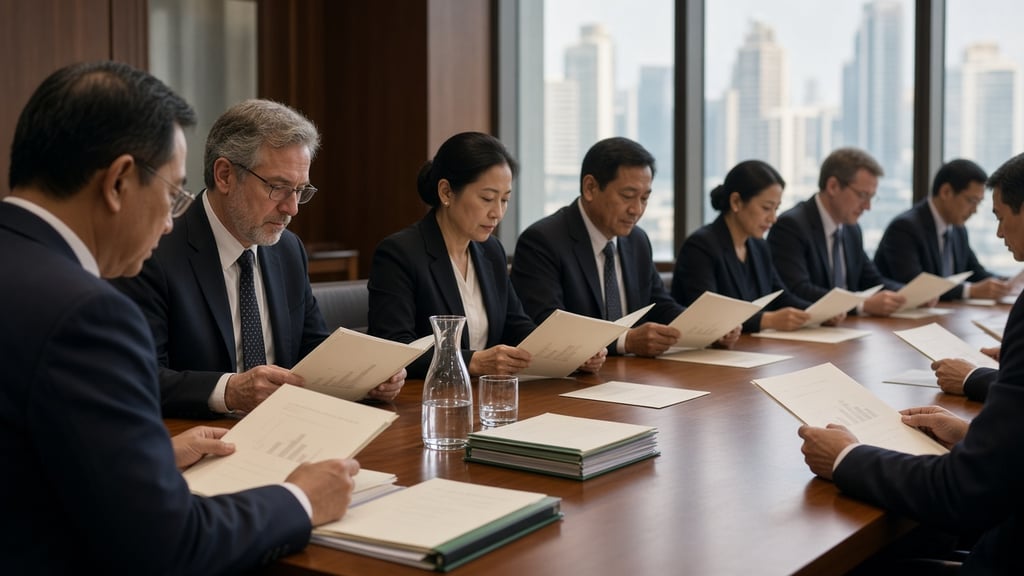
Thailand wants an OECD decision by the end of 2028, two years before a 2030 goal set in March 2025. After talks at Government House on 23 November with Secretary-General Mathias Cormann, the government said the Regulatory Policy Committee had cleared an initial assessment with no extra conditions. Twenty-five committees still hold the rest of the file.
The new date is a Cabinet choice, not a new legal clock. On 19 May 2026 ministers appointed a 17-member steering committee under Prime Minister Anutin Charnvirakul and created an OECD chief coordinator. The planning council, the foreign ministry, and the Office of the Council of State form the secretariat. Finance Minister Ekniti Nitithanprapas is one of three vice chairs.
Thailand is at step 6 of 10. Accession talks opened on 17 June 2024, and the Council adopted the roadmap on 10 July 2024. A 33-chapter Initial Memorandum went to Paris on 8 December 2025. Formal opinions, a final statement, a unanimous invitation from the 38 members, an accession agreement, and deposit of that agreement in France all remain. There is no fixed timetable.
What the 2028 date actually requires
Each committee compares statutes and daily practice with OECD instruments. As of 11 November, adherence stood at 12 of about 270. Thirteen committees had returned questionnaires, nine had finished fact-finding, ten were still answering, and two had not received a questionnaire. The rest are expected in the first half of 2027. Clearing one regulatory committee is a start. It is not a membership vote.
Tax is the part residents already feel. The Emergency Decree on Top-up Tax, B.E. 2567, published on 26 December 2024, applies from accounting periods beginning on or after 1 January 2025. It sets a 15 percent floor for groups with at least 750 million euros in consolidated revenue. That is BEPS Pillar Two. It hits large multinationals, not a pensioner. The Common Reporting Standard, automatic exchange of account data, is why a bank file-check gets blamed on Paris even when the branch is chasing mule accounts.
Still open is whether Thailand will tax foreign income that never enters the country. That idea is not in the 2024 decree. Accession makes it harder to drop. It does not, by itself, write the law. Governance is slower still. The 9 April 2026 policy statement tied 2028 to statutes that block membership and to public data in line with OECD integrity rules. The anti-corruption commission is reviewing the foreign-bribery offence ahead of the Anti-Bribery Convention. State-enterprise policy has twelve recommendations, among them a split between owner and regulator. Draft laws now need at least 30 days of public comment, twice the old minimum. A 28 November column in Krungthep Turakij argued that rule-of-law performance, not the calendar, will decide if long-term capital believes the shift.
Labour rules, green finance, and the foreign-business lists travel together. OECD figures put productivity growth at 4.8 percent a year in 2010-2015 and 2.1 percent in 2015-2023, with the working-age population projected to shrink 29 percent between 2023 and 2060. The Energy Ministry and the OECD have a clean-energy finance roadmap, the 2023 survey urged a carbon price, and that work feeds the draft 14th plan for 2028-2032. On investment, full membership can liberalise direct capital and add volatility when short-term money moves, but members may lodge reservations. The Foreign Business Act B.E. 2542 still sorts restricted activities into lists that need a licence or Cabinet approval. A 2028 entry does not delete those lists. It forces Bangkok to say which closures are temporary.
What changes for long-term capital
Institutional investors buy a peer-reviewed rulebook, not a communique: a minimum tax that matches the global floor, accounts that can be exchanged, a real merger screen, and state enterprises that disclose. Twenty country-programme projects from 2023 to 2026 were the rehearsal, covering governance, the business climate, skills, and green recovery. Thailand also plans to host the OECD Global Roundtable on Equal Access to Justice in 2027. Until formal opinions land, 2028 is a target Paris can still refuse.
What This Means for Expats and Travelers in Thailand
Short-stay visitors will not see a new visa rule because a committee in Paris finished a questionnaire.
Keep the tax files separate. The top-up tax is a large-group minimum, not a new charge on a retirement visa. The open question is personal foreign income: taxed only when remitted, or taxed wherever it sits. Move a lump sum with a Thai tax adviser, not with a headline about 2028. Nominee shareholdings sit under the Foreign Business Act and a stricter transparency file. Accession gives the Department of Business Development a diplomatic reason to enforce rules that already exist.
If the useful part arrives, it will be ordinary: longer comment periods, cleaner competition decisions, and project finance that can cite a green standard other capitals recognise. None of that shortens a 90-day report. Recommendations change daily life only when they become statutes.

Comment verification
Step 1 of 3
Verify your email once to publish your comment. Your email is never shown publicly.
Enter the 6-digit code sent to .
Choose the display name shown next to your comments.