Court rejects bid to halt asset seizures in Thaksin tax case
Central Tax Court on 16 November 2026 dismissed former PM Thaksin Shinawatra's request to halt Revenue Department seizure and attachment of assets tied to a 17 billion baht tax claim, holding the measures were already in enforcement.
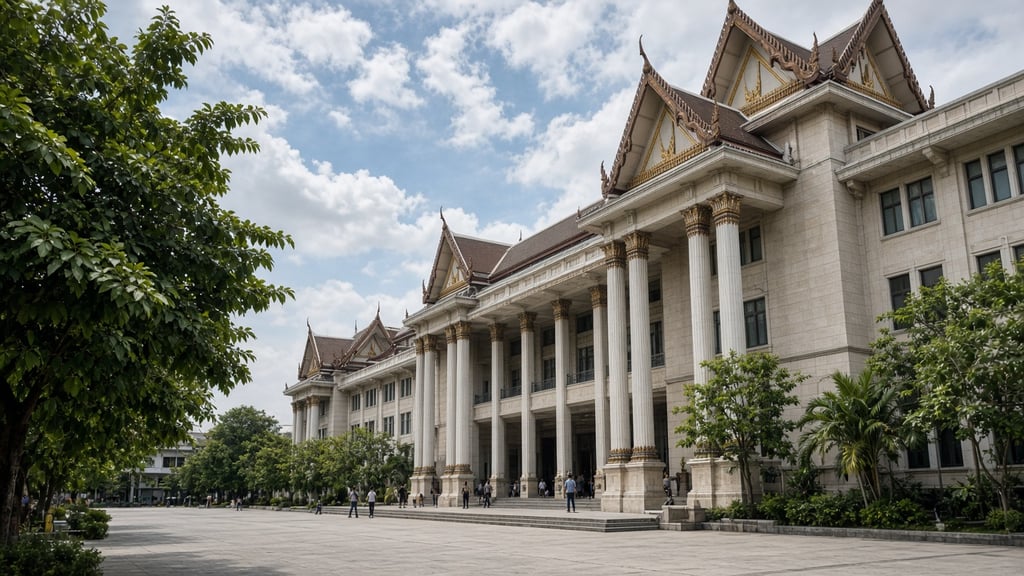
Thailand's Central Tax Court on 16 November 2026 dismissed a request by former prime minister Thaksin Shinawatra to halt Revenue Department seizure and attachment of assets tied to a tax claim of about 17 billion baht. Sitting at the Government Complex on Chaeng Watthana Road, the court held that the measures had already reached the enforcement stage.
The filing is black case Por 59/2569. Thaksin, as plaintiff, asked for a temporary order stopping seizures and attachments, arguing unlawful duplicate collection of the same tax. The court did not decide that factual dispute. It first asked whether he had standing to seek interim protection before judgment.
Why the court treated the case as enforcement
Part 4 of the Civil Procedure Code splits temporary measures before judgment from enforcement of judgments or orders. Section 254 sits in the first of those two divisions. It is written for a plaintiff who, if later successful, could force a defendant to pay, act, or refrain from acting. The court said Thaksin does not occupy that position here.
The director-general of the Revenue Department has used Section 12 of the Revenue Code to order seizure, attachment, and later auction, on the ground that tax has fallen due and has not been paid. Section 12 allows that action nationwide without a court seizure warrant. Paragraph four of the same section applies civil procedure rules, by analogy, to seizure and auction, while attachment follows director-general regulations with ministerial approval.
Those rules, the court held, are the enforcement rules in Part 4, Division 2. In that frame the director-general stands like a judgment creditor and Thaksin like a judgment debtor. A debtor who says enforcement is unlawful may seek a stay under Section 289 if the statutory conditions are met. The court found no right to a Section 254(2) order, read with Section 17 of the 1985 Act on the Establishment of and Procedure for Tax Courts, and dismissed the petition. Each side bears its own costs at this stage.
What remains live in the main lawsuit
The dismissal is an order on the interim petition, not a judgment on the tax itself. Thaksin's lawyers said they will appeal. Their core factual claim is that the income now being chased formed part of more than 40 billion baht already seized and attached in 2010. The Central Tax Court has not ruled on whether the sums are the same.
The main tax lawsuit continues. The court has listed 21 December 2026 for a hearing to define the issues for trial. Thaksin filed the case in July 2026. At an October hearing he indicated he accepts the Supreme Court's finding on tax liability while contesting later enforcement steps as unlawful.
How the 17 billion baht claim reached this point
On 17 November 2025, the Supreme Court's tax litigation division read judgment 6890/2568 and restored a personal-income-tax assessment of about 17.6 billion baht, including tax, penalties, and surcharges, linked to the 2006 sale of Shin Corporation shares. Lower courts had earlier cancelled the assessment. The Supreme Court treated the debt as final for collection.
On 5 June 2026 the Thai government published a Revenue Department update. Acting director-general Somsak Anantawat said the department had kept chasing arrears during appeals and was tracing property in Thailand and abroad with other agencies. If collection still fell short, the department would consider a bankruptcy filing, within statutory time limits.
Enforcement so far has not closed the gap. Frozen deposits of about 90 million baht have been described in court-side briefings, along with orders covering five vehicles, including two armoured cars, and land in Chiang Mai held jointly with Thaksin's sister. No auction has been held.
What This Means for Expats and Travelers in Thailand
This ruling is about one high-profile taxpayer, yet the same machinery applies to any Thai tax debt that has fallen due. Section 12 of the Revenue Code lets the director-general seize or attach assets anywhere in the kingdom without first obtaining a court seizure warrant. Filing a lawsuit does not, by itself, freeze that process. If the department has already moved into enforcement, a pre-judgment injunction is the wrong button. A stay of enforcement, where the statute allows it, is the closer analogue.
Foreign residents who own Thai land, condos, cars, or bank deposits should treat a final tax assessment as a live collection file, not a debating point. Jointly owned property can be caught in an attachment even when a spouse or sibling is not the assessed taxpayer. Bank accounts can be frozen long before any auction. Bankruptcy, if the department later files it, is a separate court track with its own tests, not an automatic next step after a missed payment.
Tourists are not the target of this case. Short-stay visitors without Thai-source tax exposure have no extra airport or hotel duty because of the 16 November order. Expats who run companies, hold Thai bank accounts, or keep titled assets here should keep assessment notices, payment receipts, and lawyer letters in one file. The next listed date in this lawsuit, 21 December 2026, is for defining trial issues. It is not a stay.

Comment verification
Step 1 of 3
Verify your email once to publish your comment. Your email is never shown publicly.
Enter the 6-digit code sent to .
Choose the display name shown next to your comments.