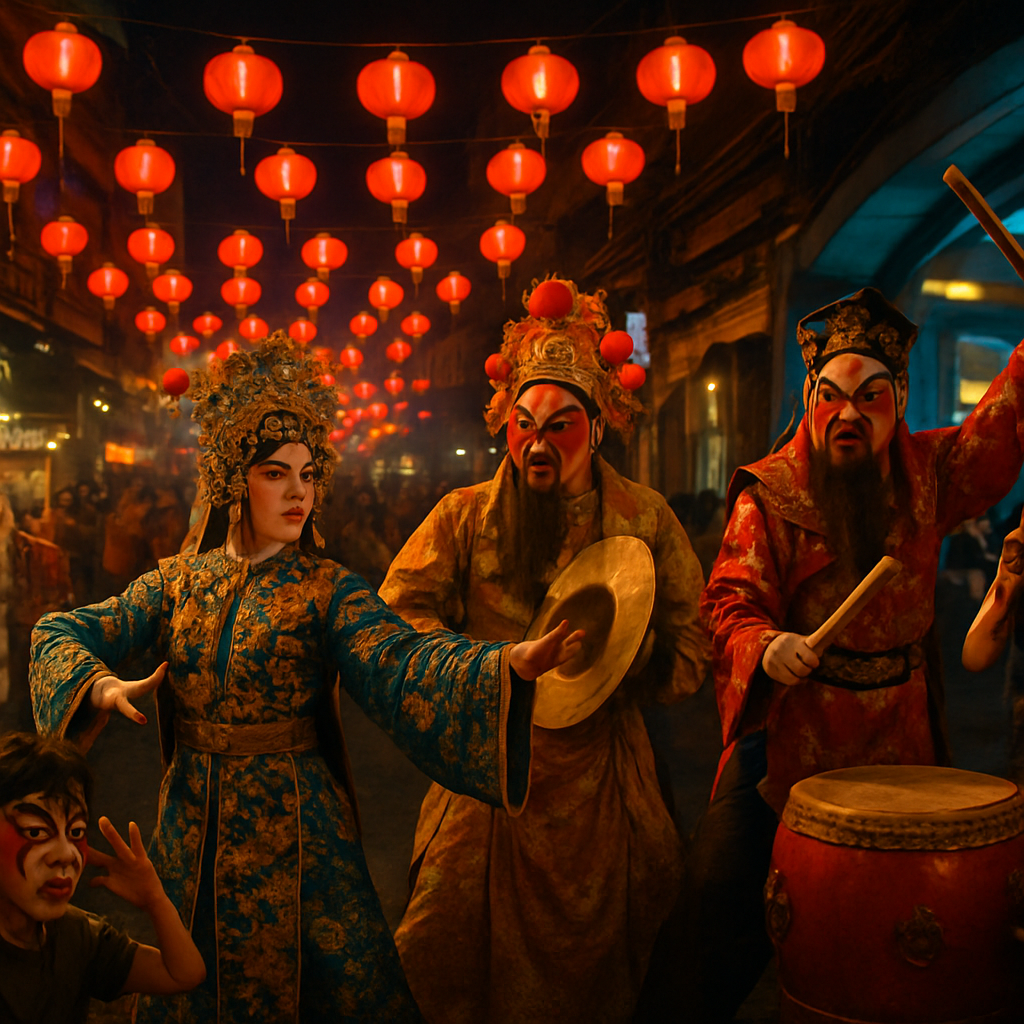
The clang of cymbals, the swell of age-old melodies, and the measured pace of rhythmic chanting returned to Yaowarat — Bangkok’s legendary Chinatown — as Chinese opera reclaimed its place on the neighborhood’s bustling streets. For three luminous nights around Wat Mangkon Station, BEM Happy Journey 2025: Yaowarat turned the area into a living stage, where past and present rubbed shoulders under lantern light.
Organized by Bangkok Expressway and Metro Public Company Limited (BEM) together with the Mass Rapid Transit Authority of Thailand (MRTA), the festival did more than offer entertainment. It invited people to step back into memories of a Yaowarat where glowing lanterns, crowded alleys and the commanding presence of Chinese opera were as ordinary as street food stalls and long conversations on the curb.
For many elderly Thai-Chinese residents, the sound of opera was the soundtrack of life before smartphones and streaming replaced neighborhood theatres. Costumes shimmered like folklore brought to life; stylized movement translated emotion into a visual language everyone seemed to understand; and dramatic storytelling threaded family history into community ritual.
Onstage, the Sai Yong Hong opera troupe performed beloved classics — Bao Qingtian’s righteous justice, the valor of The Yang Family Generals, and gripping episodes from Romance of the Three Kingdoms. Their faces, painted in bold colors, became hieroglyphs of character: hero, villain, sage. The audience responded with everything from smiles to tearful nods, a quiet testament to the art’s enduring power.
“It felt like stepping back into the Yaowarat of my youth,” said Grandma Kanokwan Siriwattanakosol, who has followed Chinese opera for more than 25 years. “The food, the voices, the street lamps — it all came flooding back. This was more than a show; it was a return to a chapter of my life.”
Grandma Kanokwan’s reaction was echoed by others. Ms. Wanthanee Saekow reminisced about childhood bus rides to Yaowarat and how the neighborhood always seemed to hum with celebration — from Chinese New Year to the Vegetarian Festival. She noted that the MRT Blue Line now makes the area easier to reach, but that accessibility hasn’t diluted its soul.
Young visitors arrived with different expectations — often curious, sometimes skeptical — and left converted. Ms. Wayuphak Sirikulwicheth, who watched Chinese opera for the first time, said she was captivated by the vivid colors, dramatic makeup and the music’s pulse. “Now I understand why this tradition has lasted,” she said, smiling as the final chorus faded.
That blend of generations — children tugging at elders’ sleeves, teenagers photographing painted faces, longtime fans settling in for the full arc of a tale — created a rare cross-generational chorus. It was proof that Yaowarat remains a living memory rather than a fossilized relic.
Beyond nostalgia, the festival highlighted how urban change and cultural retention can coexist. The MRT Blue Line brings modern convenience, making Wat Mangkon Station a contemporary artery into a historical heart. Still, the neighborhoods’ narrow lanes, incense-scented shrines and the clatter of vendor carts maintain the character that draws both locals and visitors.
Organizers said the event aimed to reconnect people with the Yaowarat of old and to spark curiosity in younger generations. Judging by the crowds and the warm reactions, the mission succeeded: people didn’t just watch; they remembered, relived and shared.
There is something quietly triumphant about seeing a centuries-old art form reclaim space on a modern city street. When the chorus rose, the past didn’t vanish into history — it stood shoulder to shoulder with the present, reminding everyone that culture isn’t a static exhibit behind glass. It lives in the noise of markets, in the cadence of stories, and in the act of showing up.
As the final night closed and the lanterns dimmed, Yaowarat returned to its everyday rhythm. But echoes lingered: a tune hummed on the commute home, a child imitating a painted face, an elderly patron recounting a childhood memory to a rapt companion. Those small, human moments are the festival’s true legacy.
BEM Happy Journey 2025: Yaowarat offered an evening of spectacle, yes, but also a gentle reminder: neighborhoods survive not merely by being preserved, but by being lived in. When people gather to share food, stories and music, tradition breathes anew. In Yaowarat, that breath was as colorful and insistent as any opera drumbeat.
Source: Khaosod.













Beautiful to see Chinese opera back on the streets of Yaowarat, but I worry public money and corporate logos are turning it into a show for photos rather than people.
I was there with my grandma and she cried when she heard the music; not everything is about Instagram, Somsak.
As an urban anthropologist I think both points are true: festivals can be both commodified and revitalizing, depending on sustainability and community control.
Fair point, Larry — I just hope organizers actually consult residents before making a yearly tourist attraction out of their memories.
My mother sang these songs in the kitchen; seeing kids mimic the painted faces felt like handing the torch back to the neighborhood.
Why are we spending money on opera when the city needs better sidewalks? Seems like a fancy PR stunt by BEM to me.
That’s short-term thinking, Joe. Cultural events boost business for small vendors and keep neighborhoods alive.
Maybe, but who gets the contracts? I bet the usual contractors and the vendors get pushed out next year.
I watched for the first time and felt surprised by how cinematic it was; those painted faces are like living emojis with so much meaning.
I was bored at first but then one performer winked and my friend started recording the whole thing, so it won me over.
Recording is fine, but sometimes people forget to look up from their phones and actually listen.
This festival is an interesting case of intangible cultural heritage being reactivated in situ; the MRT’s involvement raises questions about who frames ‘authenticity’.
You mean like when they repave the alleys and the old stalls disappear? I lived here 40 years and change never stops being two-faced.
Exactly, Somchai; preservation must be community-led, not top-down, to avoid turning living practices into museum pieces.
As someone who saw it for the first time, I felt it was authentic and moving, not staged in a fake way.
I cried hearing the chorus — it is the Yaowarat of my youth and I am grateful they brought it back to the street where it belongs.
Your story made me want to bring my grandmother next year; modern life forgets the small things like songs and smell of incense.
Bring her, please. These are the nights we remember and pass on to children.
I enjoyed the spectacle but noticed more tourists than locals; festivals that rely on outsiders risk losing the very culture they sell.
Tourism can provide funds, but if decisions are made for tourists only, the local articulation of tradition decays quickly.
Exactly. The fix is simple: local committees and revenue sharing so vendors and troupes survive between events.
I loved the costumes and music, but I also felt bad that the performers looked exhausted; are they getting paid fairly for these revival nights?
Good question. Often cultural troupes struggle financially, which is ironic given how many photos they end up in.
If the city wants culture, it should fund artists properly instead of one-off events.
This is nostalgia fetishization. People romanticize the past but neglect the real social issues that made life hard then.
True, but remembering doesn’t erase problems; it can also awaken a desire to protect what remains.
Maybe, but be careful: a staged past can be safer for politicians than solving housing and jobs.
As a vendor I sold more sticky rice in three nights than I do in a week; festivals like this are lifelines for small sellers.
See? Not everything is exploitation. Some livelihoods actually benefit and stay in the neighborhood.
Exactly, and when vendors thrive, the area keeps its texture and culture.
I found the article romantic but vague; I’d like to know attendance numbers, budget, and how the troupes were chosen.
They did mention Sai Yong Hong troupe and BEM/MRTA organized it, but transparency is spotty in these press pieces.
Spotty is the right word. If this is to be a model for cultural policy, we need metrics and fairness.
As someone who covers events, I agree that reporting should include logistical details so audiences can assess impact.
I taught kids about Romance of the Three Kingdoms and they were mesmerized; cultural education can start in places like this, not only in classrooms.
Agreed. Live performances create embodied knowledge that textbooks can’t replicate.
Exactly — and it helps kids feel connected to their city’s layered histories.
Is anyone else worried MRT involvement means the next festival will be inside a sanitized terminal? Public space matters.
That scenario is common: containment of spontaneity into managed events. Keep an eye on where decisions are made and who benefits.
I agree; if the space becomes curated by corporate schedules, the neighborhood loses its unpredictability and soul.
I liked the drums and the colors and the man with the big beard. I want to paint my face like that.
Kids get the purest reaction — they don’t overthink authenticity, they just feel the joy.
This piece made me nostalgic for my own city’s street festivals, but I also felt uneasy about ‘reclaiming’ being used as marketing language.
Language like ‘reclaim’ can be performative when enacted by corporations instead of communities; semantics matter in policy.
So true; words shape perception and policy. We should demand community voices be centered.
If BEM and MRTA genuinely partner with local elders, troupes and vendors, this could be a model for culturally-informed urban transit planning.
Partnerships are nice on paper, but I’ve seen neighborhoods ‘partnered’ into oblivion before.
Then accountability mechanisms are necessary: long-term seating for troupes, subsidized stall rents, and local decision boards.
Those are concrete ideas. Let’s push for them next time this festival is planned.
People complaining about tourists need to remember tourists bring cash. Money can save old arts if spent wisely.
Cash helps, but it must be distributed equitably to avoid making artists just props for tourism.
Agreed. Transparency in revenue allocation would solve many concerns.
I wish they’d broadcast more background information during the show; new viewers could appreciate the stories more with a little context.
Or put QR codes on programs for translations and plot summaries so teens will actually read them.
Yes, tech can bridge gaps without turning everything into an app-first experience.