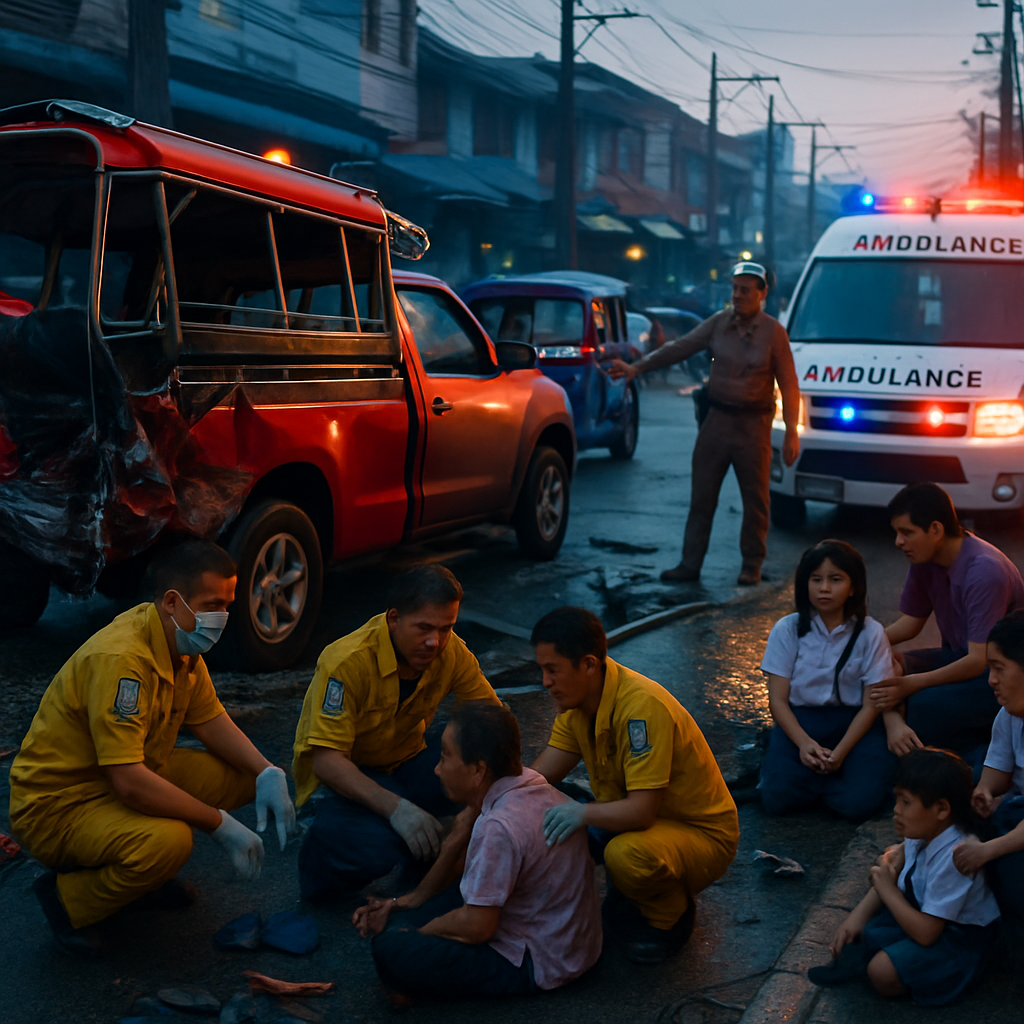
Early on the chilly morning of December 15, a routine commute in Chon Buri turned into a chaotic scene when a bronze pickup truck ploughed into the rear of a red songthaew, scattering passengers and sending at least 14 people to Chon Buri Hospital. The crash happened at around 7:30 a.m. on the inbound lane opposite the Tuk Nam building in Ban Suan subdistrict, Mueang district — a stretch normally filled with sleepy commuters and the hum of school traffic.
The moment everything changed
Witnesses described a loud, bone-jarring bang followed by a violent shudder. Students on their way to school reported the songthaew shaking so hard that classmates were thrown from their seats. One student, still visibly shaken, said the vehicle lurched and screamed under the impact, leaving passengers scrambling across the road in confusion and pain.
A 65-year-old passenger named Nipa recounted how she had been on her way to the hospital when the crash occurred. “There was a loud bang and then the vehicle spun,” she told reporters. “People were thrown from the songthaew. I lost consciousness and only later realised a pickup truck had hit us.” Her account captures the sudden terror of a morning that started like any other.
First responders and the aftermath
Officers from Mueang Chon Buri Police Station and local rescue crews raced to the scene. They found the red songthaew with its rear severely mangled and the pickup truck parked nearby with its front-left side crushed. Rescue teams immediately administered first aid to injured passengers who were scattered across the roadway and quickly moved them to waiting ambulances bound for Chon Buri Hospital.
Authorities say about 14 people suffered injuries ranging from cuts and bruises to more serious trauma. Thankfully, the rapid response likely prevented the situation from becoming even worse.
Driver statements and the unfolding investigation
The pickup’s driver, 50-year-old Sitthipon, admitted to police that he had dozed off at the wheel. He told officers he was returning from the market when he lost control and rear-ended the songthaew. The songthaew’s driver, 61-year-old Thanachai, explained he had just picked up passengers from Nong Mon and was preparing to drop them off near Chonkanyanukoon School when the collision happened.
Thanachai reported that several passengers were thrown from the vehicle by the force of the impact. Police have launched a formal investigation, are questioning Sitthipon further, and indicated that legal action is expected to follow depending on the findings.
Community ripple effects
Morning school runs in this part of Mueang Chon Buri often resemble a small, orderly parade: tuk-tuks, motorcycles, and songthaews ferrying students along narrow lanes. When something goes wrong in that fragile choreography, the consequences are felt by families, schools and the neighbourhood at large. Parents who rushed to the hospital in the wake of the crash described scenes of panic, unanswered questions and the fear of waiting for news about their children.
Why this matters beyond Chon Buri
Sleep at the wheel is an all-too-common hazard worldwide, and this incident is a stark reminder of how a momentary lapse can ripple into life-changing injuries. The case here is textbook: long hours, the lure of a quick nap after market duties, and the vulnerability of passengers packed into shared transport. Authorities, road safety advocates and transport operators will likely use this incident to stress the importance of driver rest, vehicle maintenance and passenger safety measures — especially during school commute hours.
Related incidents and broader safety context
In a separate but related incident, a Thai man crashed his sedan into a home in Pattaya, injuring three people, including a homeowner’s wife who was trapped when a wall collapsed on her in the bathroom. Such collisions across the region underscore the growing need for better road safety enforcement and public awareness.
What happens next
Police in Mueang Chon Buri will continue their inquiry into the December 15 collision, interviewing witnesses and reviewing any available CCTV or dash-cam footage. If negligence or sleep-related impairment is confirmed, criminal or civil charges could follow.
For the injured, recovery begins now at Chon Buri Hospital. For the community, the clean-up and questions remain — and for drivers everywhere, a sober reminder: never underestimate the danger of driving while overly tired. A blink, a nod, or a brief doze can change lives in an instant.
If you were near Ban Suan subdistrict that morning and have photos or footage that could help investigators, please contact Mueang Chon Buri Police Station. Community cooperation often proves vital in reconstructing events and ensuring accountability.
We’ll continue to follow this story and provide updates as official reports become available.
















We reported this morning’s crash near Ban Suan and are collecting any photos or footage to help investigators. Please contact Mueang Chon Buri Police Station if you have relevant material. We’ll update this thread as official information comes in.
I was near Tuk Nam this morning and it was a nightmare. The songthaew looked like it was pushed hard from behind and people were screaming.
Yes, that was me in the article — still feeling dizzy and grateful to be alive. Many of us were thrown from our seats and I’m worried about the children who were on board.
Nipa, thank you for confirming and for sharing your account. We hope the hospital staff are giving everyone proper care and we’ll link to updates on victims’ conditions when available.
This is why you should never let tired people drive. Lock them up from the wheel if needed. End of story.
Blaming only the individual ignores systemic issues like long market hours and lack of rest infrastructure for informal workers. Sleep deprivation is a public health problem that requires regulation and support, not just punishment.
Sure, talk about systems while kids get injured. I’m not saying don’t fix systems, but the driver admitted he nodded off — personal responsibility matters.
From a legal perspective, admission of dozing off is strong evidence, but courts often consider work patterns and employer pressure when deciding liability and penalties.
Songthaews are built like paper and they cram too many people in. Why are we still allowing these unsafe vehicles near schools? It’s just asking for trouble.
Not everyone can afford private transport and these vehicles are lifelines for many communities. Better regulation and enforced seat limits would help more than banning them.
Regulation must be coupled with enforcement and alternatives. If operators are fined without providing affordable transport options, families will be left worse off and unsafe practices may continue covertly.
I get that people need cheap rides, but we should prioritize kids’ safety. Subsidized buses during school hours would be a compromise.
Seems fishy. How do you just ‘doze off’ and drive straight into the back of a car without braking? I bet the driver was texting or had something else going on.
Conspiracy theories aside, vehicles often don’t leave skid marks when the impact is instant from sleep. If his foot failed to move, no braking happens. Not everything is a cover-up.
I was on that songthaew and it all happened so fast. There was a loud bang and then I remember my classmate crying. No one was on their phones before the crash, we were all quiet and sleepy.
As a teacher I regularly worry about student commutes. CCTV often shows drivers closing their eyes for a second before disasters happen, and one second is enough.
I might have dash footage since I was driving behind during the morning. I’ll check and contact the police if it helps the inquiry.
This breaks my heart. Parents must be terrified waiting in hospitals while kids are being treated. We need community support for the families.
People keep talking about blame, but right now volunteers and blood donors are needed. Let’s organize a drop-off schedule at Chon Buri Hospital so families don’t feel alone.
Hospital staff are stretched but doing their best. Minor injuries are being treated quickly, and surgical teams are on standby for serious cases. Donations of blankets and baby formula were already helpful today.
Thanks, NurseMay. I’ll spread the word about needed supplies and arrange a community ride-share for anxious parents who can’t get to the hospital.
School zones must have stricter controls during commute hours. A lowered speed limit and physical barriers could give kids more protection from accidents caused by inattentive drivers.
We are coordinating with local police to reassess school commute plans and will propose temporary speed reduction measures. Parental coordination and staggered pickup times are also under discussion.
Staggered times are impractical for many working parents. We need reliable, safe transport, not shifting the burden back to families every time something bad happens.
Fair point about working parents. Policy should include employer involvement and funding for safe school transport so solutions don’t fall unevenly on families.
I drove past and took photos of the scene before police cordoned it off. I want to upload them to help investigators but I’m not sure of the right channel.
Please submit any footage or photos directly at Mueang Chon Buri Police Station or use the secure upload form on our official page. Thank you for cooperating.
Thank you. I’ll head to the station this afternoon and hand the SD card over in person. Hope it helps reconstruct what happened.
Why are drivers working such long hours? Markets close late and they still have to shuttle people early. It seems like a recipe for exhaustion.
Exactly. Many informal sector workers lack regulated hours or rest periods. Policies like mandatory breaks, access to rest spaces, and education on fatigue could reduce such incidents.
I remember when delivery and market work had stricter hours and drivers rested between shifts. Things changed when competition pushed people to work longer.
Competition without safety nets hurts everyone. If drivers had access to fair wages or cooperatives, they’d be less pressured to push through exhaustion.
From a legal standpoint, if the driver operated commercially and was on duty, the company or cooperative could be vicariously liable. Evidence of schedule pressure would be pivotal in court.
Legal talk aside, someone still made a choice to get behind the wheel while tired. Contracts and companies won’t bring back the injured or comfort families in the ER.
You’re right Joe, accountability matters. But accountability that includes systemic remedies prevents recurrence. Courts can impose penalties and require operational changes.
Schools should keep records of which students take which routes and share that with parents. Quick parent-school communication saved time today in identifying who was on board.
Our school did call parents quickly, and some teachers went with students to the hospital. That helped calm kids who were panicked and crying.
Investigators will likely look at dash-cam and CCTV, interview witnesses, and run a toxicology test if needed. Expect a thorough probe given the number of injuries.
I still think media should ask tougher questions about driver history and vehicle maintenance records. Those are usually swept under the rug.
We will request maintenance logs and driving records. Transparency is important, and any suppression of records can lead to stronger legal consequences.
Community action beats outrage alone. Let’s form a rota for hospital assistance and petition local authorities for improved morning patrols and checks.
I’m in for organizing supplies and rides. If people donate a little time, it could relieve a lot of stress for victims’ families.
Minor trauma patients will often recover fully but we need follow-up care for whiplash and concussion symptoms. Families should watch for delayed signs like headaches or vomiting.
Thank you for the guidance. I will make sure everyone I know goes back for a check-up even if they seem okay now.
If drivers are working both markets and school runs, why isn’t there a law preventing dual-shift driving? That seems like a basic safety fix.
Regulating dual-shifts for informal operators is complex but the ministry will propose guidelines and incentives for safer scheduling in cooperation with transport authorities.
Update: I checked my footage and caught the moments after impact. It’s grainy but might show the pickup’s speed beforehand. I’ll hand it over to the police this afternoon.
Whether footage exists or not, the public needs to keep the pressure on authorities so this doesn’t become ‘just another accident’ and then forgotten.
Pressure is good but temper it with facts. Premature accusations can ruin lives if used against someone who genuinely made an error. Balance outrage with evidence.
I saw an elderly lady get hurt and it made me think we should all learn first aid. It felt helpless watching until the rescuers came.
Schools should teach basic first aid and have kits on every songthaew route. Quick action before ambulances arrive can change outcomes.
Beyond emergency measures we need public health campaigns about drowsy driving, targeted at workers with shift-based schedules. Education, rest infrastructure, and enforcement should coexist.
If markets started an earlier shift rotation years ago, drivers wouldn’t be up all night. Policy choices years ago ripple into tragedies now.
Is there any news on the legal status of Sitthipon? People here are asking if he will face charges and what kind.
We are continuing the investigation and will charge according to the findings. If negligence is confirmed, criminal charges could follow; updates will be provided as the inquiry progresses.