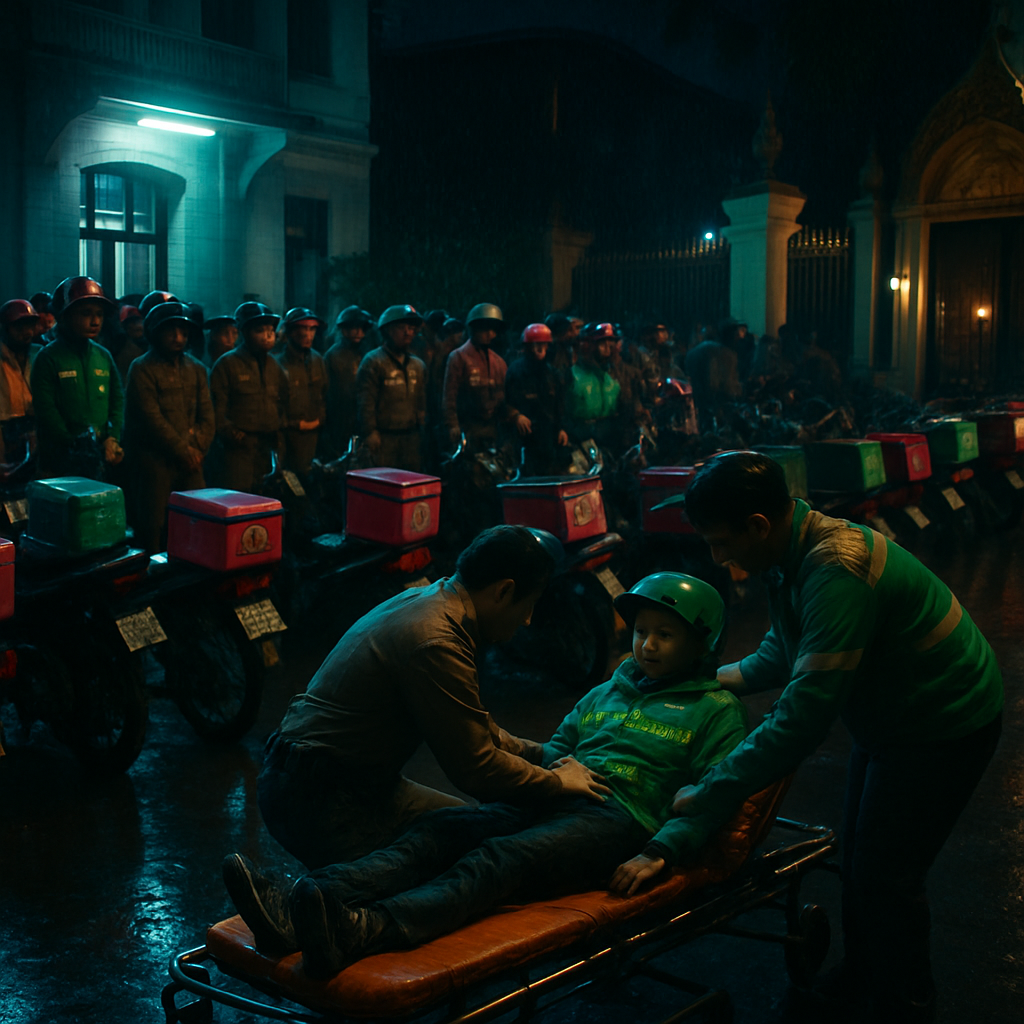
What began as a routine food delivery in the heart of Bangkok turned into a night of outrage and solidarity when nearly 100 delivery riders converged outside Pathumwan Police Station on the evening of 25 January 2026. The gathering followed a violent altercation the previous day inside the exclusive Royal Bangkok Sports Club on Henri Dunant Street, where two private security guards are accused of assaulting a female delivery rider, leaving her unconscious and sparking an online firestorm.
The incident happened at about 3:00pm on 24 January. According to police reports, 28-year-old Ms. Supphannika and her partner, 28-year-old Mr. Nattawut, were on a routine motorcycle delivery when they tried to enter the club grounds. A security guard at the entrance ordered the pair to stop and insisted they leave their motorcycle outside. What started as a verbal request quickly escalated into a physical confrontation.
Police say the dispute intensified while Mr. Nattawut walked away to park the bike. In the ensuing argument, one guard allegedly struck Ms. Supphannika with a helmet and then kicked her after she collapsed, causing her to lose consciousness. Mr. Nattawut reportedly suffered injuries as well when he attempted to intervene. Bystanders rushed to aid the couple and transported them to Police Hospital for treatment.
By the next afternoon, Ms. Supphannika’s uncle, 67-year-old Mr. Jamnong, had filed an official complaint with Pol Lt Col Warit Karnyurawat at Pathumwan Police Station. Authorities moved quickly: both security guards were detained for questioning and later charged with jointly assaulting another person causing injury. They were scheduled to appear at Pathumwan District Court on 26 January.
The case took on new dimensions after images and video footage of the assault circulated online. The graphic clips galvanized Bangkok’s delivery rider community, many of whom already face daily risks balancing time pressure, traffic and occasional hostility while doing their jobs. Around 10:47pm on 25 January a sizable group of riders arrived at Pathumwan Police Station, not to foment trouble but to demand accountability and to show solidarity with one of their own.
Officers kept a careful watch as the crowd gathered. Pol Col Rangsan Sonsing, acting superintendent of Pathumwan Police Station, supervised the situation, while Pol Maj Gen Chaikrit Pho-a, commander of Metropolitan Police Division 6, later arrived to help manage tensions. With police maintaining crowd control and the suspects being processed inside the station, the assembled riders dispersed peacefully later that night.
Medical staff treating the injured couple confirmed the severity of the damage. Ms. Supphannika sustained inflammation to her right jaw and required hospital observation for two days, while Mr. Nattawut received outpatient treatment for minor injuries. Khaosod and police statements formed the basis of the account that spread across social media and news outlets nationwide.
This episode underscores a growing friction point in modern Thai cities: the clash between private security at elite venues and a workforce that keeps the city moving. Delivery riders are highly visible in Bangkok’s streetscape, carrying essential food and goods to apartments and offices from dawn until late night. Their work has become even more conspicuous during the pandemic era, and with that visibility comes heightened exposure to risks—road hazards, aggressive customers, and, as this incident highlights, confrontations at private properties.
For many riders who gathered at the police station, the protest was personal. “We’re not asking for trouble,” one rider told a local reporter, “we just want fair treatment and protection when we do our jobs.” Whether the accused guards acted out of authority, misunderstanding, or something more malicious will be sorted out in court, but the public reaction shows how quickly a single violent incident can become a flashpoint for broader social concerns.
Authorities have treated the matter seriously: charges of joint assault causing injury carry legal consequences, and the court appearance will determine whether the guards face further penalties. Meanwhile, the injured couple recuperates and the delivery rider community remains watchful, more connected than ever through social media networks where footage and eyewitness accounts spread within minutes.
As Bangkok continues to evolve—from its race to modernize city spaces to its reliance on gig economy workers—the incident at the Royal Bangkok Sports Club is a reminder that public safety, respect for laborers, and clear protocols for private security are essential. For now, the focus is on justice for Ms. Supphannika and ensuring that those who protect private venues do not cross the line into violence.
Expect more updates as the case progresses through Pathumwan District Court. In the meantime, the story has already left its mark: a community of riders united at a police station late into the night, demanding that common courtesies—and the law—apply to everyone, regardless of where they work or where they deliver.


















As the reporter who covered this, I can confirm police moved quickly but many riders say justice feels slow. The video circulation clearly shaped the public reaction, and the club’s exclusivity only intensified the backlash. I’ll keep updating as the court proceedings unfold.
Quick police action is fine, but why do guards at elite places think they can use violence like that? This isn’t just a scuffle, it’s abuse of power and classism rolled into one.
Be careful saying ‘abuse of power’ without evidence; security guards have to protect private property and sometimes tempers flare. I’m not defending violence, just saying context matters.
I agree context matters, Somsak, but the footage and the medical reports show clear injury. Courts will weigh intent and circumstance, but public pressure is pushing authorities to treat it seriously.
Context matters? So it’s okay to hit someone because you ‘protect property’? That argument protects bullies, not rules.
This is exactly why I avoid fancy places. They act like rules don’t apply to their staff. If the guards thought they had impunity, social media corrected that fast.
But social media can also ruin lives with partial clips and no nuance. Are we sure the whole story isn’t being edited for outrage?
Partial clips happen, sure, but multiple witnesses and hospital records back up the rider’s side here. ‘Nuance’ can’t be an excuse for brutality.
As someone who rides for a living, I can say the clips matched what people around me saw. Riders are tired of being treated like second-class citizens.
The ‘they destroyed a life with one clip’ narrative ignores systemic problems; the clip opened a solvable debate about security training and riders’ rights.
We should push for clearer protocols at private venues for deliveries. A written rule about where to wait and how to interact would prevent misunderstandings that escalate to violence.
Protocols help but only if enforced impartially. Wealthy clubs often have informal cultures that tolerate rough handling of outsiders.
True, enforcement is the weak link. Maybe licensing standards for private security with mandatory de-escalation training would help.
Mandating de-escalation training is evidence-based and would likely reduce incidents. However, implementation needs oversight, or it’s just another regulation on paper.
Some commenters are quick to call this class war, but could it be an isolated incident of two tempers flaring? Not every conflict equals systemic oppression.
Isolated? When riders report daily harassment, one blow feels less isolated. Patterns matter more than a single moment.
I hear that, but caution against immediate moralizing. Let the court decide criminal culpability first.
I ride a motorbike for deliveries and this scares me; even when I’m calm, a rude guard can turn the job into danger. It’s exhausting that we must prove our dignity every day.
As a manager of an office building, I see both sides—riders under time pressure and security under orders. Better communication channels could reduce clashes.
Communication is great in theory, but when a guard decides to escalate physically, it becomes life or death. We need accountability measures, not just ‘better channels.’
Accountability is key, yes. The police charging the guards is a positive sign, but does the court follow through? Evidence suggests not always.
This story sits at the intersection of gender, labor, and public space. A female rider was assaulted; gendered violence may have played a role and must be investigated.
Intersectional analysis matters for legal strategy and public policy. Gendered assumptions can influence both security behavior and judicial outcomes.
Exactly. We should track similar incidents to see whether women riders are disproportionately targeted.
I’m glad someone mentioned gender. Too many people jump to class without seeing the misogyny in physical attacks on women doing their jobs.
As a criminologist, I note that rapid public attention often increases the likelihood of formal charges, but sustainable change requires legislation and oversight. Training, licensing, and civilian review boards could all play a role.
Civilian review boards sound good, but are they truly impartial or just more bureaucracy? We’ve seen both outcomes.
They vary in effectiveness; success hinges on independence, funding, and transparency. Without those, they become toothless.
Also consider technology: mandatory bodycams for private security might deter violence and clarify disputes.
People keep talking about policy, but what about immediate safety nets? Riders need legal aid funds and rapid-response hotlines to report intimidation.
Practical support like legal clinics would help, and companies using riders could partner for those resources. Corporate responsibility matters too.
Yes, platform companies should contribute; they profit from riders yet often abdicate responsibility for field-level conflicts.
I’ve reached out to delivery platforms for comment; some say they provide training, others point to the private venue as responsible. There’s no single answer yet.
My building recently formalized a drop-off zone to avoid confrontations and it helped a lot. Simple design changes in urban spaces can reduce friction.
Design matters, but it won’t stop people who choose aggression. Urban planners and security companies need to work together on both physical and social solutions.
All the debate aside, if someone is violent, they should be prosecuted. Private club or not, hit someone and face the law.