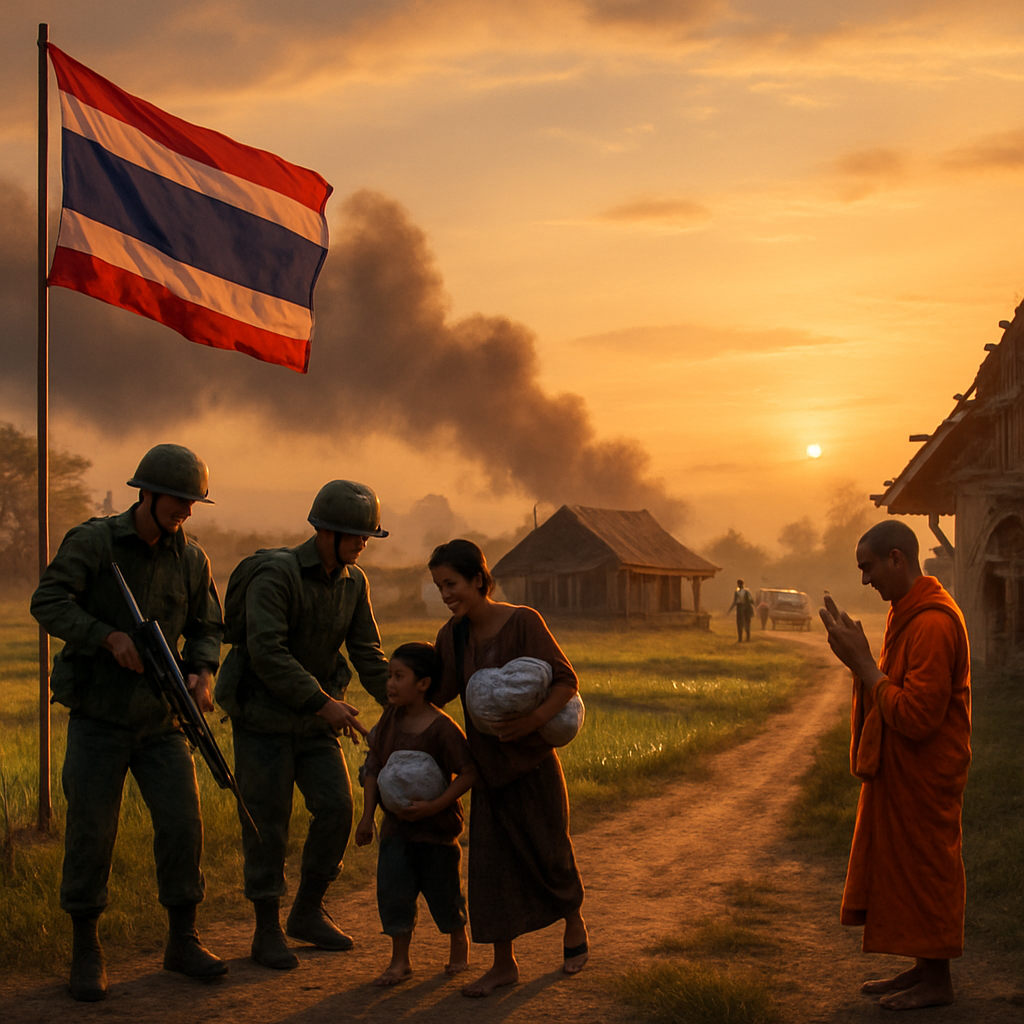
In a dramatic — and at times theatrical — turn of events, former US President Donald Trump announced on December 28 that a ceasefire between Thailand and Cambodia was in effect, following roughly 20 days of intense border clashes. The deal, reportedly reached on December 27, was hailed by Trump on his Truth Social account as a swift resolution achieved with “very little assistance” from the United Nations.
Trump’s post read like a victory lap: “I am pleased to announce that the breakout fighting between Thailand and Cambodia will stop momentarily, and they will go back to living in peace, as per our recently agreed to original treaty.” He praised the leaders of both countries for what he described as fast, decisive leadership and effective negotiation — adding, with trademark emphasis, “It was fast & decisive, as all of these situations should be!”
But the announcement didn’t stop at congratulations. In a familiar refrain, Trump took a jab at the UN’s role in global conflict resolution. He suggested the United States — or at least his approach — has been more effective, saying bluntly that perhaps “the United States has become the real United Nations, which has been of very little assistance or help in any of them.” He urged the global body to “start getting active and involved in world peace.”
Beyond political soundbites, the human cost of the border fighting is stark. Thai authorities confirmed that 27 Thai soldiers were killed during the clashes, including three who died in the Nong Chan district of Sa Kaeo province on December 26. Cambodian military casualty figures are muddled: Thailand’s Royal Armed Forces earlier stated a cumulative Cambodian death toll of at least 221 soldiers, while the 2nd Army Area offered a lower December-only figure of 102. Local Cambodian outlets reported vastly smaller numbers — some as few as seven — highlighting how foggy and contested casualty reporting can be in the aftermath of conflict.
Displaced civilians are now trickling back to damaged villages and towns after being uprooted to temporary shelters. Many return cautiously; officials say a significant number of evacuees plan to wait at least 72 hours before confidently heading home, wanting to make sure the ceasefire holds and no new skirmishes erupt. Both Bangkok and Phnom Penh have pledged to maintain monitoring mechanisms intended to prevent a flare-up — a necessary reassurance when gunfire has only recently fallen silent.
So what happened, exactly? The short version: a flare-up that escalated over about three weeks, heavy exchanges across a disputed border, mounting casualties and displacement, and then a ceasefire hammered out by national leaders. The longer version involves a mix of territorial tensions that have simmered for years, sudden escalations, and intense diplomatic pressure to avoid a wider conflict. Whatever the precise sequence, the ceasefire marks an important — if fragile — pause.
For locals, the ceasefire is a practical relief more than a geopolitical talking point. Farmers want to tend fields again. Merchants hope customers will return. Children want to go back to school. That compact between human normalcy and geopolitical stability is where the real stakes lie: beyond the headlines, beyond the posturing, millions want safety.
What’s clear is how differently different actors tell the story. For Trump and his supporters, the announcement was presented as proof of decisive leadership and an argument for American influence. For the United Nations and many international observers, the episode underscores how multilateral institutions sometimes struggle to take center stage amid fast-moving crises and competing national narratives.
And then there’s the information chaos: wildly varying casualty figures, mixed media reports, and local sources contradicting official tallies. In this environment, reliable facts are precious. Investigators and independent monitors will likely be needed to reconcile the disparities and provide a clearer account of what occurred — and who bore the heaviest price.
For now, residents remain on edge but hopeful. After roughly 20 days of hostilities, many have tentatively returned to their neighborhoods; others are waiting the stipulated 72 hours before making the trip home. Both governments have signaled they will keep watch over the ceasefire — but as residents and analysts alike will tell you, the real test is whether calm holds when international attention inevitably moves elsewhere.
Until then, the region is breathing a tentative sigh — a fragile moment where diplomacy, local resilience and careful monitoring must do the heavy lifting to keep peace from unraveling. Whether this ceasefire becomes the foundation for lasting calm or merely the quiet between storms remains to be seen.


















Looks like Trump just staged another showmanship win; if true, peaceful borders are good news but this smells political. The idea that the US single-handedly brokered it while sidelining the UN is classic chest-thumping rhetoric. Either way, civilians coming home is what matters most.
This reads like spin to me — bold claims about brokering peace need independent verification. Casualty numbers are all over the place and that should make people skeptical of any one narrative. Trump announcing it on Truth Social isn’t the same as a verified diplomatic communique.
I get the skepticism, Sophia, but diplomacy sometimes happens fast and informally; not every deal waits on a formal conference. Still, verification from neutral observers would make this more credible.
Of course it’s true — he ends wars by flexing on social media. Or maybe this is a ratings stunt before the next campaign stop.
Procedurally, effective ceasefires usually require monitoring mechanisms, verification protocols and confidence-building measures, not just announcements. The article notes monitoring but doesn’t detail who will verify compliance or how independent observers will access the border zones.
Exactly, Amir — without third-party monitors the ceasefire is fragile, and casualty disputes suggest both sides may still have incentives to misreport.
I’m relieved villagers can go home cautiously, but 72 hours is hardly a long wait when your house is destroyed. Governments promising to ‘watch’ the ceasefire sounds vague and uncomforting. People need aid, repairs, and schools reopened, not just press statements.
Aid logistics will be the real test — if NGOs and local authorities coordinate quickly, recovery can start, but if not, displacement could last months. Cross-border tensions make humanitarian access complicated.
Thanks, Kenji — exactly, the red tape is scary for families who can’t wait and already lost crops and livelihoods.
This is scary, I hope kids get to go back to school soon.
Me too, Tommy — peace pauses like this help but real safety comes from lasting agreements and rebuilding. Local schools are often the first sign normalcy is returning.
Yeah I wish reporters talked more about schools than politicians.
This episode is a case study in how individual leaders can overshadow multilateral institutions during acute crises; the UN’s limited visibility here is telling. Yet outsourcing conflict resolution to charismatic figures risks transient outcomes without institutional follow-through. We need robust verification and regional frameworks to prevent recurrence.
So you’re saying the UN is useless? That’s convenient for politicians who want credit without the paperwork.
I’m saying the UN has limits but is not useless — it provides sustained mechanisms and legitimacy, whereas unilateral proclamations can lack enforcement and impartiality. Both actors have roles to play if we want durable peace.
Durable peace requires incentives for both sides to comply; if either party benefits more from sporadic escalation, monitoring alone won’t fix the root causes. Treaties must address land, livelihoods, and local grievances.
Trump did it again — a one-liner ceasefire announcement and suddenly the narrative flips. I want proof beyond a Truth Social post.
Proof is important, but diplomacy sometimes uses unconventional channels. Still, independent confirmation would silence skeptics for good.
I agree with both: media literacy matters, but don’t downplay the possibility this actually helped stop more bloodshed in the short term.
Fine, I’ll wait for independent monitors. I’m not trusting a tweet-style proclamation to define peace.
Reading about families returning made me tear up; the human cost is always buried under leader statements. We should be asking who will help rebuild wells, homes, and clinics first. Politics aside, practical relief is urgent.
Humanitarian responses must be prioritized, but they also need security guarantees to operate. Humanitarian corridors, demining, and transparent casualty verification are immediate needs if reconstruction is to begin safely.
Totally — without security, aid workers can’t reach affected areas and recovery stalls. That’s the reality for people on the ground.
Those casualty numbers are contradictory and alarming; 27 Thai soldiers vs reports of hundreds of Cambodian casualties is a gulf that should raise alarms. Such divergence suggests propaganda or very poor reporting infrastructure. An independent inquiry is essential.
Fog of war explains some mismatch, but when numbers differ by an order of magnitude it’s either deliberate misreporting or chaos. Either outcome is dangerous for accountability.
Agreed — and without solid figures we can’t even estimate the scale of reconstruction or the depth of trauma communities face.
I find it obscene that a former US president takes credit in this way while multilateral agencies are sidelined. This feeds a cult of personality where diplomacy is a press stunt. The UN and regional ASEAN mechanisms exist for a reason.
Sometimes personalities push reluctant parties to the table, Anna; it’s messy but realpolitik often works like that. The question is whether the follow-up institutions will actually lock in terms.
Realpolitik without transparency just reproduces cycles of violence; I want institutions involved so there’s less room for revisionist narratives.
Anyone who’s worked in diplomacy knows leaks, backchannels and personal relationships can resolve conflicts quicker than committees. That doesn’t mean committees aren’t necessary for the long haul, though. The real test is the monitoring mechanism they promised.
Exactly, Mike — quick fixes help but must be embedded within durable frameworks. Monitoring must be neutral, well-resourced, and empowered to report openly, or the ceasefire will be a fragile bandage.
Agreed, and transparency will build trust locally so displaced people feel safe returning, which is the ultimate metric of success.
Information chaos is the real battlefield now; when dozens of figures circulate, narratives serve agendas more than facts. Media consumers need to demand access to raw data and third-party verification. Algorithms should favor original reporting, not hot takes.
Raw data is ideal, but in conflict zones data collection is hazardous and slow. Still, international bodies can prioritize rapid verification via satellite imagery and independent field teams.
Sat imagery helps but isn’t a substitute for on-the-ground testimonies; both are needed and tech platforms should surface both responsibly.
I hope everyone is okay and children can play again soon.
A diplomatic announcement is only step one; durable peace requires dispute-resolution mechanisms over territory and resettlement, plus economic incentives for border communities. Researchers should document what incentives produced the truce so lessons can be learned. Independent monitors must be granted unfettered access to reconcile casualty figures and prevent revisionism.
How realistic is unfettered access in those border areas though, Amir? Sovereignty concerns and military distrust often block observers. Creative incentives might be needed to get both sides to agree.
Alexandra, it’s difficult but not impossible — phased access combined with confidence-building steps and third-party guarantees can open doors. Diplomacy is incremental.