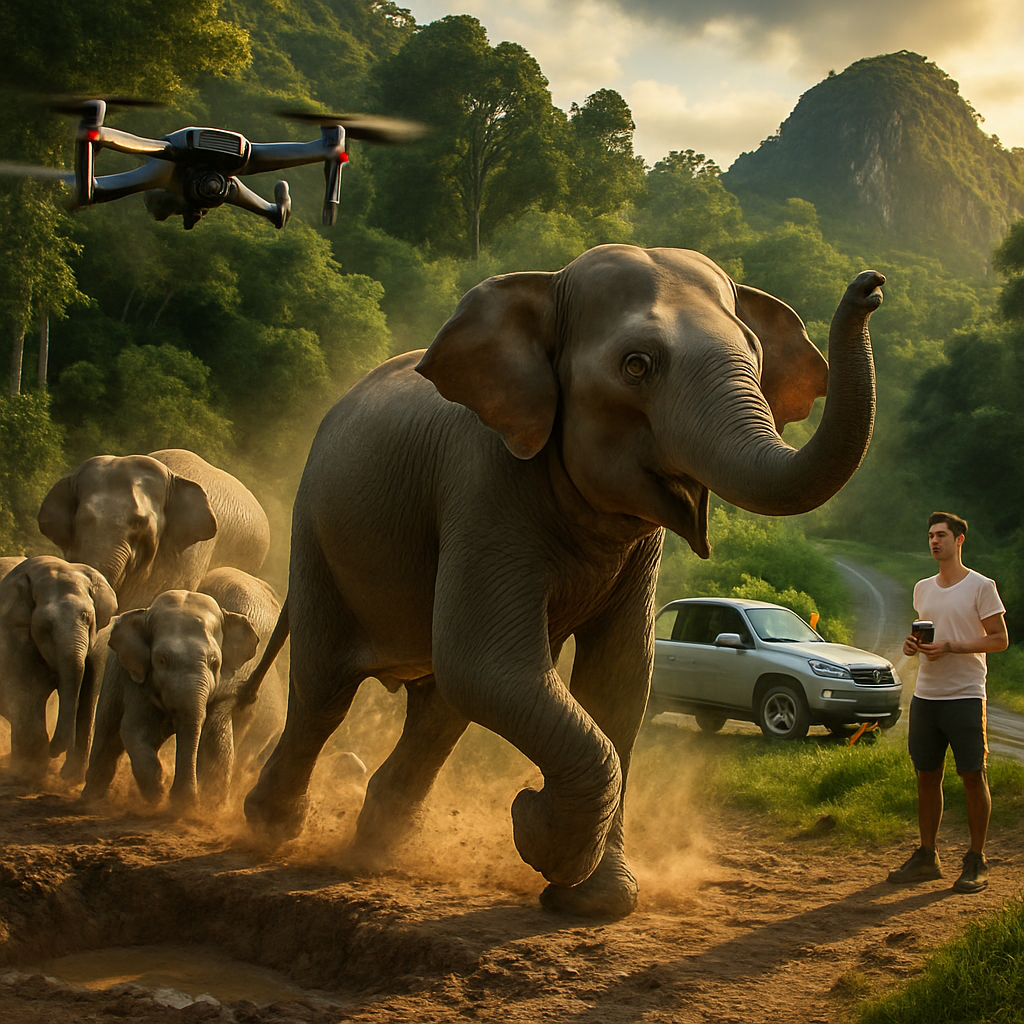
It was a scene that could have been mistaken for a wildlife documentary gone wrong: at Tung Kwang Mineral Lick in Khao Yai National Park, a drone’s whirring suddenly turned a peaceful elephant gathering into a frantic dash for safety. The footage, shot on January 21, shows the moment a large female elephant breaks away from her herd and bolts into the forest — spooked by a small metal hobbyist encroaching from the sky.
The location is one of Khao Yai’s most cherished wildlife-viewing spots in Nakhon Nayok province, where animals come to lick mineral-rich soil and visitors patiently wait for the natural drama of nature to unfold. Instead, yesterday’s drama came courtesy of a man in a white T-shirt who had parked a Suzuki by the roadside and launched a drone — allegedly close enough to the herd to cause visible distress.
Videos of the incident spread across Thai social media like wildfire. In seconds, the soothing backdrop of rustling trees and lumbering elephants had been replaced by heated comments, anger, and an avalanche of sympathetic messages for the frightened animals. Netizens called the footage “unacceptable” and urged park authorities to track down the operator and hold him accountable. The drone was eventually recalled to its operator, but the damage — and the questions — had already been done.
Why does this matter so much? Because it’s not just about a startled animal or an awkward tourist faux pas. Elephants, when scared, can act unpredictably: they may charge, run onto roads, or collide with vehicles — putting not only themselves at risk, but also the people around them. Tung Kwang sits near a roadside gathering point; a panicked elephant dashing toward traffic could spark accidents that would be dangerous and tragic.
Under Thailand’s national park regulations, drones are not a casual toy to be flown wherever you please. Operators must obtain permission from the head of the national park in question and secure clearance from the Civil Aviation Authority of Thailand (CAAT). If the drone is being used for commercial purposes, there’s another hoop to jump through — permission from the Department of National Parks, Wildlife and Plant Conservation, plus applicable fees. Put plainly: fly a drone near protected wildlife without the paperwork, and you’re breaking the rules — with potentially serious consequences.
Thai social media didn’t just gripe — users voiced a swell of sympathy for the elephants and demanded that park officials identify the operator and take legal action. Many commenters framed the incident as a reminder: these animals are not props for amateur aerial filming. They are sentient, vulnerable, and deserving of space and protection.
As of this writing, Khao Yai National Park officials and related authorities have not released an official statement about the January 21 incident. That silence has only intensified calls for a formal response and visible enforcement. People want to know what penalties will be applied and how the park will prevent this from happening again.
To complicate the day’s headlines, another clip circulated showing an apparent violation of park rules: a motorcyclist driving through a herd of elephants crossing a road inside a national park. The user who uploaded that video said the rider was a foreign national, but authorities have not confirmed this identity. The two videos together painted a picture of careless human behavior putting wildlife—and fellow visitors—at risk.
There’s a lesson here that’s both simple and urgent. National parks are sanctuaries, not social media stages. Rules governing drones, vehicles, and proximity to wildlife exist for a reason: to reduce stress on animals and to keep people safe. A drone that seems harmless from a distance can sound terrifying close up to an elephant with vulnerable calves. A motorbike weaving through a lumbering herd might be a fast thrill for a rider, but it could turn catastrophic for the animals and other visitors.
For visitors to Khao Yai and parks everywhere, a few commonsense steps would go a long way: respect posted rules, keep a safe distance from wildlife, and if you plan to use a drone for legitimate reasons, secure the proper permits from park authorities and CAAT well in advance. If you witness reckless behavior, alert park staff immediately — your call could prevent harm.
Watching those viral videos, it’s hard not to feel a pang of frustration — and a surge of hope. Frustration that a beautiful, ancient species was made anxious by a buzzing pastime. Hope because the same online attention that amplified the incident could spur quicker action, better enforcement, and broader awareness about how to visit parks responsibly.
Until officials clarify the next steps, the images of a frightened elephant disappearing into the trees will linger. Let them be a reminder: in the wild, the rules aren’t just formalities — they are the thin line between awe and disaster. Respect that line, and the planet thanks you.

















I filmed and compiled the viral clip and I can confirm the drone flew unusually close to the herd, then the female bolted into the trees. Park authorities have been contacted but no public statement yet. This kind of silence only fuels public anger.
As a guide in Khao Yai I’ve seen tourists get reckless for a shot, and this is exactly why we need stricter patrols and on-the-spot fines.
Tom, can you describe how often this happens and whether guides report these incidents to park rangers? I want to include that in follow-ups.
Legally, the operator could face fines or prosecution under national park and aviation regulations if evidence shows reckless behavior; but enforcement is the weak link here.
From a conservation science perspective, even short-term stress can affect elephant social behavior and calves, so the legal framework needs to reflect biological impacts, not just property rules.
Poor elephants, they looked terrified. Someone should make the person pay for vet checks or something. This is scary for kids who love animals.
This is disgusting and shows how entitled some tourists are. National parks can’t be photo studios for influencers.
Agreed, but we also need clearer signage and staff to explain the rules in multiple languages so visitors actually understand.
Signage helps, but punishment must be visible. A few publicized penalties would deter others more than signs alone.
Why are we so quick to criminalize hobbyists? Maybe the operator didn’t know the rules. Teach, then punish.
Ignorance isn’t an excuse when the law and common sense are clear. Elephants are not props.
I fly drones too and this makes the whole community look bad. Operators must be responsible and follow park rules.
If hobbyists unite for better self-policing and education, we could reduce incidents, but enforcement still needed for repeat offenders.
Fair point. I’m not defending reckless behavior; I want to emphasize training before criminalizing everyone.
Where are the park rangers in the video? Lack of visible enforcement is a real institutional failure.
Rangers are understaffed and under-resourced. The Department needs funding and authority to confiscate drones on the spot.
I asked park HQ about ranger numbers and they declined detailed comment; I’ll press for staffing numbers in my next report.
The rider weaving through the herd is equally infuriating. That could have ended disastrously for both humans and elephants.
People love the adrenaline but forget that roads in parks are shared spaces, not racetracks.
Tourism pulls money into rural areas, but bad behavior like this undermines long-term sustainability. Operators and guides need more training.
And tour operators should lose licenses if their clients continually break laws. Reputation must have teeth.
Exactly — economic incentives should favor responsible tourism over clickbait.
CAAT and the park both have jurisdiction; a joint task force would streamline enforcement and prevent jurisdictional finger-pointing.
Integrated management is crucial. Also consider buffer zones and drone-free corridors around mineral licks during peak visitation.
What’s a buffer zone? Sounds technical, but if it keeps animals safe I’m for it.
Public prosecution would set a precedent, but many cases die because evidence or witness statements are lacking. Viral videos help, but chain-of-custody matters in court.
So you’re saying we need formal complaints and witness affidavits before anything happens? That’s complicated and slow.
Crowdsourced evidence has precedent; if people submit videos with timestamps and locations, it strengthens enforcement.
I’ve been to Khao Yai and people think they can do anything for a viral clip. Banning drones near herds should be permanent.
I know some locals who want harsher penalties for foreigners who break rules, but we must be careful not to encourage xenophobia.
It’s about behavior, not nationality. If a local or foreigner endangers wildlife, they should face the same consequences.
Agreed — enforcement must be equitable, otherwise it breeds resentment and claims of bias.
The online mob’s reaction can be toxic too; we should push for constructive solutions rather than witch hunts.
Constructive solutions include education, fines, and boots on the ground. Witch hunts alone won’t change behavior long-term.
Public shaming sometimes works as a short-term deterrent, but policy change is the lasting fix.
How do we verify these clips aren’t edited to exaggerate the reaction? Social media can distort context.
I have the original footage and metadata; I’m willing to share it with authorities and verified press to avoid misinformation.
If officials stay silent, public pressure will force action, but I worry about scapegoating one person without fixing systemic problems.
Systemic fixes like ranger presence, clearer rules, and tourist education campaigns should be prioritized.
And revising penalties so they’re applied consistently will help. Right now enforcement is patchy at best.
From the ecological side this incident should prompt monitoring of stress responses in local elephant populations. One event may signal more frequent disturbances.
People who thrill-seek in protected areas don’t respect boundaries. Confiscation of devices and heavy fines are reasonable deterrents.
Sixth-grader take: Be kind to animals and don’t make loud machines scare them. It’s that simple.
I worry criminal records for a hobbyist mistake could ruin lives, but repeat or reckless behavior should have escalating penalties.
Escalating penalties make sense; first-time unintentional breaches could trigger education and fines, while deliberate provocation warrants harsher measures.
Why isn’t there an app for reporting infractions with GPS and instant notification to rangers? Tech could help enforcement.
Tech helps but human judgment is essential. Rangers must respond quickly when notified, otherwise apps are just noise.
Insurance companies could refuse coverage for guided trips that violate park rules, creating financial incentives for guides to enforce rules.
Local businesses depend on healthy wildlife populations. They should lobby for stricter protections and community patrols.
We need transparent follow-up from park officials: who was at the scene, what steps are being taken, and what evidence has been collected.
Can we push for mandatory drone no-fly maps tied to registration systems? Preventive measures beat punitive ones.
No-fly maps are useful, but enforcement still requires real-time monitoring or swift consequences for violations to be effective.
I’ll coordinate with local guides to prepare an incident report template so evidentiary standards improve when someone records wrongdoing.
Let’s not forget the emotional toll on visitors who witnessed the fright. Park counseling or debriefs for visitors could help after traumatic wildlife encounters.
I still want official confirmation about the motorcyclist being foreign. Rumors can inflame sentiments unnecessarily.
I asked authorities about the motorbike video and the response was inconclusive; I’m following up for identity verification and will report back.