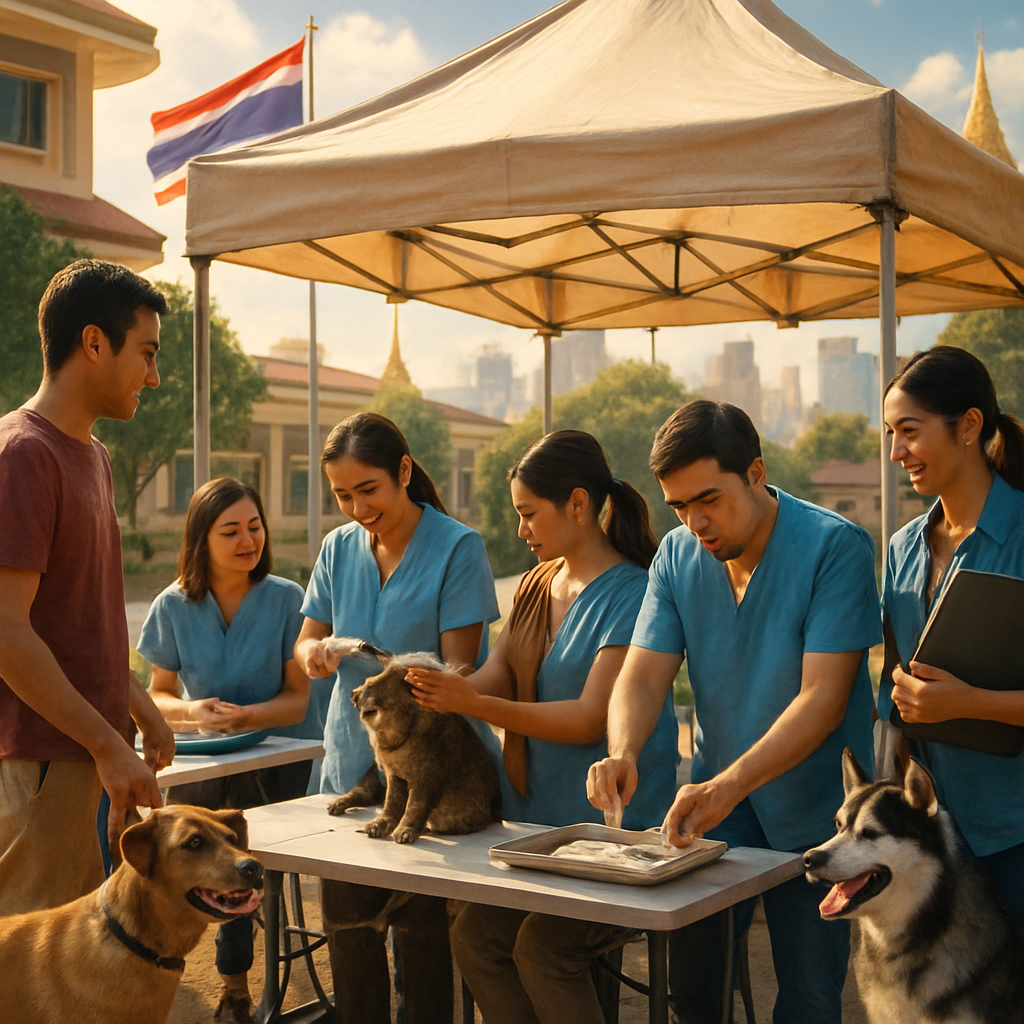
Good news for Bangkok’s dog-and-cat parents: the Bangkok Metropolitan Administration (BMA) has launched a citywide push to make pet ownership safer and more traceable — and it’s free. From now through 30 June 2026, you can register and microchip your furry family members at the Din Daeng District Office (Old Site) — no cash required, just a little planning and your pet’s best behavior.
What’s on offer?
The program provides complimentary microchipping and registration for dogs and cats to strengthen pet traceability and support rabies-control efforts across the capital. There are 500 daily slots total: 200 digital booking slots via the QueQ mobile app and 300 walk-in slots for those who prefer to show up in person.
When and where
The fixed service is based at the Din Daeng District Office (Old Site). Opening hours are generous to accommodate busy schedules:
- Monday–Friday: 08:00–20:00
- Weekends: 08:00–16:00
Note: walk-in queues close one hour before the end of each session — so arrive early if you haven’t reserved a slot.
How to book
Download the QueQ app and reserve one of the 200 daily digital slots if you want a guaranteed time. If you’re spontaneous, the 300 walk-in places are available on a first-come, first-served basis. Either way, your pet gets a microchip and an official registration that helps reunite lost animals and supports public-health tracking.
Major Dog Day #4 — a mobile chance to chip up
If you’d rather meet the BMA team outside Din Daeng, mark your calendar for Major Dog Day #4 on Saturday, 17 January 2026. The veterinary crew will be at Chulalongkorn University Centennial Park offering 300 free microchipping slots between 11:00 and 20:00. Important: park services require pre-registration for the event, and the quota is capped at four pets per household. This mobile service is strictly for residents of the Bangkok metropolitan area.
What to bring — paperwork made simple
To make the visit quick and painless, bring these essentials:
- Owner’s original ID card.
- A copy of your House Registration (Tabien Baan) proving the pet lives in a Bangkok district.
- If you rent: a written letter of consent from your landlord or building management permitting pets.
- Vaccination and sterilisation certificates, if you have them — these help keep records complete but aren’t always mandatory.
Double-check papers before you leave; a smooth check-in means less stress for everyone — especially your cat, who will disapprove of any delay.
Can’t get to Din Daeng?
The BMA hasn’t forgotten the rest of the city. Microchipping services are available at all eight BMA Veterinary Clinics scattered across Bangkok, so you’ll likely find a nearby location that fits your schedule. For updates about mobile units, pop-up events, and any schedule changes, follow the BMA Public Health Veterinary Office on Facebook — it’s the fastest way to catch last-minute announcements.
Why bother microchipping?
Microchips are tiny, affordable, and effective. Once implanted, a chip gives your pet a permanent ID that shelters and vets can scan to reunite lost animals with their owners. On a larger scale, microchipping and registration help authorities track vaccination status and manage rabies prevention — a public-health win for both humans and animals.
Tips for a smooth visit
- Bring a familiar blanket or toy to calm your pet.
- Keep pets leashed or in a secure carrier.
- Arrive early for walk-in slots; queues close one hour before the session ends.
- Have all documents ready in a single folder to speed up check-in.
This free service is a simple step that can make a big difference — protecting your pet, helping reunite lost animals with families, and supporting Bangkok’s public-health goals. Whether you book through QueQ, brave the walk-in line at Din Daeng, or catch the team at Chulalongkorn University Centennial Park, now’s a great time to get your dog or cat microchipped and registered.


















Great to see free microchipping available across Bangkok, especially at Din Daeng. This will make reuniting lost pets much easier and help with rabies tracking. I hope the QueQ app slots don’t all vanish in minutes.
The public-health benefit is obvious, but what about data privacy and access to the registry? Who else can see owner details and for what purposes?
Seems paranoid. It’s just a pet database to stop rabies and reunite dogs with their owners. If you worry too much you won’t even cross the street.
I get the privacy worry, Niran, but the BMA should publish a clear policy. Transparency would calm both privacy advocates and worried pet owners.
As someone in public health, I can say aggregated, de-identified data is invaluable for epidemiology. Individual access should be strictly controlled and logged.
Also a practical tip: bring that blanket your cat loves or you’ll face a hissy, theatrical protest. Trust me, a calm pet makes everything faster.
Free is great, but limiting four pets per household at the park event seems unfair to big families with many strays. Shouldn’t there be an exception process?
Logistics and time constraints force quotas. If they didn’t limit it, lines would be chaotic and many people would end up waiting all day.
Quotas are fine but BMA should run more pop-ups not just Din Daeng and one park day. Spread the service around so large households can get help.
Why not prioritise households with strays or low-income residents? The BMA could allocate extra slots for the vulnerable.
Microchipping combined with vaccination records is an evidence-based strategy to reduce rabies transmission and improve surveillance. The operational hours are well chosen to maximize uptake.
Sure, but microchips only work if shelters and vets regularly scan them. Many places still don’t, especially in rural areas.
That’s a systems issue. Training and providing scanners to shelters should accompany any registration drive to realize the benefit.
Also consider language barriers and app access. QueQ app might be tough for the elderly or non-tech-savvy owners.
I tried a BMA clinic once and the staff were polite but slow. Paper checks took ages. They should streamline with tablets at the desk.
Tablets would be great. Even a simple pre-fill form online before arrival could cut check-in times.
Agreed, but then you need reliable internet on-site and backup for tech failures. Balance is key.
Maybe volunteers could help with paperwork to speed things up. Student vets could gain experience and the public benefits.
Landlords making you get a letter of consent is ridiculous. If you own the pet and it lives there, the state shouldn’t need landlord permission to microchip it.
It’s about proving the pet lives in Bangkok, not letting landlords control healthcare. Letters are just proof of residence in ambiguous rental situations.
Still, many tenants will never ask their landlords. Perhaps a sworn statement from tenants could be an alternative.
True, a sworn statement would be more practical. Not everyone has a friendly landlord.
I’m impressed they included sterilisation records option. Linking sterilisation status to incentives could reduce stray populations humanely over time.
Exactly. Integrating microchipping with sterilisation campaigns creates a one-two punch: identification plus population control.
But sterilisation campaigns need funding and follow-up. One-off events won’t fix the root causes of abandonment.
Some people will never sterilise because of cultural beliefs. Education must go along with services to change behavior.
I manage a small rescue and this kind of city program is a lifesaver. Free chips lower the barrier to reunions and records.
Rescues should be given priority booking or dedicated slots. They handle many animals and already do the hard work of care.
Yes please, an allocation for rescues would be practical and efficient.
I volunteer too and would love a dedicated slot system. Otherwise our volunteers waste hours in line.
The whole thing smells like bureaucracy. Free service is good, but expect long waits and lots of paperwork. They should simplify it.
Bureaucracy can’t be eliminated overnight, Larry, but public outreach and clearer checklists would trim time significantly.
I like that they listed what to bring. Too many people show up unprepared and then clog the system for others.
A printable checklist or SMS reminders after QueQ booking would help reduce missing documents and delays.
Yes, and perhaps an on-site photocopy service or volunteers could help those who forget a copy of their house registration.
Some people won’t bring anything because they are informal settlers; mobile units should accept alternative proofs to be inclusive.
Major Dog Day at Chulalongkorn Park sounds fun, but capping hours until 20:00 is late for families who work. Weekend hours are helpful though.
Evening hours help office workers. The park event timing seems intended for convenience and visibility in a central public space.
Visibility matters. Events in parks attract walk-ins who might never visit a clinic otherwise.
We should ask if the registry can link to international pet databases for expats who move frequently. Cross-border reunification matters too.
Interoperability is complex but desirable. Standard microchip IDs (ISO) help, but legal frameworks and data-sharing agreements are needed.
Small suggestion: BMA could publish success metrics, like how many lost pets reunited since the program began. That would justify continuity.