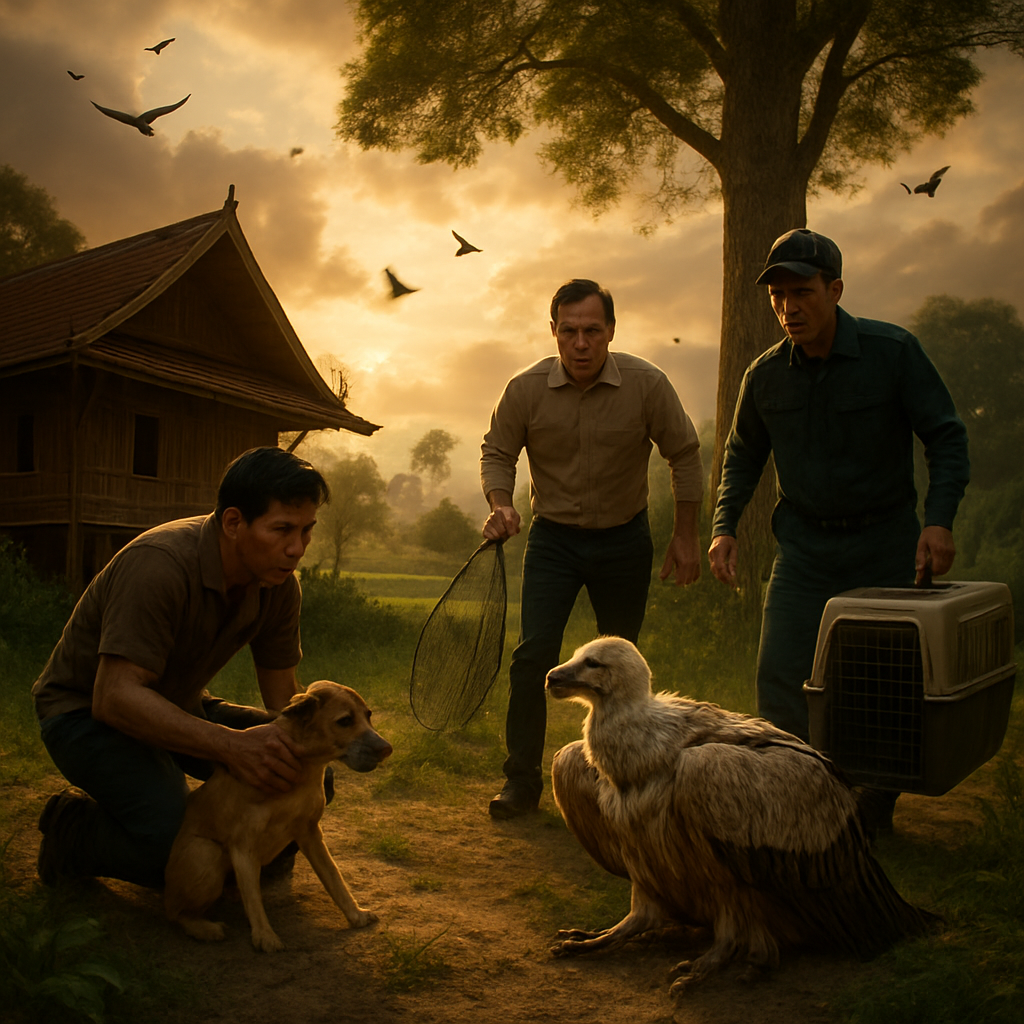
It was a dramatic sky show that ended with a very tired guest. On the morning of January 19, residents of Chiang Thong subdistrict in Wang Chao district, Tak province, witnessed a majestic, pale-winged silhouette cruising the low clouds—only for the spectacle to take a worrying turn. The bird, later confirmed as a Himalayan Griffon Vulture, glided with its wings spread wide before crash-landing behind a home and collapsing, apparently too exhausted to carry on.
Homeowner Boonluea was the first to notice the commotion. He recalled the sound of frantic wing beats and a flock of crows apparently giving chase, prompting the large vulture to seek refuge on a teak tree behind his property. It stayed there for a while, then suddenly lost its grip and tumbled to the ground. For several minutes the giant bird lay motionless, giving onlookers a stomach-tightening pause—until, slowly, it rose to its feet.
Keeping his dogs at bay and acting fast, Boonluea contacted local councillor Nopparat Manat, who then alerted the relevant wildlife authorities. Officers arrived and carefully captured the exhausted bird, taking it to the Wildlife Conservation Division at Protected Area Regional Office 14 in Tak for rehabilitation and monitoring. Dailynews published photos of the rescue, capturing both the fragility and the quiet grandeur of a creature built to command the skies.
Experts later verified the bird’s identity: a Himalayan Griffon Vulture, a protected species under Thailand’s Wildlife Preservation and Protection Act B.E. 2562 and classified as near-threatened globally. With an estimated population of around 66,000, these vultures are not common visitors to Thai skies. Officials believe this particular individual was a young vulture migrating south from the Tibetan Plateau or western China—possibly on its very first long-haul trip. It may have been bound for the Indonesian archipelago when fatigue, poor thermals and erratic wind patterns left it stranded.
This rescue is the latest in a handful of similar cases. In late December 2023 a juvenile Himalayan Griffon was rescued in Lopburi province and successfully rehabilitated and released; earlier this January another was found in Satun and is currently under care at the Kasetsart University Raptor Rehabilitation Unit. The pattern points to young, inexperienced migrants getting disoriented or exhausted as they cross unfamiliar, humid tropical zones where thermals—the natural updrafts that soaring birds rely on—are scarce.
Why do these enormous birds struggle so much? Think of it as a young long-distance flier learning the hard lessons of migration. Himalayan Griffon Vultures are heavy-bodied birds that depend on warm rising air to glide efficiently over long distances. In humid tropical climates, thermal lift can be weak or inconsistent. Add to that shifting wind patterns and limited availability of natural carcasses for food, and you have the perfect recipe for exhaustion. Without easy access to food or reliable thermals, juveniles often run out of steam and end up in lowland areas far from their usual routes.
Thankfully, Thailand’s wildlife protection framework and responsive local communities are helping turn many of these wrong-way journeys into success stories. The rescued Tak vulture was taken to a regional rehabilitation center where veterinarians can assess its condition, treat any injuries, and prepare it for eventual release if recovery goes well. Officials urge anyone who finds an injured or stranded vulture—or any protected wildlife—to call the Department of National Parks hotline at 1362 so trained personnel can properly handle and transfer the animal to a suitable facility.
There’s a gentle reminder wrapped into this dramatic rescue: vultures play an essential role in ecosystems by disposing of carcasses and preventing the spread of disease. Their survival benefits people too. Respectful curiosity, prompt reporting, and keeping pets away from distressed wildlife are simple steps that can make a big difference.
For now, the Tak vulture rests under professional care. Whether this youngster will finish its migratory odyssey south after a period of rehab remains to be seen, but thanks to quick-thinking locals and wildlife officials, it has a fighting chance. And when it does soar again, the memory of that bustling teak tree in Chiang Thong will be a reminder that even the grandest travelers sometimes need a little help along the way.
If you ever come across an injured or stranded vulture, don’t attempt to capture or feed it yourself—call 1362 and let the experts step in. Together, we can keep Thailand’s skies welcoming to both local and wandering wings.


















This rescue is heartwarming but also a red flag about changing migration patterns. Young vultures getting lost suggests larger shifts in wind and thermal behavior that could be climate-linked. We should study these incidents as early-warning signs.
Good point — consistent monitoring of migratory corridors would help validate if these are climate-driven anomalies or natural juvenile dispersal. Himalayan Griffons depend heavily on thermals, so increased humidity in Southeast Asia plausibly reduces their glide efficiency. Tagging juveniles and sharing data internationally is essential.
I think it’s just birds being dumb, not climate science. Animals always get lost sometimes.
Sure, juveniles get lost, but frequency matters; multiple rescues in a short period is not ‘sometimes’. We need data, not dismissal.
Tagging data already shows variable routes in juveniles — but international cooperation is patchy, so we miss patterns. Local rescues help individuals but don’t solve migratory disruptions.
Please tell people not to feed vultures or handle them. The article even warns against it, but everyone thinks they can be a hero with snacks and gloves. Feeding wild vultures can make populations dependent and spread disease.
I disagree a bit — in rural places, improvised feeding sometimes keeps a starving bird alive until experts arrive. It’s risky, yes, but when the hotline is far, people act.
Acting is fine, but handing meat to a near-threatened species without vet oversight is irresponsible. You could also injure the bird or misdiagnose its problem.
Local reality matters: many villages are hours from rehab centers. Training communities on safe containment and immediate triage would be more practical than blanket ‘don’t touch’ rules.
Exactly — community training plus faster hotlines is the solution, not shaming villagers who try to help.
As someone who had to call the wildlife authorities once, quick local action saved the bird. Hotlines like 1362 are only useful if people know them and trust responders. Education and presence at community meetings made the difference here.
We appreciate the shout-out. Rapid response depends on clear reporting and safe containment. Please keep dogs away, photograph the bird from a distance, and call us instead of attempting capture.
I wish officials would publish response times and outcomes for transparency. When communities see actual results, they report more often and with less fear of legal backlash.
Great suggestion, Somsri — I’ll push for regional response data to be made public and for simple flyers that list steps people can take.
Transparency also helps researchers. If rehab centers share post-release tracking and success rates, we can learn what habitat supports returning migrants best.
Wow that vulture looked like a giant airplane! I’m happy they saved it because animals are cool.
Maya loved the pictures but asked why the bird couldn’t just rest on the tree. I explained thermals and migration in simple words and she wants to be a bird rescuer now.
Kids are our best advocates. If Maya gets involved in local citizen science, she might actually help spot the next one early.
I will join the bird club at school!
From an ecological standpoint, vultures provide invaluable sanitation services that reduce pathogen spread. The decline of scavengers has direct public-health implications, so investing in rehabilitation and monitoring is cost-effective. Policy should integrate veterinary, conservation, and public-health sectors.
Totally agree, but budgets are tight. Convincing policymakers requires hard economic numbers showing avoided disease costs and tourism value from healthy ecosystems.
We have some local studies estimating carcass removal value, but they’re sparse. More interdisciplinary research proposals could leverage university-government funding.
If students draft cost-benefit briefs and partner with regional offices, it’s easier to secure pilot funding. Evidence drives policy in Thailand.
Policy sounds nice, but enforcement of wildlife protection laws is inconsistent. Until that improves, trafficking and accidental harm will persist.
People here say vultures are bad luck and fear them near home. Cultural beliefs influence how fast people call authorities, sometimes causing harm. Education campaigns must respect beliefs while promoting safety.
Respectful engagement with monks and local leaders can change perceptions. When a revered monk speaks about the ecological role of animals, people listen and behavior changes quickly.
Community teachings about compassion for all beings can coexist with practical advice about safety. We can host talks that blend tradition and science.
That’s encouraging. Using familiar community voices is far more effective than external lectures.
I wish more rescued birds could be satellite-tagged post-rehab so we know where they go and whether they complete migration. Right now we release and hope for the best, which leaves a big data gap.
Satellite tagging is expensive but invaluable. Even small sample sizes can show corridor usage and stopover sites. International collaborations could defray costs and standardize protocols.
Exactly — let’s push for a regional tagging consortium and shared open data. That would make each rescue contribute to broader conservation.
There’s also the ugly side: exotic bird trafficking networks that exploit rare visitors. Increased rescue publicity can inadvertently tip off collectors looking for juvenile vultures. We must balance awareness with caution.
Good point. Public messages should include legal warnings about trafficking and clear instructions to hand animals to authorities. Stronger penalties and monitoring of marketplaces are necessary.
And enforcement needs to be proactive, not just reactive. Without undercover work and market surveillance, penalties are merely symbolic.
I hadn’t thought about trafficking. Publicity is a double-edged sword — we need to highlight rescues while protecting the animals from predators of a different kind.
Rehab units like Kasetsart’s have limited capacity and specialized needs. Scaling up requires trained staff, quarantines, and veterinary supplies — it’s not just space. Funding and training programs are essential.
Training is the bottleneck. A networked volunteer program with certified training modules could expand capacity quickly while maintaining standards. Accreditation by regional wildlife authorities would ensure quality.
We’re piloting such a module at our university and would welcome partnerships with regional offices to standardize it across centers.
Please contact our regional office — we can provide case studies and access to hotline coordination to strengthen your curriculum.
I saw crows chasing it; nature can be brutal. But humans making it worse by cutting forests and poisoning carcasses is the real problem. Vultures die when we interfere.
Some people act like every animal rescue is a moral crusade. Sometimes it’s just a single bird having a bad day. Not every trend is a crisis.
Dismissing patterns because single events can be random is dangerous. Scientists look for statistically significant increases; multiple rescues clustered in time and space deserve investigation.
Also remember that antibiotics and pesticides in livestock can poison scavengers. It’s not only habitat or weather; our farming practices send invisible threats into the food chain.
We should lobby for safer carcass disposal practices and bans on harmful veterinary drugs known to kill vultures. Regulations helped save vulture populations in other countries before.
We already investigate poisoning cases, but proving contamination is complex and resource-intensive. Public reporting of suspicious livestock deaths helps our investigations.