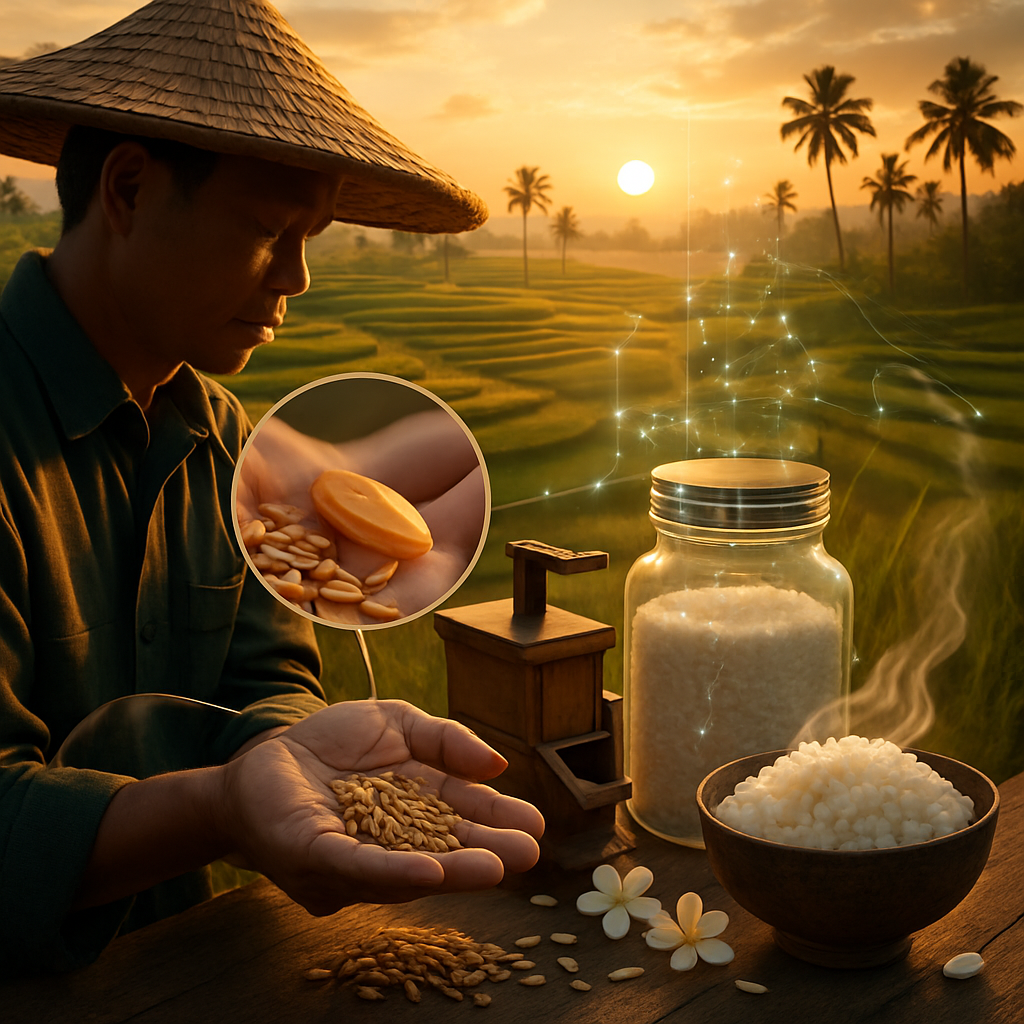
Thailand has a new culinary swagger. Meet “Khao Praneat” (Exquisite Rice) — a national branding pivot that aims to recast Thai rice not as a bulk commodity, but as an artisanal, terroir-driven luxury. It’s part marketing, part cultural reclamation, and entirely a strategic response to a global market that now buys with its heart and its head: taste, provenance and proof.
Why Thailand can’t win on volume anymore
For decades Thailand ruled rice markets by sheer scale, producing over 20 million tonnes a year. But the game has changed. Average yields—roughly 600–700 kg per rai—are simply outpaced by regional rivals like Vietnam, which hits around 1,200 kg per rai. Price wars against more productive producers are a losing proposition. The smart move? Stop racing on quantity and start competing on quality.
A biodiversity secret worth selling
Thailand’s ace in the hole is not acres, but ancestry. With more than 5,000 indigenous rice strains in its genetic library, the country can craft narratives and flavor profiles other producers cannot replicate. Khao Praneat leverages that living heritage — spotlighting varieties from the aromatic classics like pure Khao Hom Mali and Khao Hom Pathum to rarities such as Khao Leum Pua and Khao Rai Dok Kha.
The three pillars of Exquisite Rice
Khao Praneat isn’t a label slapped on a bag; it’s a quality architecture built on three pillars:
- Exceptional varieties: Only strains with proven sensory and cultural value make the cut.
- Meticulous cultivation: Specific geographical indications (GI), full traceability, and adherence to standards like GAP and Organic ensure the rice is both safe and terroir-authentic.
- Artisanal processing: Slow milling to preserve aroma, careful selection to reduce broken grains and precise moisture control to guarantee peak cooking performance.
As Commerce Minister Supajee Suthumpan puts it, buyers today “no longer choose rice simply by habit; they prioritise taste, origin, the producer’s story, and comprehensive consumption information.” Nop Dharmavanich of Rice Hub frames the ambition plainly: get global buyers to treat premium Thai rice the way they treat specialty coffee or fine wine.
Storytelling + data = trust (and better prices)
Emotional desire draws the buyer in — a charming origin story, the aroma of Khao Hom Mali Thung Kula Rong-Hai, an image of a sun-drenched paddie. But desire only unlocks premium pricing when paired with verifiable proof. “Data is the heart of the New Rice Economy,” says Atthapon Chaianun, president of the Thai Digital Education Association (TDeD). If a grain tastes divine but can’t be traced, it’s still a commodity.
That’s why the plan includes a central database and QR-code traceability: consumers and importers can scan and know exactly where a bag of rice came from, which farmer grew it, and under what standards it was produced. This prevents the old habit of “general averaging,” where top-tier rice is diluted into bulk pricing, and ensures model farmers actually see the premium they deserve.
From pilot farms to global plates
The initiative starts with 200 model farmer groups, selected from a national database of over 700 producers. These early adopters become living proof that heirloom varieties plus exacting practices translate into superior rice — and superior income. The target is audacious: help farmers earn five to ten times more for their harvests.
And it’s not just theory. At Thailand Rice Fest 2025, Khao Praneat scored an early win: a 16-million-baht export deal for 450 tonnes of specialty rice. That contract is more than a transaction; it’s validation that international buyers will pay for provenance, traceability and a good story.
What this means for the future
Thailand’s pivot from commodity to craft could reshape the country’s rice economy. Instead of being squeezed by yield-focused competitors, Thai farmers can cultivate distinctiveness — aromatic profiles, historical ties to place, meticulous post-harvest care — and be paid accordingly. If the approach scales, it promises a more sustainable livelihood for farming communities and a stronger national culinary brand.
Think of Khao Praneat as Thailand’s declaration that rice can be as celebrated as any fine vintage. It’s an invitation to the world: taste the difference, scan the QR, meet the farmer, and understand why a single grain can carry an entire culture.
For consumers and buyers who demand both soul and transparency, Thai rice is ready for a starring role on the global table — fragrant, traceable and undeniably exquisite.


















This Khao Praneat push sounds brilliant — finally turning rice into a story-driven product like coffee or wine. If Thailand can actually enforce traceability, farmers should see real returns. But marketing alone won’t fix structural issues in rural areas.
Enforce traceability? Haha — show me the audits. QR codes are easy to fake and middlemen will find a way to game any system. Until enforcement is independent, this feels like lipstick on a pig.
Independently audited blockchains or tamper-evident supply-chain tech can make fraud much harder, but it’s costly and requires capacity building at the farmer level. It’s doable, but only if the government and private sector share the cost and training.
Fair point, Larry — skepticism is healthy. I just think giving farmers brand-level incentives is better than competing on yield alone. If audits are external and buyers demand verification, middlemen lose leverage.
As a Thai consumer I love the idea of celebrating heirloom varieties, and I want my neighbors to earn more. But who pays for the extra processing and certification? Smallholders can’t shoulder all those expenses.
I’m a farmer and I can tell you the upfront costs are real: sorting, slow milling, record-keeping. If the promised 5–10x price only reaches a handful of exporters, it won’t help most families.
Geographical Indications can capture value without forcing massive CAPEX on each farmer, if cooperatives manage certification and profit-sharing. Policy design matters as much as branding.
Thanks for the nuance. Cooperatives doing certification could work if profits are transparent, but trust in cooperatives is low in some provinces. That social capital must be rebuilt.
As a chef I welcome terroir rice on menus; diners love provenance stories and distinct textures. Premium Thai rice could become a restaurant differentiator worldwide.
Rice is yummy. I like smells and my mom cooks jasmine.
Chefs will pay more for consistent quality and aroma, but only if supply is reliable. A single bad shipment can ruin a restaurant’s reputation quickly.
Exactly — reliability and traceable origin matter to us. If Khao Praneat delivers both, I’ll feature it prominently and tell the farmer’s story on the menu.
The genetic diversity mentioned is a cultural and scientific treasure, but commodifying heirloom strains raises concerns about biopiracy and benefit-sharing. Who owns these seeds — the community or commercial interests?
This is a real worry. Turning sacred landraces into export products without legal protections can strip communities of control. We need ABS (access and benefit-sharing) mechanisms in place first.
We at Rice Hub are working with communities to ensure IP is respected and premiums return to model farmer groups. It’s messy but possible with contracts and transparent pricing.
Good to hear Rice Hub says they’re cooperating, but words aren’t enough. I want to see binding contracts, community consent records, and independent monitoring.
Economically this pivot makes sense: move up the value chain to avoid price competition. But niche luxury markets can’t absorb millions of tonnes; scaling will be the key challenge.
Niche can scale if you segment the market globally and build brand equity. Think Japanese sake or single-origin chocolate — smaller volumes, much higher margins.
True, but those categories also had long-term marketing and regulatory support. Thailand will need sustained investment and quality control to shift perception away from bulk rice.
Don’t forget trade barriers and labeling laws. Exporters must ensure Khao Praneat meets importing countries’ organic and GI rules or face costly rejections.
Sounds like another government PR stunt. Promises of 5–10x returns are convenient headlines, but I’ve seen ‘pilot projects’ fade while middlemen keep the money. Proof, not spin, is needed.
As someone involved in the digital traceability plan, I can say the database and QR system are already piloted and tied to payments data. Transparency is not just a slogan here.
I’ve been told many times that new schemes will help us, yet paperwork and fees swallow the benefits. If payments come directly with traceable proof, maybe it’s different this time.
I’ll believe it when I see direct bank statements from farmers after an export contract clears. Until then, it’s just hope.
My family grows Khao Hom Mali and we’ve saved seed for generations, so this could finally let us tell our story and earn decent money. I worry about children leaving farming if machines take over for quality control though.
Rural youth migration is a policy problem that branding alone won’t fix; combine premium pricing with rural services, schools, and market access to make farming attractive again.
Yes, both ends must be fixed. If farmers can earn and the village has decent schools, maybe children will stay and innovate rather than leave.
I like fancy packaging, but consumers overseas will pay only for consistent sensory differentiation. Aromatic claims are subjective and can be diluted quickly unless there’s rigorous sensory profiling.
Sensory labs and GC-MS fragrance profiling can objectively document aroma compounds, which can be linked to GI regions. It’s scientific, but expensive for wide adoption.
If Thailand backs sensory labs centrally and subsidizes testing for model farmers, that could work. Otherwise it’s a PR stunt drowning in fakery.
450 tonnes and a 16-million-baht deal is a real sign buyers will pay for provenance, not just talk. That pilot could become a template if follow-through is transparent.
As an importer, I can confirm: buyers are hungry for verified origin stories and are willing to pay for traceability, but we want warranties and quick resolution if issues arise.
Good point — buyers will demand warranties. Contracts linked to the QR system and escrow payments could build that buyer confidence.
The plan’s three pillars are sensible, but I worry about exclusion: which varieties qualify and who decides that cultural value? Power dynamics could mean elites pick winners while marginal strains are ignored.
Exactly. Cultural gatekeeping can erase local meanings. Participatory governance with farmer representation is essential when defining ‘exceptional’ varieties.
Agreed — participatory committees with rotating seats and transparent criteria would help prevent capture by exporters or urban elites.
Restaurants telling the farmer’s story can add value, but chefs must be careful not to exoticize or simplify complex livelihoods. Respectful storytelling means accurate credit and fair pay.
Totally agree — menus can empower farmers when they list names and villages, not just romanticized labels. Diners respond well to authenticity.
For private capital, predictable margins and branding are attractive. I’d back exporters that demonstrate traceability and stable farmer partnerships over flashy one-off deals.
Investors should require impact metrics, not just ROI. If premiums don’t trickle down, social and reputational risks will hit returns in the long run.
Premiumization mustn’t encourage monoculture of ‘marketable’ heirlooms at the expense of broader biodiversity. Incentives should preserve overall seed diversity, not narrow it.
Right — economic incentives can distort on-farm diversity. Policy should compensate farmers for maintaining genetic banks and mixed cropping systems.
If I can choose between trickle profits from bulk rice or steady incomes from specialty rice grown with care, I prefer specialty. But training and help with paperwork are needed.
Training and low-interest credit should be bundled with the program. Otherwise many smallholders will be left out of the premium market.
Will Khao Praneat be affordable for regular consumers or only for fine-dining and wealthy markets? I worry about rice becoming elitist while local tables suffer.
The government must secure GIs and trademarks internationally before major branding, otherwise others could register names and block Thai exports. Legal groundwork is cheap insurance.
Legal protection is essential, but enforcement across hundreds of markets is costly. Prioritization by export destination will be necessary.
This could be a model for other crops if done right: combine heritage, geo-labeling, traceability, and farmer co-ops. But pilot evaluation must be transparent and publicly available.
Public reports help, but action on the ground matters more. We need quick payouts and on-site support, not just glossy evaluations.
Don’t forget informed consent for using cultural narratives. Some communities may not want their rituals or names commercialized, and that must be respected.
QR and mobile traceability are great, but rural connectivity and digital literacy are real barriers. Offline-first solutions and intermediaries will be necessary.
Buyers will also look for resilience: climate impacts, supply shocks, and crop disease can disrupt specialty supply more than bulk markets. Risk management must be part of the plan.
We’ve built traceability pilots with farmer IDs and chain-of-custody records. Scaling is the next hurdle, and we welcome private and donor partnerships to expand capacity.
Transparency from organizations like yours is important. Publish open data about premiums distribution and certification outcomes so independent researchers can evaluate impact.
Seeing other people talk about paperwork makes me nervous, but if buyers actually pay us and schools improve, I will try. Community meetings and simple checklists help my neighbors join.
I’ll keep watching the money flow. If model farms become a PR layer while most farmers stay in the same rut, this will just be another headline with no systemic change.