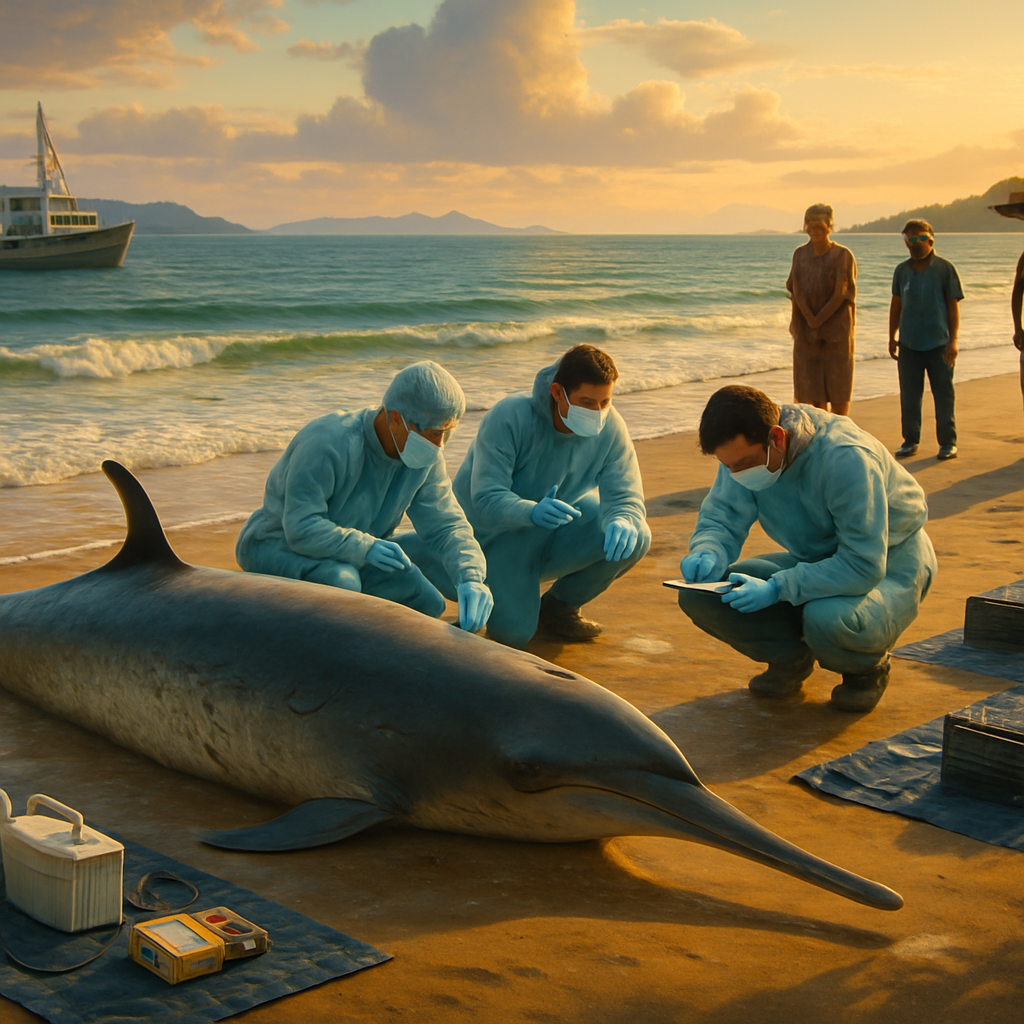
When the morning tide left behind a mysterious visitor on a Chanthaburi shoreline on January 13, locals and scientists alike did a double-take: the stranded animal was later confirmed as a Longman’s beaked whale (Indopacetus pacificus) — the first verified record of this elusive deep‑sea cetacean in Thai waters. What might have looked like a sad, solitary beach spectacle quickly became a headline-making clue that Thailand’s offshore waters are home to far more hidden life than we might assume.
A first for Thailand — and a rare one at that
Marine specialists from the Department of Marine and Coastal Resources (DMCR), led in the announcement by Kongkiat Kittiwatanawong, confirmed the identification after an initial assessment. The animal was a male, roughly five metres long, with a slender profile and a gently curved dorsal fin — classic hallmarks of the beaked whale family Ziphiidae. Scars streaking its body suggested past skirmishes with sharks, a reminder that life below the surface can be brutally competitive.
Necropsy teams from the DMCR began carefully examining the carcass to determine the cause of death. While the outcome is naturally somber, Kongkiat and colleagues have described the discovery as a conservation silver lining: a rare proof of species presence that enriches our understanding of marine biodiversity.
Why this sighting matters
With this confirmation, the roster of whale species recorded in Thai waters has risen to 29, according to ThaiWhales, a community group that monitors sightings across the country. That’s not just a number for whale enthusiasts — it’s a signal that Thailand’s coastal and offshore ecosystems are connected to broader oceanic highways used by species we seldom glimpse.
Longman’s beaked whales are among the most infrequently observed cetaceans worldwide. These deep-water specialists prefer offshore, tropical to subtropical stretches of the Indo-Pacific, returning only rarely to shallower shores. Adult sizes range widely — roughly four to nine metres — and adult males are distinguished by a pair of oval-shaped teeth at the tip of the lower jaw. Their diet is primarily squid, and they’re thought to move in groups from a modest handful up to large gatherings of 10 to 100 individuals.
Reading the whale’s story
Even a deceased whale has a lot to tell. Scars from shark bites hint at past encounters, while stomach contents, body condition and signs of disease or human interaction that necropsy teams look for can reveal whether natural causes, entanglement, ship strike, or environmental stress played a role. The DMCR’s veterinarians are performing the forensic work marine biologists rely on to turn a washed‑ashore mystery into actionable knowledge for conservation.
Not an isolated marine drama
Thailand’s shores have been in the spotlight recently for more cheerful marine visits as well. Up on the Gulf coast, beaches at Bang Saen and Wonnapha in Chon Buri drew attention when three Bryde’s whales — a mother and two calves among them — were sighted near the surf. Such close but differing encounters — a rare beaked whale confirmed after washing ashore, and live Bryde’s whales spotted near popular beaches — underscore how dynamic and surprising coastal waters can be.
What we can take away
- Scientific value: Each confirmed record of a rare species sharpens our map of marine biodiversity and helps guide conservation priorities.
- Conservation urgency: The presence of deep‑water species nearshore highlights the need for careful management of fisheries, shipping lanes, and pollution controls.
- Public engagement: Beach discoveries reawaken public curiosity and can galvanize local support for marine protection — if handled respectfully and scientifically.
It’s tempting to think of the ocean as an endless, anonymous blue. Incidents like the Chanthaburi discovery are reminders that the deep sea is teeming with lives we barely know. The Longman’s beaked whale’s arrival on Thai sand — though tragic for the animal — gives researchers a rare data point and the public a vivid story about why the ocean deserves our attention.
As the necropsy findings are processed, marine scientists will deliver a clearer picture of what happened to this bachelor of the deep. Meanwhile, the tally of 29 whale species in Thai waters stands as an invitation: to keep watching, keep protecting, and keep learning about the secretive giants and squiddish dinners that roam our seas beyond the horizon.

















A five‑metre Longman’s beaked whale on a Thai beach is both heartbreaking and enraging; shipping and fishing pressure are not just numbers on a report. This should trigger immediate reviews of shipping lanes and fishing practices near known deep‑water corridors. If we ignore this, more rare species will wash up as evidence.
Maybe it just got tired and died naturally, people always blame humans first. Nature is brutal sometimes and whales fight sharks, that was mentioned in the article. Not every dead animal is a conspiracy.
The necropsy is crucial; stomach contents and tissue analysis can reveal signs of anthropogenic stress, disease, or trauma. Jumping to conclusions before forensic results can mislead policy and public opinion. Still, the presence itself expands our knowledge of regional biodiversity and should inform monitoring efforts.
As a local fisherman I can say we rarely see anything like this, but boat strikes are common in busy seasons. If authorities mapped out a few no‑go zones it might reduce incidents. Enforcement is the hard part though.
I appreciate the practical view, Sombat, but enforcement and rerouting both cost money and political capital; we need public pressure. Dr. Mei is right about the necropsy — we need good data before reshaping policy. Still, this discovery should be framed as more urgent.
Wow, I never knew Thailand had so many whale species. Thirty kinds sounds like a lot and makes me wonder what else is out there. Beaches should feel safer for wildlife.
This is sad. Can volunteers help with beach monitoring and public education? People love to take selfies but need rules for respect.
Use this as a classroom lesson about ecosystems and human impacts. Simple activities could teach kids why deep‑sea species sometimes end up near shore. Hands‑on learning translates into future stewardship.
As someone following DMCR updates, this confirmation is a milestone for Thai marine records and an opportunity for better offshore surveys. Longman’s beaked whale sightings are rare but not unprecedented in neighboring waters, so regional collaboration matters. I hope the data are shared with international cetacean databases.
Regional datasets will help us model habitat preferences and migration routes, which can inform protected area design. Genetic samples from the carcass could clarify population structure and connectivity across the Indo‑Pacific. This is more than a local curiosity; it feeds global science.
I distrust every ‘rare species’ headline that comes after a corpse shows up. How many of these records are just isolated bodies carried by currents? I want long‑term sighting data, not single carcass drama.
NoBull, single records matter when they fill true gaps in species maps, but I agree they must be contextualized in long‑term monitoring. DMCR and ThaiWhales seem to be improving data collection, so let’s push for sustained surveys rather than one‑off attention.
The scarred whale image haunts me; it shows the food chain is messy and dangerous. But it also makes me proud that scientists are examining the body instead of letting it rot without learning anything. Respectful science matters.
We used to see more life far out, but nets and trawlers have changed the ocean. Young guys don’t remember the old abundance. Maybe this is proof the sea is quieter now.
I work in shipping logistics and I sympathize with calls to change routes, but rerouting has huge economic ripple effects. Any navigation change must be evidence‑based and internationally coordinated, not emotional reactions.
This is both sad and hopeful — sad for the individual whale, hopeful because science learns. I worry about plastic and chemical pollution too; necropsies should test for toxins. Local education campaigns could help reduce disturbances.
Toxin panels and microplastic analysis are increasingly standard in cetacean necropsies and can indicate chronic exposure. If pollutants are found, it would point to systemic issues requiring policy responses across fisheries, industry, and waste management. It’s not just about a single animal.
I am 11 and I feel sad. Why do sharks bite whales, are they mean? Can we make oceans happy again?
kiddo7, sharks aren’t mean; they survive by hunting and scars show a whale has been through fights. We can help oceans by reducing plastic, supporting protected areas, and learning more about animals so we treat them with care.
This news will probably be used by activists to push draconian bans that hurt coastal livelihoods. Conservation needs to balance people and species, not favor dramatic headlines over sustainable solutions. Data-driven, community‑led measures work best.
Community‑led is fine, but when an endangered habitat is at stake timid measures won’t cut it. Sometimes you need bold protections to stop the bleeding before populations crash. Waiting for perfect data is a luxury species don’t have.
I suspect the whole story is being framed to attract tourism and funding. ‘First verified’ has PR value, and necropsies take months; watch for grant announcements. Not saying the whale wasn’t real, just saying motives matter.
Skeptic_99, skepticism is healthy but don’t let cynicism drown genuine conservation wins. Yes, funding follows attention, but that funding can support real protections and local jobs if managed well. We need checks and balances, not blanket dismissal.
Seeing the word ‘bachelor of the deep’ made me smile but the story is sobering. Cultural storytelling could help public engagement, but we must keep science central. People connect to narratives, and this whale’s story can spark stewardship.
As a diver I find this both fascinating and worrying; deep‑water species near shore may signal shifts in prey or temperature. We need more acoustic monitoring to detect deep‑diving species without relying on strandings. Technology can fill gaps.
Acoustic monitoring is expensive and requires expertise, but it’s one of the few noninvasive ways to study beaked whales. International partnerships could subsidize equipment and training for Thai researchers. Collaboration beats working in isolation.
Rita, absolutely — and citizen scientists can help with surface sightings and reporting, feeding data into acoustic analysis. Let’s not make everything about foreign teams coming in; build local capacity and pride in marine science.
Cool but sad. Do they eat fish like the ones we catch? I like squids and whales eating squid sounds funny.
YoungOne, Longman’s beaked whales mainly eat squid and deep‑sea fish, not typical shallow reef fish. That’s why understanding their offshore habits matters for deep‑sea conservation. Simple facts help shape smart policies.
Thanks! I want to learn more and maybe be a scientist who finds whales. This story made me want to study the ocean.
From an academic standpoint, each verified range extension is a datapoint for modeling climate and habitat shifts. We should publish the findings quickly in open access forums and include metadata for later meta‑analyses. Transparency accelerates science.
Open data is crucial, and engineers can help automate carcass reporting and sample cataloguing with simple apps. Better logistics speed necropsy timelines and ensure samples go to proper labs. Tech is a force multiplier for limited field teams.
Agreed, EnginGirl — integrating citizen reports with automated triage and standardized sampling protocols would improve response. We must be careful with data quality controls, but modern tools can indeed broaden our reach while maintaining rigor.